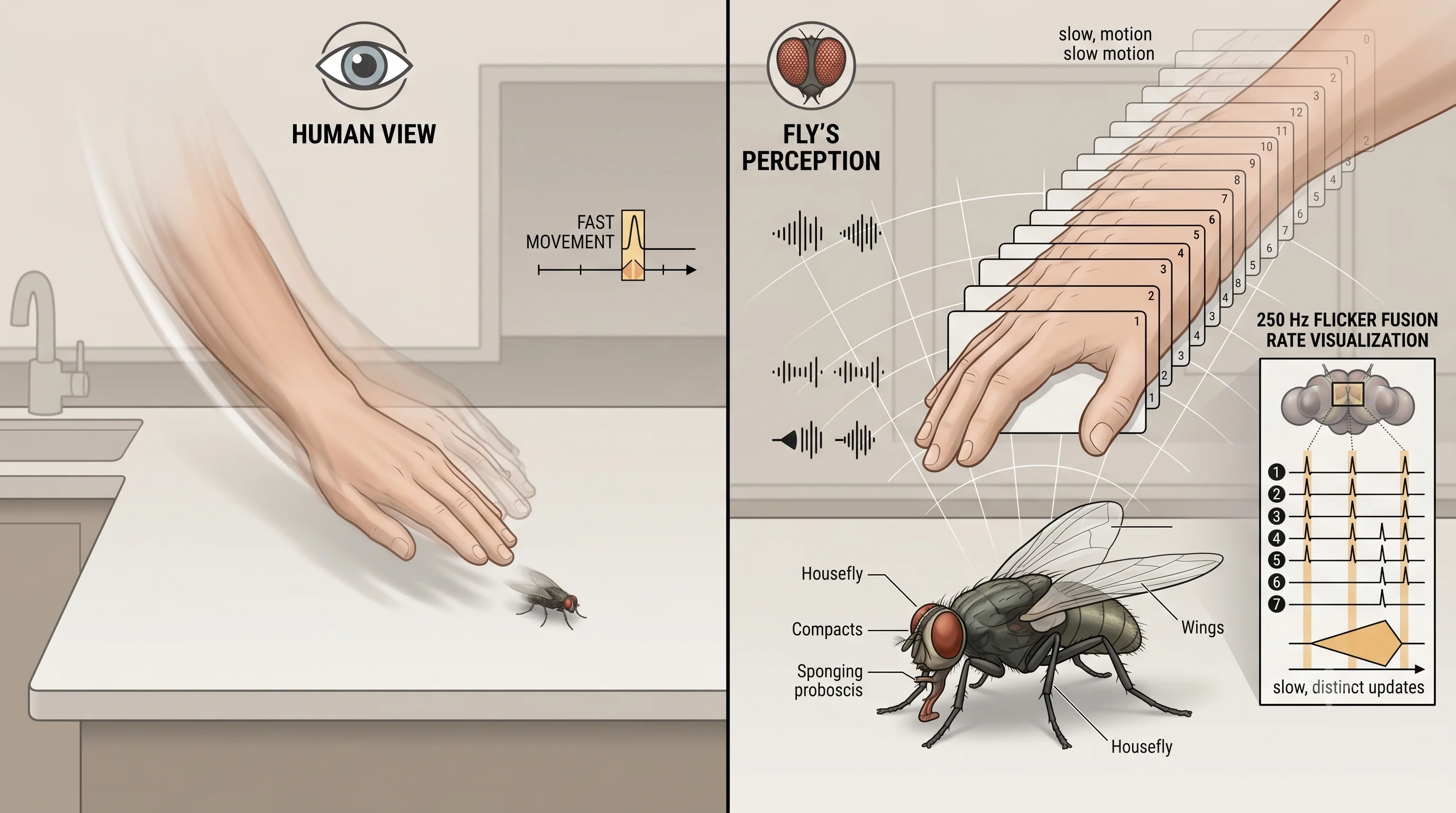
The house fly can escape a hand movement because time doesn’t read for it the way it does for us. The structure of its compound eye samples motion more frequently and raises the alarm early. That’s why what feels to us like a single sudden attack is, on its side, an approach noticed early. For the general picture, go back to the article House Fly: Biology, Behavior and Seasonal Effects; the backbone of biology and behavior sits there.
What is a compound eye?
The house fly’s eye is not a single-lens camera; it is made up of a large number of small units called ommatidia. Each unit deals with one part of the scene, and the brain combines these parts. This structure excels at motion. Humans are better at detail; the house fly is better at flow. That’s exactly why the fast swing of a hand comes across to it not as “instantaneous” but as a readable movement. For the anatomical groundwork of this article, you can look again at the summary information in our main house fly article. In addition, the next subtopic directly connected to this subject will be the compound eye vs human eye comparison.
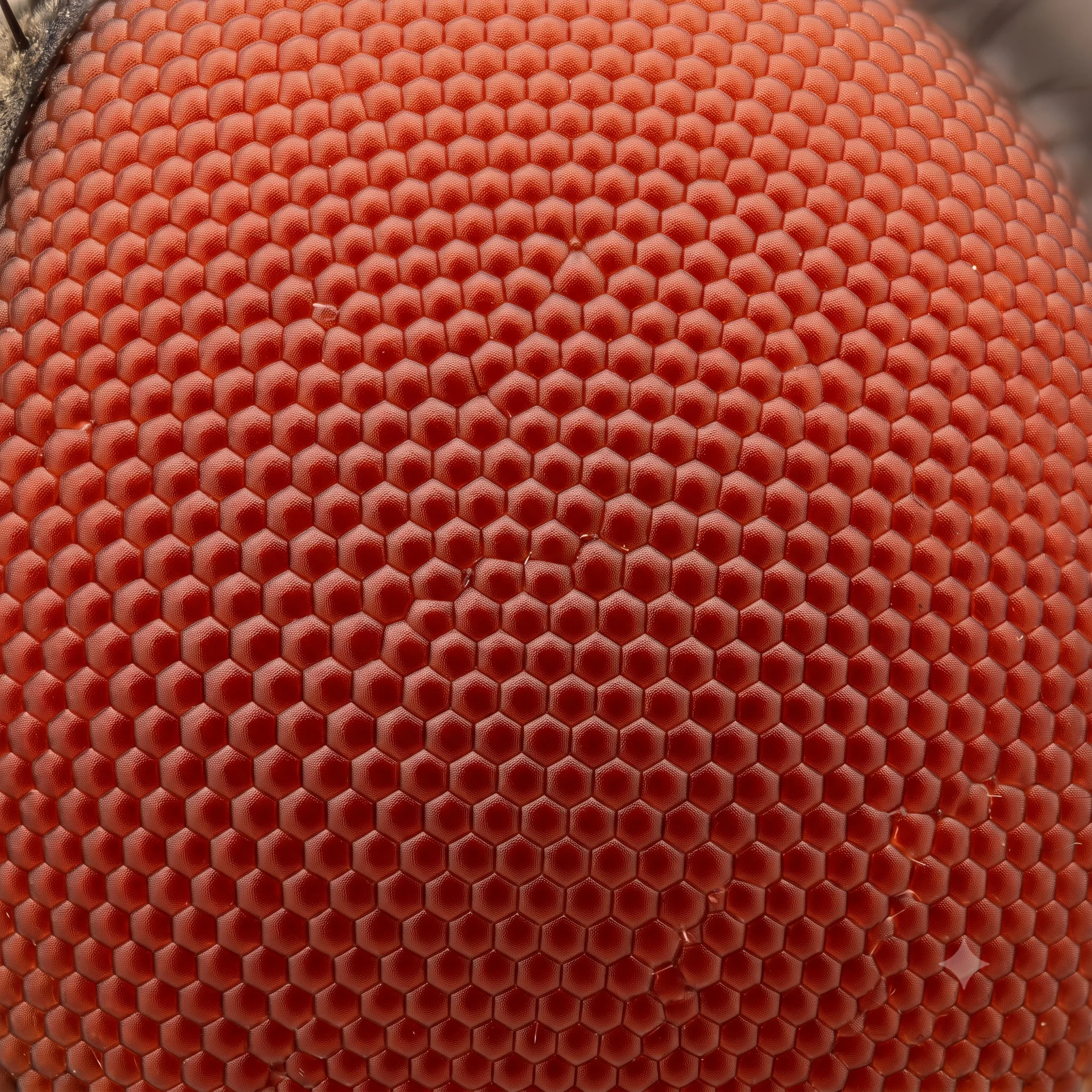
The difference of the compound eye is not only the number of lenses; it is the speed of processing. Rather than trying to resolve detail in depth, the house fly catches changes in motion. This makes it suited more to escape than to hunting. The world may be less sharp, but the threat is seen earlier.
Why does the flicker fusion rate matter?
The flicker fusion rate is the threshold at which successive image fragments are perceived as a single flow. In humans this value can be sufficient at a low frequency in everyday use; in the house fly it is higher. The result is simple: a hand that is fast in our eyes flows more slowly for its eye. This difference spoils the attempt to catch it. For the basic concept, Britannica compound eye gives a good introduction. For a broader background, you can look at the note M. Land visual system in insects, 1997 and at TUBITAK general science resources (in Turkish).
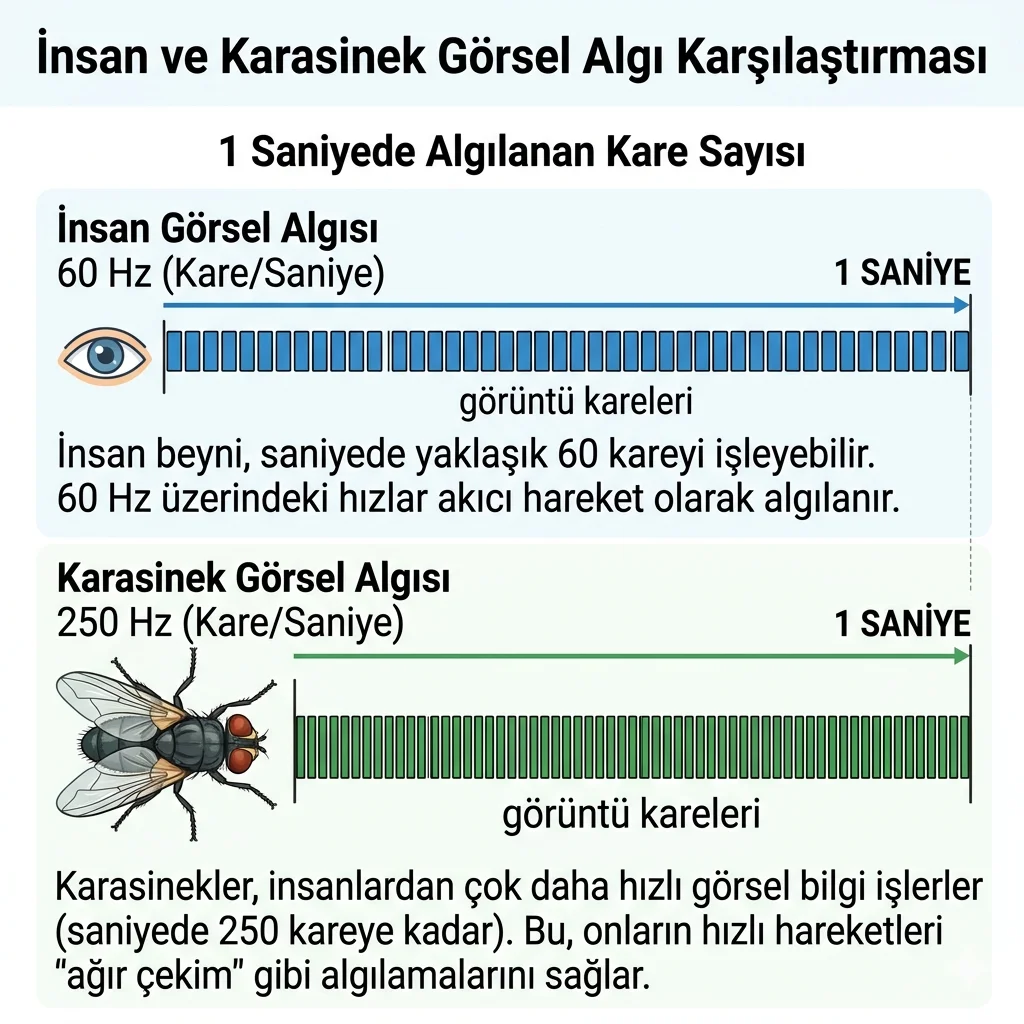
The critical idea here is this: as the number of frames increases, the start of a movement is caught earlier. So the house fly has already begun to decide at the moment a human thinks is the “last moment”. Numbers like “250 Hz” give an idea; they shouldn’t be read as an exact laboratory result. Still, the main message doesn’t change: fast vision means fast escape.
How does the escape mechanism work?
When the house fly sees a threat, it doesn’t think for long. The signal travels to the muscle and wing control system by a very short route. Thanks to this, the response delay stays low. In other words, the point is not just seeing well; it is responding quickly to what is seen. A reflex of around 100 milliseconds works in the fly’s favor when it coincides with the hand movement. It is better to read this behavior topic together with the behavior section in the house fly behavior section.
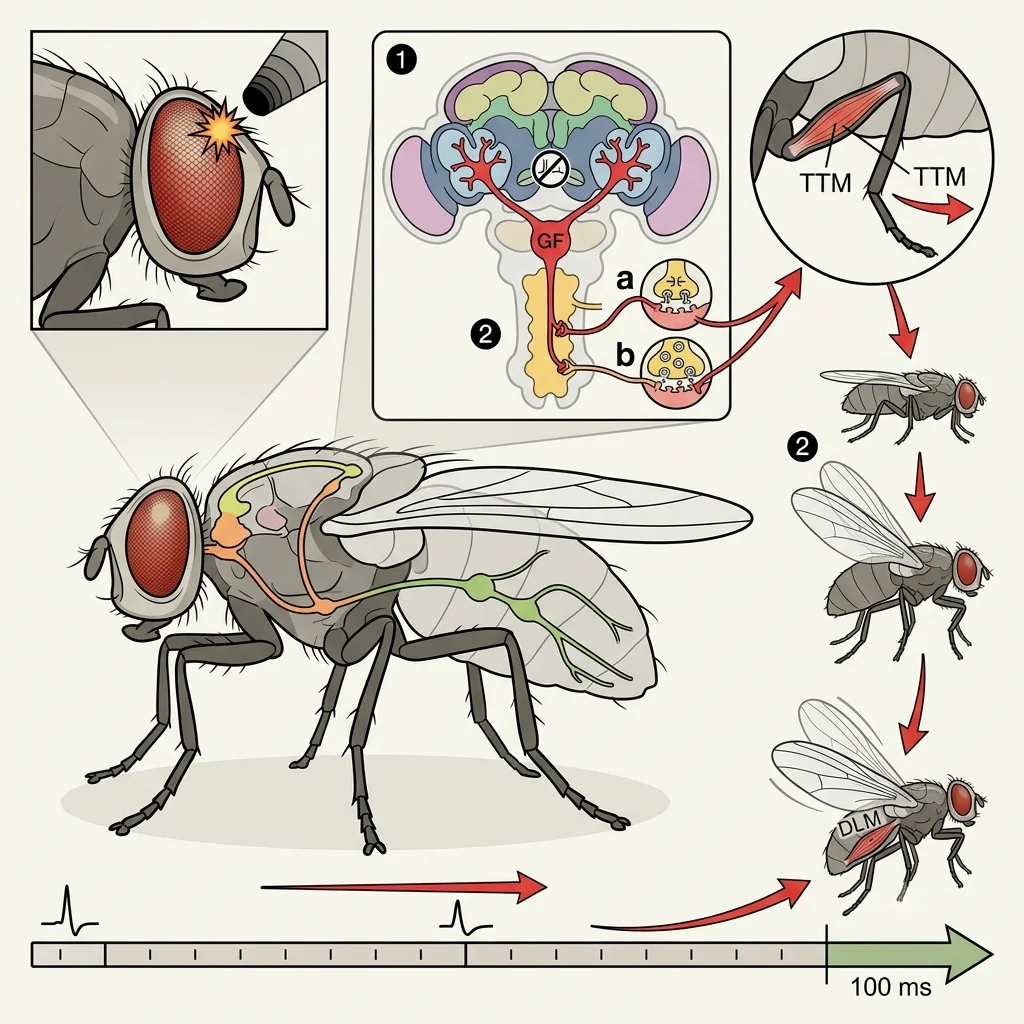
Here the house fly wins not because it “got scared” but because its signal line is short. Vision, decision and muscle command are very close to each other. That’s why it is hard to catch the insect in a single move; even the smallest time difference turns into an escape.
Why can’t it be caught in practice?
A person who wants to swat a fly usually makes a wide and fast attack. This may be exactly what the house fly expects. Because it sees the movement early and sets up its escape route. For a better result, you need to go in slowly and speed up at the last moment. Alternatively, sticky traps, fly screens and similar passive solutions are more reliable. A topic such as the house fly vs fruit fly difference could also be covered as a follow-up to this article.
The short conclusion is clear: the house fly beats you not with its intelligence but with the speed of its perception. A movement that is a single move for us is a data stream for it. When the compound eye, flicker fusion and the reflex pathway come together, this is what emerges. The same scene, two different senses of time.
FAQ
- Can a house fly see 360 degrees? No; but its field of view is very wide.
- Does a house fly see colors? Yes; it is especially sensitive toward UV and blue-green.
- Do other insects see this fast too? It varies from species to species; predatory species are generally faster.
- What is the technique for swatting a house fly? Break the rhythm, speed up at the last moment, or use a passive trap.
Source note: Britannica compound eye, M. Land 1997, TUBITAK science resources (in Turkish).