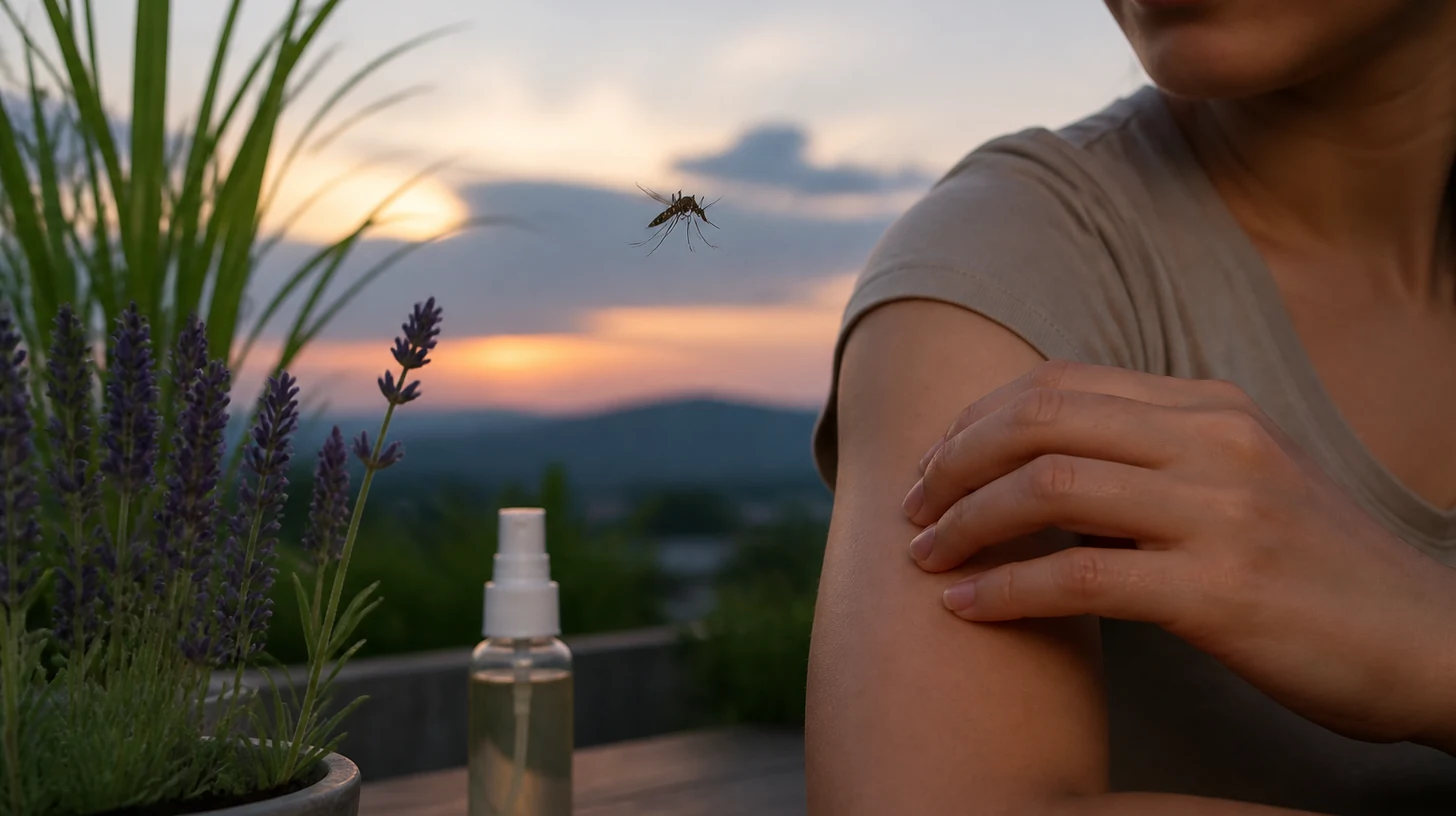
Mosquitoes do not definitively flee from any single scent; the effect of scents such as citronella, lavender or lemongrass depends on the product, the concentration and the conditions of use. The really important difference is that a plant sitting on the balcony is not the same thing as a repellent with a known active ingredient and usage label. Understanding how mosquitoes find people also helps you weigh claims about which “natural solution” works. For species, habitats and protection options, you can read the main mosquito guide.
Which scents do mosquitoes use to find people?
Female mosquitoes use several cues together when searching for a host. Carbon dioxide released in breath can trigger orientation from a distance; skin odors, body heat and humidity become effective at close range. That is why there is no single, universal answer of the kind “they dislike this scent and won’t come near it.” Species, environment and the concentration of the scent can change behavior.
A review on odor perception and repellents in mosquitoes explains the role of carbon dioxide in host seeking and how different scents can affect this behavior. However, an effect measured in insect behavior does not guarantee the same protection in every home or outdoor area. The main mosquito guide covers species, the life cycle and protection in more depth.
Do citronella, lemongrass and other fragrant plants work?
Keeping the plant itself is not equivalent to using a product derived from it and prepared in a specific way. Mississippi State University Extension states that there is some scientific evidence that lemongrass, lemon balm, bee balm and lemon thyme deter mosquitoes, but that a few plants should not be expected to meaningfully reduce the number of mosquitoes around a home. The fact that citronella geranium has a scent is not considered proof that it is an effective repellent either.
Applying plant oils to the skin is not automatically safe either; essential oils can cause irritation. In particular, it is not right to apply undiluted oil to the skin or to treat a homemade mixture like a tested product. Plants can be chosen for their pleasant scent and for garden use; they should not be seen as the only defense against bites outdoors.
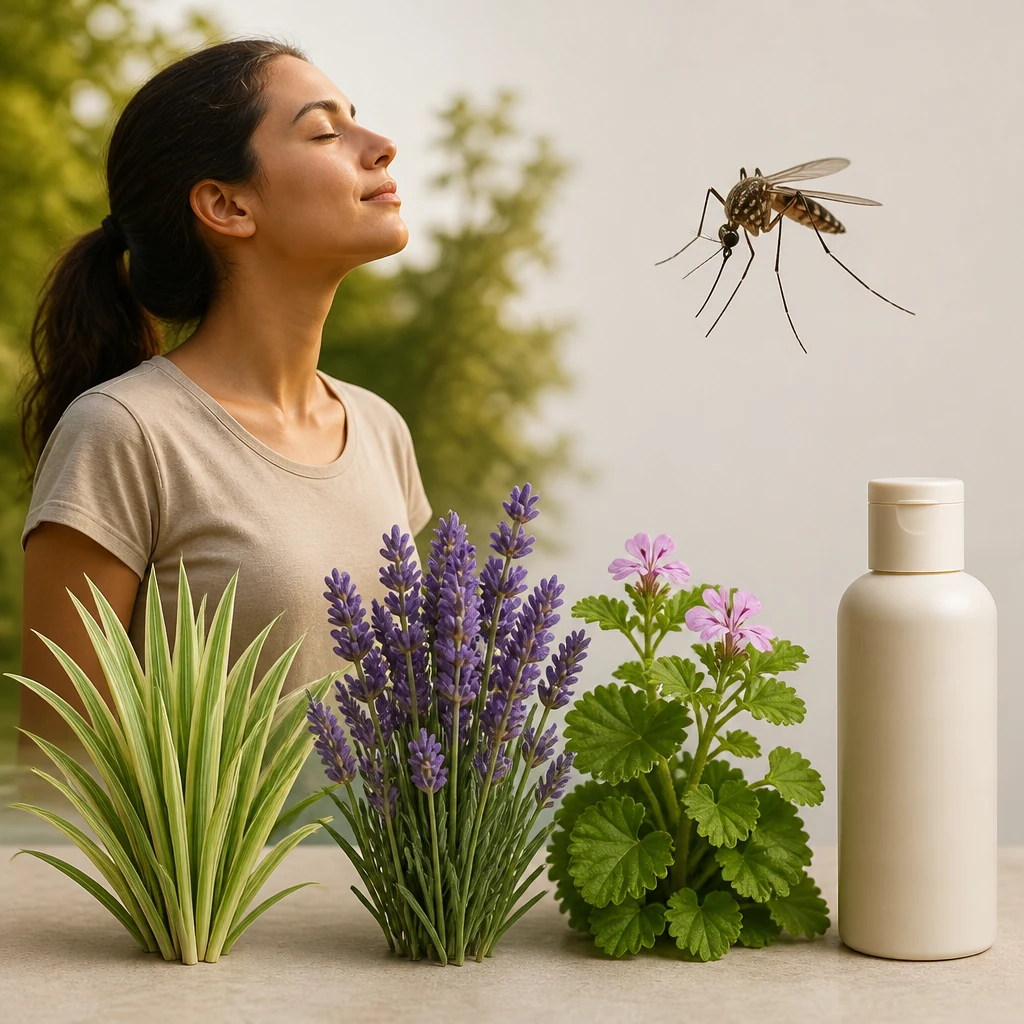
Another important detail in scent trials is how long the effect lasts. A mosquito in a laboratory container moving away for a short time does not mean you will be protected for hours in a large garden. Wind disperses scent; temperature, sweat and movement affect how long a product stays on the skin. So don’t put a plant on the windowsill in place of a screen or a labeled repellent. Reducing breeding sources inside the home is a separate task: driving adult mosquitoes away with scent does not eliminate the larvae in a puddle.
Which scent or product protects more reliably?
For a repellent to be used on people, look at the active ingredient and the product label, not the name of the scent. The CDC lists conventional repellents such as DEET and picaridin, as well as ingredients such as OLE/PMD and IR3535. The duration of protection varies with the product, concentration, sweating, water and rubbing. Apply the product only as written on its label; do not exceed the reapplication interval.
Do not confuse OLE (oil of lemon eucalyptus) with lemon eucalyptus essential oil: similar names do not mean the same formulation or a tested product. Since age limits and application instructions may vary by product, go by the label. For children, during pregnancy or on sensitive skin, follow the product instructions and, when needed, the advice of a healthcare professional instead of using random oil mixtures.
If you will be outdoors for a long time, it is more practical to carry the repellent in your bag and follow the reapplication instructions on the label. When using it together with sunscreen, the CDC recommends applying sunscreen first, then the repellent. Don’t mix the products together into a single application; each product’s own label and amount of use apply. For products applied to clothing, do not assume the skin-use instructions apply either.
| Option | Expectation | Limit / correct use |
|---|---|---|
| Citronella or lavender in a pot | Scent and ornamental plant | Does not provide reliable bite protection on its own |
| Plant essential oil | May have a short-lived effect under some conditions | Product/formulation varies; risk of skin irritation |
| Labeled repellent (DEET, picaridin, etc.) | Evidence-based personal protection option | Apply according to the label; do not exceed the duration and use limits |
| Reducing standing water, screens | Help reduce breeding sites or entry indoors | Do not replace repellent; require regular checks |
How can you reduce mosquitoes coming near you at home and outdoors?
Start with the environment: prevent water from collecting in buckets, plant-pot saucers, gutters or unused containers. Keep screens on windows and doors intact; use a bed net where appropriate while sleeping. Outdoors, long-sleeved clothing and a repellent used according to the label can be considered together. Air movement can also make it harder for mosquitoes to fly; but don’t present a fan as definitive protection on its own.
Don’t use methods such as electronic wristbands, sound-emitting devices or garlic in place of proven personal repellents. The CDC lists vitamin B, garlic, sound devices and repellent wristbands among ineffective options. The effect of candles or spatial repellents can vary with the setting; take care not to inhale the smoke or spray and follow the product instructions.
Conclusion: which scent do mosquitoes dislike?
Some fragrant compounds can affect mosquito behavior; but the saying “put out the plant and mosquitoes won’t come” is not a reliable rule. For protection, a labeled repellent, screens, suitable clothing and reducing standing water sources form a sounder whole. For mosquito species and their general biology, you can move on to the main mosquito guide.
Sources
- Ray A. “Reception of odors and repellents in mosquitoes.” Current Opinion in Neurobiology (2015). https://pmc.ncbi.nlm.nih.gov/articles/PMC4577459/
- Mississippi State University Extension Service. “Can Fragrant Plants Help Repel Insects?” https://extension.msstate.edu/blogs/extension-for-real-life/can-fragrant-plants-help-repel-insects
- CDC Yellow Book. “Mosquitoes, Ticks, and Other Arthropods.” https://www.cdc.gov/yellow-book/hcp/environmental-hazards-risks/mosquitoes-ticks-and-other-arthropods.html