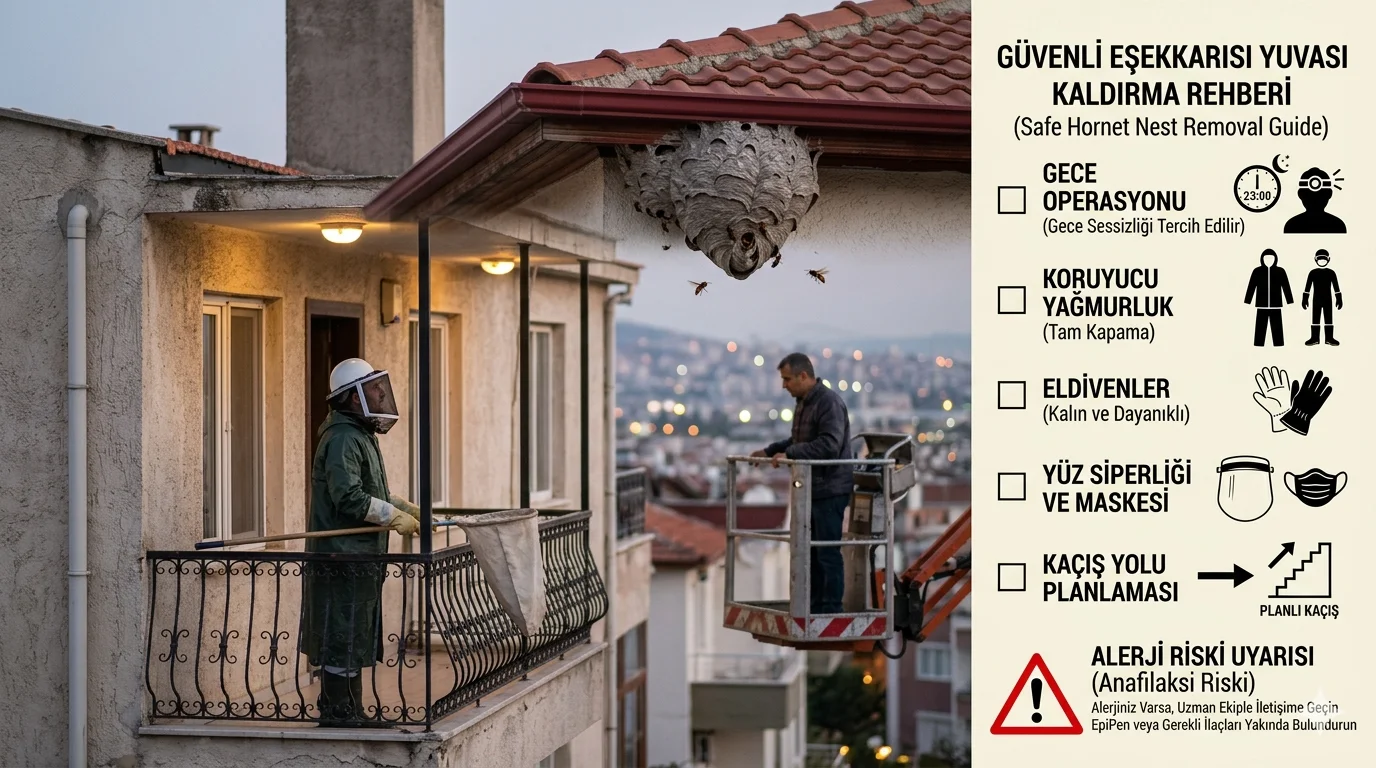
The short answer to the question of how to remove a wasp nest is this: first identify the nest correctly, then look at the risk line. The colony behavior in the Wasp article and the emergency threshold on the Wasp Sting First Aid page are the two pillars for understanding this job. The nest appears at eye level, under the eaves, at the roof edge or on a balcony; it is gray, paper-like and layered. During the day the coming and going continues, while at night the colony stays calmer.
How do you recognize the nest?
A wasp nest often doesn’t look like a honey bee hive. There is no beeswax comb; instead there is a thin, layered shell made of chewed wood fiber. The color often tends toward gray. If it is near a house, you’ll come across it under the eaves, in the attic, above a balcony, in a ventilation gap or in hollows in the exterior wall. If you see it at eye level, you’ll usually notice an entrance hole as well. If there is frequent coming and going around that hole during the day, don’t assume the nest is empty. Waiting, thinking it is an empty nest, and then approaching it is a mistake.
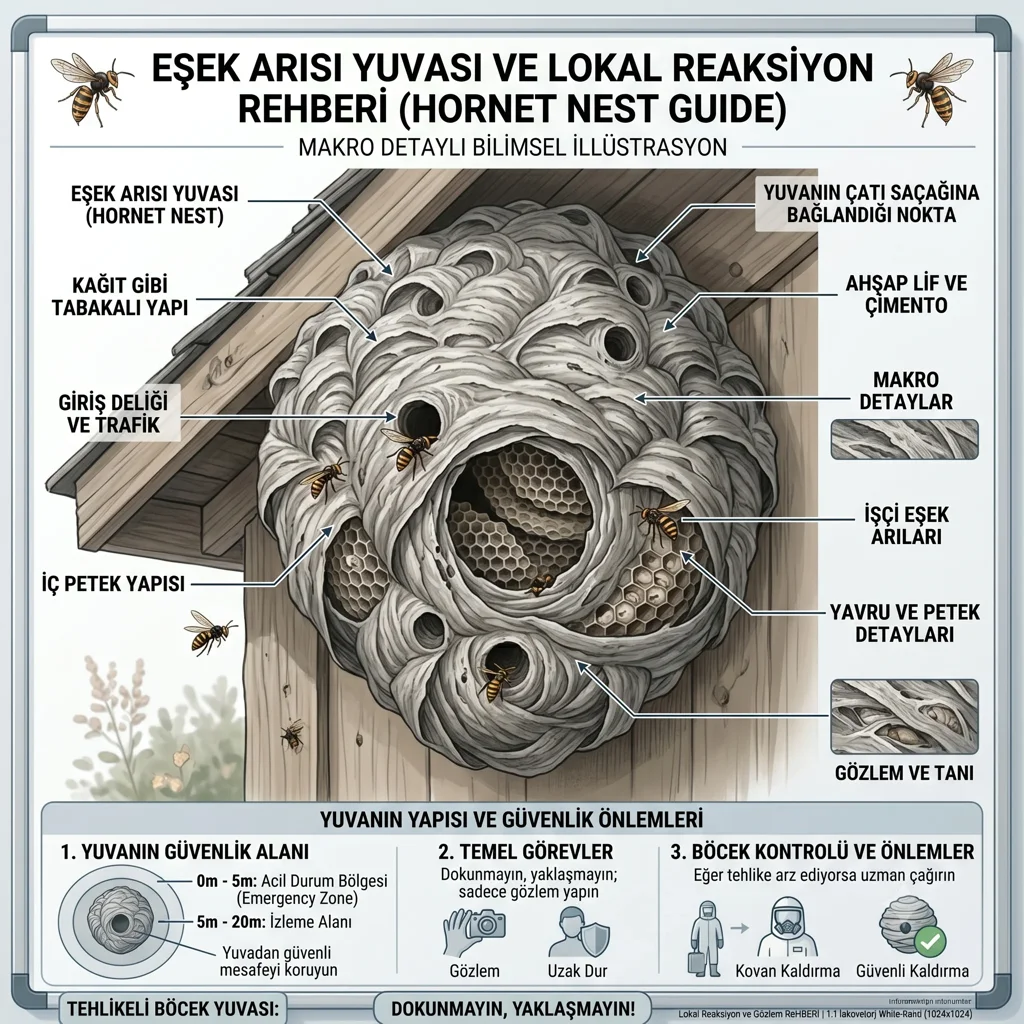
A practical tip: watch from a distance for a few minutes. If there are workers going back and forth along a single line, this is a sign of an active nest. Flight traffic decreases in the late afternoon; at night it drops even further. But this doesn’t mean it is safe. It only means the intervention window is narrowing.
When is a professional a must?
For some nests there is no DIY. Don’t bargain here.
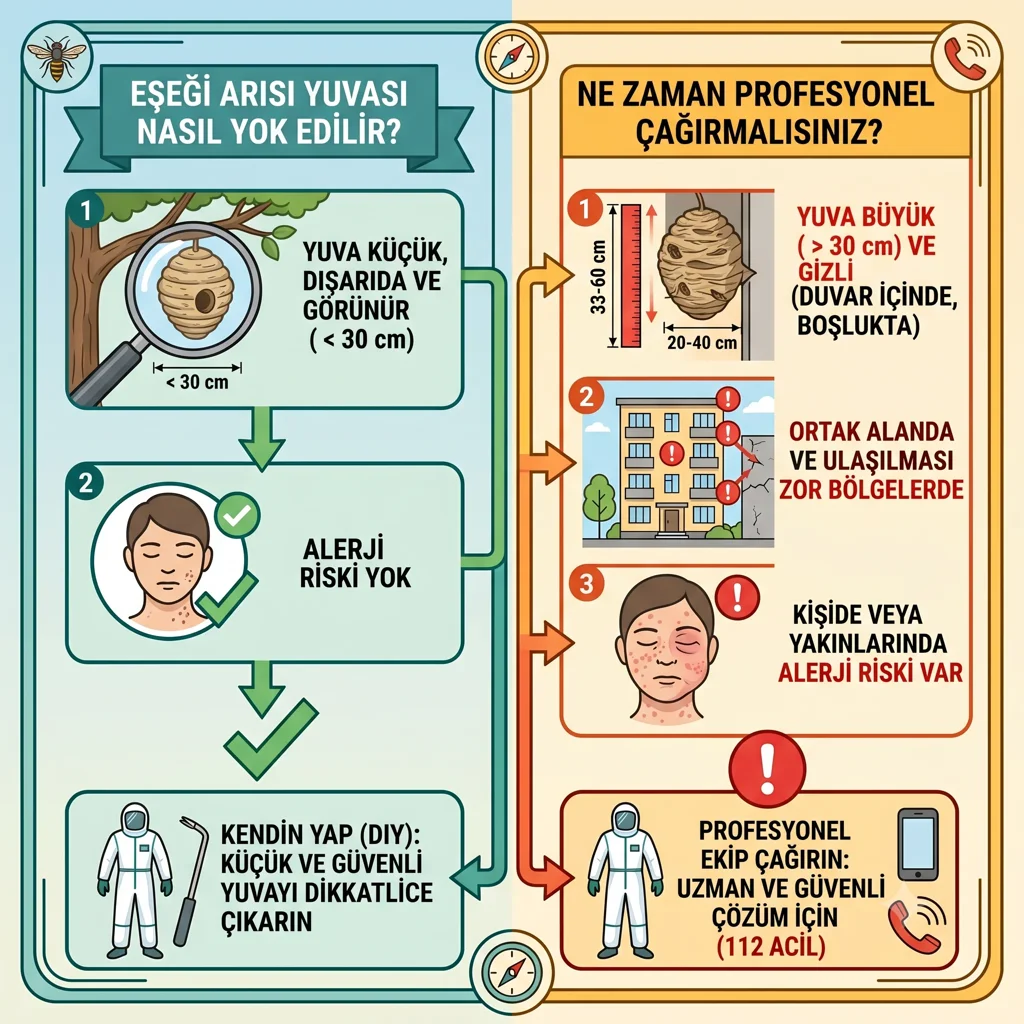
- If the nest exceeds about 30 cm in diameter.
- If the nest is inside the house, in a wall cavity, in a crack between concrete or along a utility line.
- If someone in the home has a bee allergy.
- If the nesting is in a common area, on the roof, on the apartment building’s facade or near a neighbor’s balcony.
- If a second nest has formed in the same spot.
If even one of these thresholds applies, professional pest control is the better way. Especially if there is an allergic family member, you don’t gamble with the risk of stings. If someone has already been stung and shortness of breath, lip or tongue swelling, a widespread rash or dizziness has started, your country’s emergency number comes first, then the professional help line. The emergency logic on the Wasp page applies here too.
If you’re going to DIY, do it like this at night
The line UC IPM gives for social wasps is clear: at night they gather in the nest more and activity drops. That’s why the intervention window is the night. But night doesn’t mean “attack with my eyes closed.” There is a set order.
- Wait until it gets dark. Go out in full darkness, when movement has decreased.
- Wear a thick raincoat. Put on long-cuffed gloves. Wear closed shoes. Use a hat net or a face net.
- Leave an escape route toward the door. Know in advance which direction you’ll retreat in.
- Use a wasp & hornet spray that sprays at the nest from a distance. A label listing a pyrethroid active ingredient such as permethrin or deltamethrin is a reason to prefer it.
- Check the range on the label. A 4-6 m band, that is about 13-20 feet, does the job for this task.
- Spray in short bursts. Aim at the nest entrance. Don’t linger outside for long.
- Back off at the first sign of movement. Don’t play the hero.
When choosing a spray, the instructions on the label are the main law. Do whatever the manufacturer says. If distance, protective clothing and a ready escape route don’t come together, the risk of this job grows.
Why at night and why from a distance?
The advantage of the night is not calmness alone. Human traffic also drops. There is less movement around the balcony, garden, hallway and roof. In other words, both noise and vibration between the colony and you decrease. This is also UC IPM’s emphasis for social wasps: at night they are in the nest more, and protective equipment is a must. The same page also says that suitable formulations can spray up to about 20 feet; this explains the 4-6 m logic.
The critical line here is this: you don’t stand close to the nest. Approaching it, being curious, poking it with a stick, spraying it with pressurized water or trying to solve it with fire is not right. Acting as if you were switching off a machine rather than dealing with wasps distorts the nature of the situation. If the colony is alarmed, the attack escalates.
How is an empty nest removed?
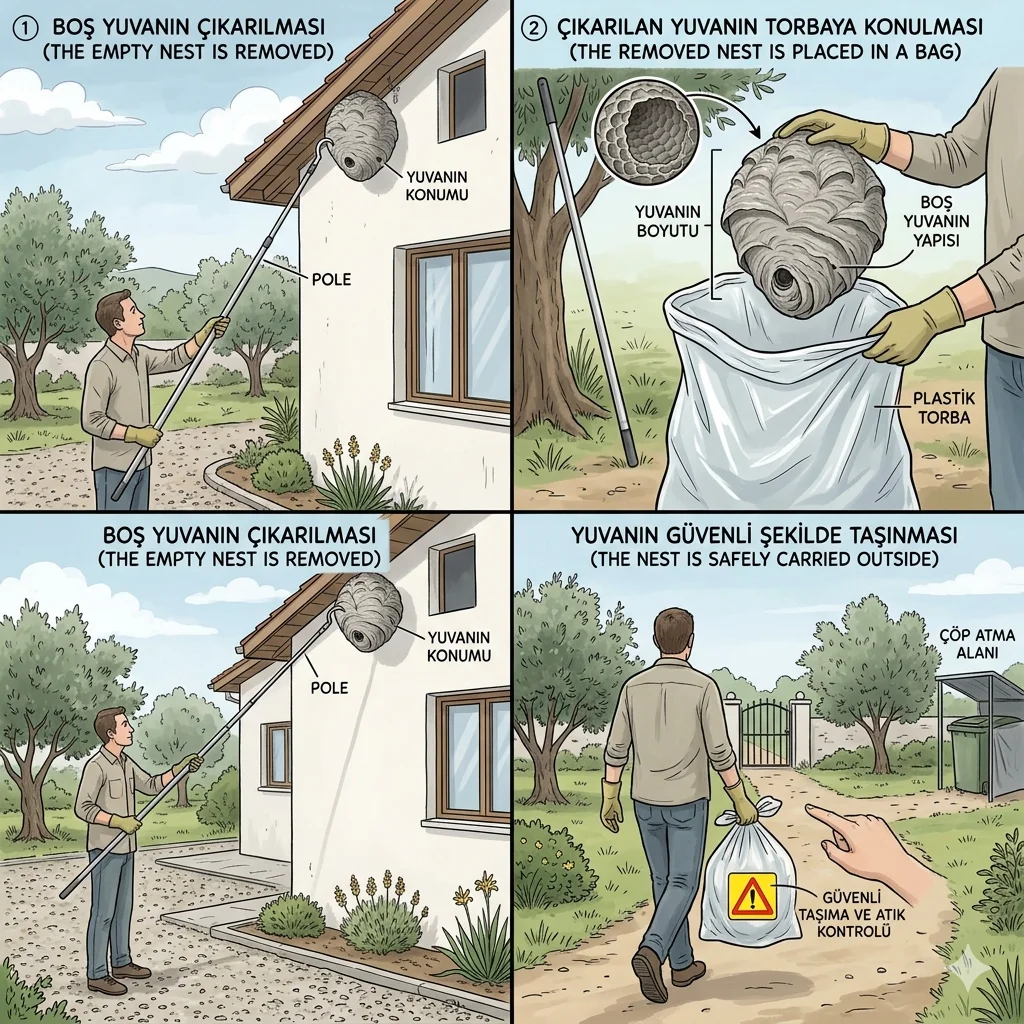
If on the following morning there is still no coming and going and the nest is really empty, the last part of the job remains. Carefully take the nest down with a long stick or pole. Don’t lean directly under it. Put the nest you took down into a double plastic bag. Close its opening. Then take it out of the house.
At this point the goal is a clean finish. Don’t crush the nest by hand, don’t break it apart piece by piece, don’t leave it open on the ground. Because old nest remains can hold the smell and residue. If you see movement the next morning too, accept that the nest is not empty and back off.
Apartment buildings are a different matter
If in an apartment building there is a roof, eaves, an area above a balcony, a shared facade or a shaft line, the job is not a single-apartment matter. Talk to the management. Keep the neighbors informed. If common areas aren’t checked, the problem can shift from one apartment to another. If a neighboring apartment’s window stays open while one apartment’s balcony is being cleared, the risk stays there.
The building management should be the decision-maker, especially for the attic and the facade line. If the nest is in a common area, one person intervening on their own is not right. This is a matter of both safety and responsibility.
What not to do
- Don’t poke the nest in the middle of the day.
- Don’t climb a ladder alone and get under the nest.
- Don’t try to solve it with a water hose, fire, smoke or a hard blow.
- Don’t block your escape route.
- Don’t experiment while keeping an allergic person next to you.
These items look short, but mistakes are costly. Seeing the nest doesn’t mean you can manage it. Managing the nest means first managing your own position.
Short decision table
| Situation | Decision |
|---|---|
| Nest over 30 cm | Call a professional |
| Inside a wall / between concrete | Call a professional |
| Someone in the home is allergic | Don’t DIY |
| Common area / roof / balcony line | Management + professional |
| Small, external, accessible nest | A controlled night treatment can be considered |
| Breathing problem / swelling / widespread rash after a sting | Your country’s emergency number |
Sources
- UC IPM — Yellowjackets and Other Social Wasps
- AAAAI — Stinging Insect Allergy
- NHS — Anaphylaxis
- Wasp vs Honey Bee: How to Tell Them Apart?
- Emergency First Aid
FAQ
How do you remove a wasp nest?
First look at whether the nest is out in the open or inside a wall. If it is a small and accessible nest, you can treat it at night, with protective clothing and a long-range spray. If it is over 30 cm, between concrete, or there is an allergy risk, call a professional.
Why is it safer to remove the nest at night?
Because social wasps gather in the nest more at night and movement in the surroundings drops. That’s why UC IPM highlights night treatment.
Which spray should be used?
Products in the wasp & hornet spray class that spray from a distance and whose label lists a pyrethroid active ingredient such as permethrin or deltamethrin are preferred. The label’s range and instructions for use are read.
When is the empty nest removed?
If there is still no coming and going the next day. Then take it down with a stick or long pole, put it in a double bag and take it outside.
Why is management needed in an apartment building?
Because the roof, facade and common areas go beyond the boundary of a single apartment. A nest in a common area also puts neighboring apartments at risk.
On the question of how to remove a wasp nest, the right order doesn’t change: read the location, classify the risk, work at night and from a distance, and if there is an allergy or a large nest, call a professional.