This article is a narrowed-down continuation of the main Wasp framework; read it together with Wasp vs Honey Bee: How to Tell Them Apart? for telling species apart. The topic here is not a single insect but an invasive species dealt with together with hive pressure, field monitoring and health risk. If you want to move on to the nest removal line, the Wasp Nest Removal article, a separate and tougher operation, covers that ground.
What is Vespa velutina nigrithorax?
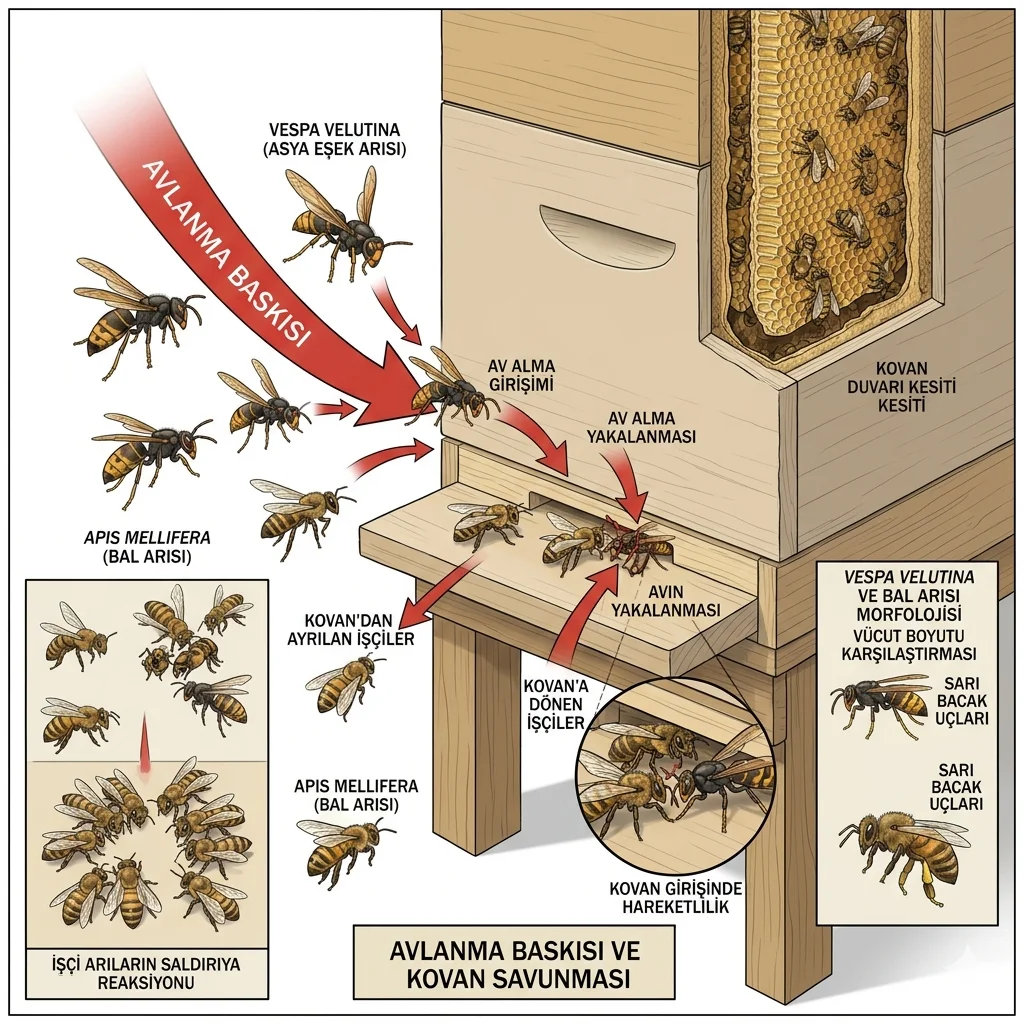
Vespa velutina nigrithorax is an invasive hornet subspecies known as the Asian hornet. One of its easiest signs in the field is that the abdomen looks almost entirely dark and the yellow color stands out only in the last band. Another distinguishing feature is that the leg tips are yellow. This small detail helps tell the species apart even when looking from a distance. The body is compact, the flight steady and the nest defense fierce. In other words, the creature in front of you is not a randomly wandering wasp but a predator working at the colony level.

What do the records in Turkey say?
In Turkey, records became clearer in the period after 2017. Bursa was one of the first provinces to stand out. In Istanbul, a record from Üsküdar was reported in 2019. The Izmir, Trabzon and Yalova lines were also discussed later. This distribution is not a single point; it gives a picture of spread consistent with ports, trade and movement within cities. That’s why the topic of Vespa velutina in Turkey is not a single-province problem but a biosecurity issue with the potential to spread.
Early records matter. Because an invasive species looks small in the first years, but if the environment is suitable it settles quickly. Every season of delay in the field increases the cost of control. That’s why it would be a mistake to read the records only as academic notes; they are also intervention timestamps.
How does it attack honey bee hives?
This is where the real risk begins. Vespa velutina hovers in the air at the hive entrance, catches worker bees one by one and, tearing their bodies apart, carries them off as food for the larvae. In the field this behavior is sometimes called “waiting and hunting at the doorway”. In the French literature, this is also accompanied by a model similar to honey bee hawking; that is, it waits at the entrance like a patrol and ambushes those that come out.
The problem is not just the loss of individual bees. When there is constant pressure at the hive entrance, workers can’t go out, the food flow is cut, larval care falters and the colony comes under stress. Even a strong colony can dwindle away under prolonged pressure. That’s why the risk is high from a beekeeping perspective; its potential to destroy a hive in one go is harsher than the ordinary defensive behavior you see in native wasps.
How does it differ from Vespa crabro?
Vespa crabro, the native European hornet, looks larger in size. The classic black-and-yellow bands on its abdomen are more distinct. Vespa velutina, on the other hand, has a darker abdomen with yellow in the last band. The yellow leg tips are the marker here; this is the detail that tells them apart quickly in the field.
The nest site is different too. Vespa velutina often builds a hanging, sheltered nest on high tree branches, above 10 meters in most records. Vespa crabro, on the other hand, may more often use lower cavities, underground hollows or sheltered spaces under roofs. In other words, one likes a nest close to the sky, the other leans more toward hidden volumes. This difference also changes the reporting and intervention plan.

What to expect in terms of human health?
Its sting on people is taken no less seriously than the sting of a native wasp. Pain, redness and swelling are the expected first reactions. But the real red line is an allergic reaction. There is a risk of anaphylaxis; that is, symptoms such as lip and facial swelling, shortness of breath, widespread itching, dizziness or palpitations can develop rapidly. In such a situation, waiting is not right.
The practical rule here is clear: don’t take a sting lightly, but don’t panic either. Keep the area clean, cool it, watch the symptoms, and if systemic symptoms appear, get emergency help. In people who have had multiple stings or who have a history of allergy, the threshold for seeking help is lower.
What should a beekeeper do?
The first job for a beekeeper is to watch the front of the hive and spot the pressure early. Using selective traps works here; but blind, random traps also hit other pollinators. That’s why a method that attracts the target species and reduces unnecessary catches is more appropriate. Not leaving the hive weak, narrowing the entrance and environmental observation are also part of the job.
The second step is reporting. If a nest is detected, don’t intervene on your own. Note the location, write down the time, take a photo from a distance if possible, and report it to the official channel. This species is assessed within the monitoring and pest species approach of Turkey’s Ministry of Agriculture and Forestry. The right reflex here is not heroism but recording and reporting.

Ecosystem note
In its natural range, Vespa velutina is part of the ecosystem as a predator and scavenger insect. But in invaded areas such as Turkey, it disrupts the balance. Because it puts pressure on bee colonies, it can affect not only beekeeping but also the pollination chain. That’s why EFSA’s invasive alien species framework and EU Regulation No 1143/2014 are important. The issue here is not a “good bug, bad bug” distinction; it is the difference between a species in the right place and a species in the wrong place.
This view is a biologist’s perspective. It doesn’t demonize the species; it measures spread, pressure and ecological cost. For the same reason, French sources such as INRAE and ITSAP don’t just describe the threat; they also deal separately with control topics such as trapping, monitoring and nest tracking.
Short field rule
- Look at the yellow leg tips.
- Distinguish the dark abdomen and the last band.
- Take a nest high in a tree seriously.
- If you see an individual waiting at a hive entrance, increase the distance.
- If you find a nest, report it, don’t touch it.
- If you’re a beekeeper, use selective traps and regular observation.
Frequently asked
Are Vespa velutina and Vespa crabro the same thing?
No. Both are in the hornet group, but their morphology, nest site and attack style are different.
Does Vespa velutina only harm bees?
The main pressure is on honey bee colonies; but its hunting behavior is also directed at other insects in general. In the invaded area, the problem is that this pressure becomes unbalanced.
Why is the nest high up?
Because it provides shelter and invisibility. A high branch tip creates a defensive advantage for the colony.
If it stings, do you need to go to the hospital?
Yes, if there is an allergy, widespread swelling, shortness of breath or any systemic symptom. In this case, emergency assessment must not be delayed.
Sources
- INRAE — Tracking Asian hornets’ return to the nest (in French)
- INRAE — The Asian hornet, a bio-indicator of environmental exposure to pesticides (in French)
- ITSAP — How to set up a control strategy against the yellow-legged hornet? (in French)
- EFSA — Invasive alien species
- EUR-Lex — Regulation (EU) No 1143/2014
- Ministry of Agriculture and Forestry of Türkiye — Topic Categories (in Turkish)
This is the essence of the Vespa velutina in Turkey file: early records, correct identification, reading the pressure in front of the hive and not approaching the nest. For the beekeeper, the rival is not a single individual but a colony system. The same line applies on the health side; if there is a sting, watch the symptoms, and if there are systemic symptoms, don’t be late.