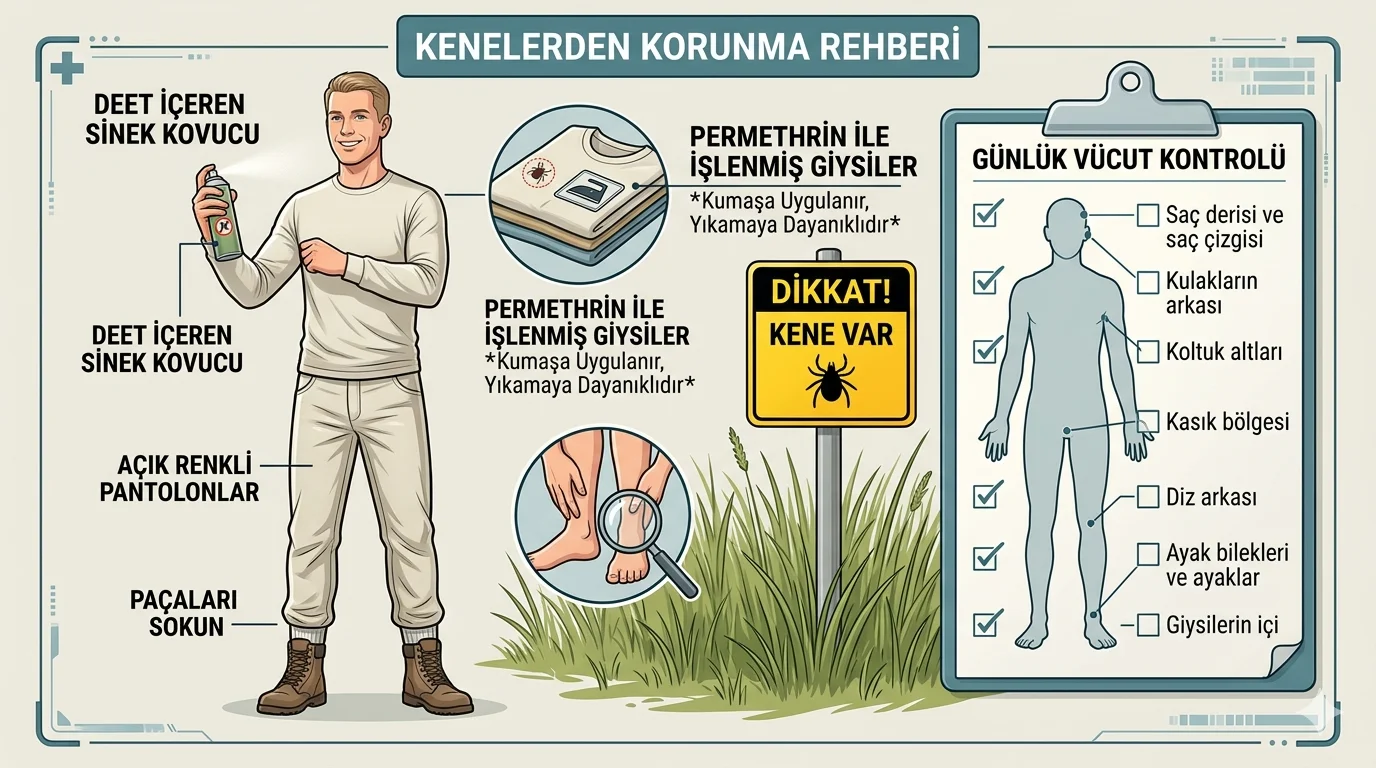
Tick prevention methods are not just a matter of spray; the picture is complete if the field behavior in the Tick: Biology, Life Cycle and Health Perspective article is read together with What to Do After a Tick Bite? An Evidence-Based Guide. This page makes clear what to wear and what to apply before you go out, and what to check when you get back.
Short rule: first lower the chance of being bitten, then check more often. The Tick Removal Method: The Correct Pull with Tweezers page shows what the second line is if a tick slips through.
Why does tick prevention need three lines?
A tick waits at the tip of a grass blade or at the edge of a bush. So the risk is not only in the forest; meadows, tall grass, the edges of rocks and the garden line are part of it too. That is why a single measure is not enough. The first line is repellent, the second is clothing, and the third is regular checking and management of the surroundings. If these three work together, the risk drops considerably.
In short, the issue is not “are there ticks?” but the question “how do you stop a tick from attaching to you?” In the field the answer is clear: the right product on the skin, the right treatment on clothing, the right check on the body.
Repellent: the skin vs. clothing distinction
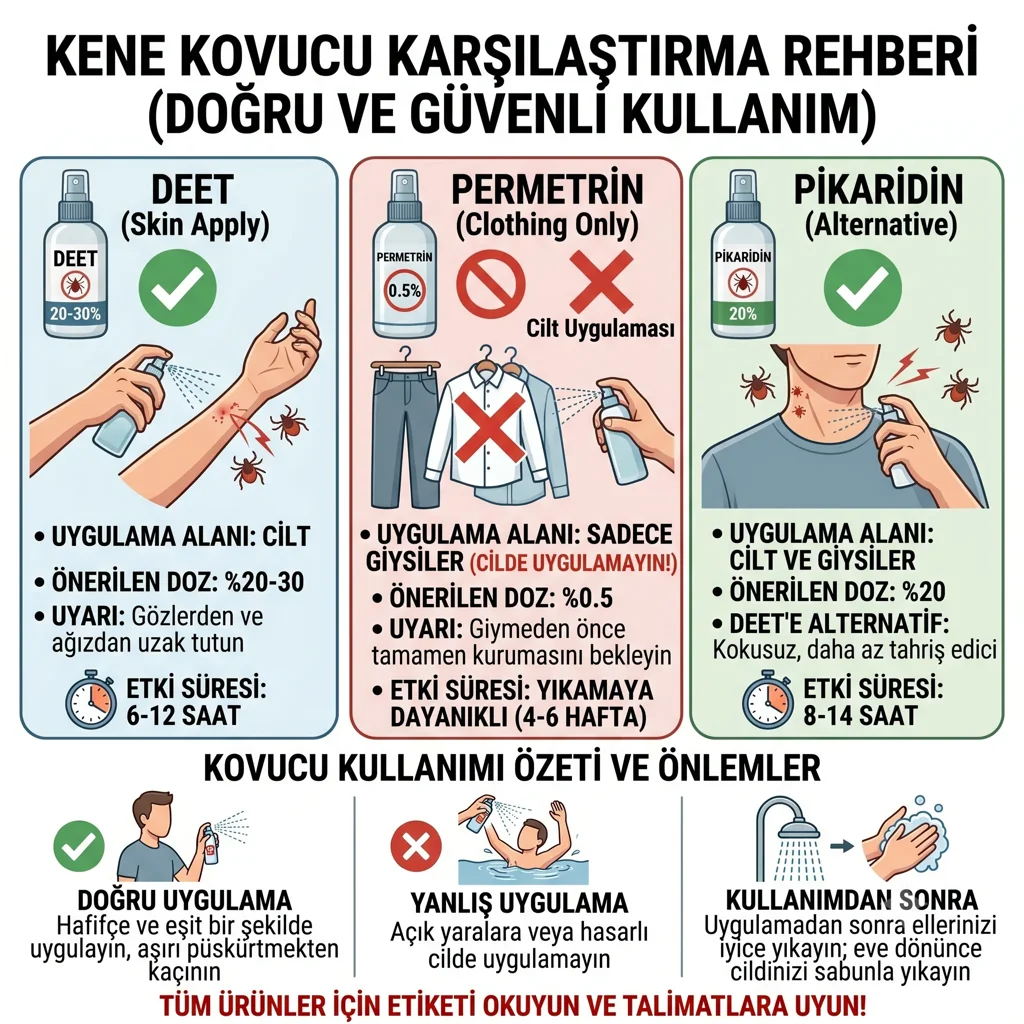
The product to use on the skin and the product to use on clothing are not the same. Don’t mix up this distinction. DEET is used on the skin in the 20-30 percent range. If you will stay outdoors for a long time, this range is sufficient in practice. Picaridin 20 percent is considered a more comfortable alternative for some people in terms of smell and feel. Both products do the job in the field.
Permethrin stands apart. Permethrin 0.5 percent is for clothing; it is not applied to the skin. It is applied to trousers, socks, shirts and the outer layer. In most applications its effect lasts until one wash. So if the clothes you put on in the morning have been treated, you set up a line of protection for the whole day; but renewal is needed after washing. This distinction looks small, but the mistake is big.
Read the label when choosing a product. In situations such as children, pregnancy, asthma or sensitive skin, the choice of product may vary from person to person. What is needed here is not rote rules but the label and guidance from a physician/pharmacist. The rule is short: DEET and picaridin on the skin, permethrin on clothing.
Clothing: be visible, make attaching harder
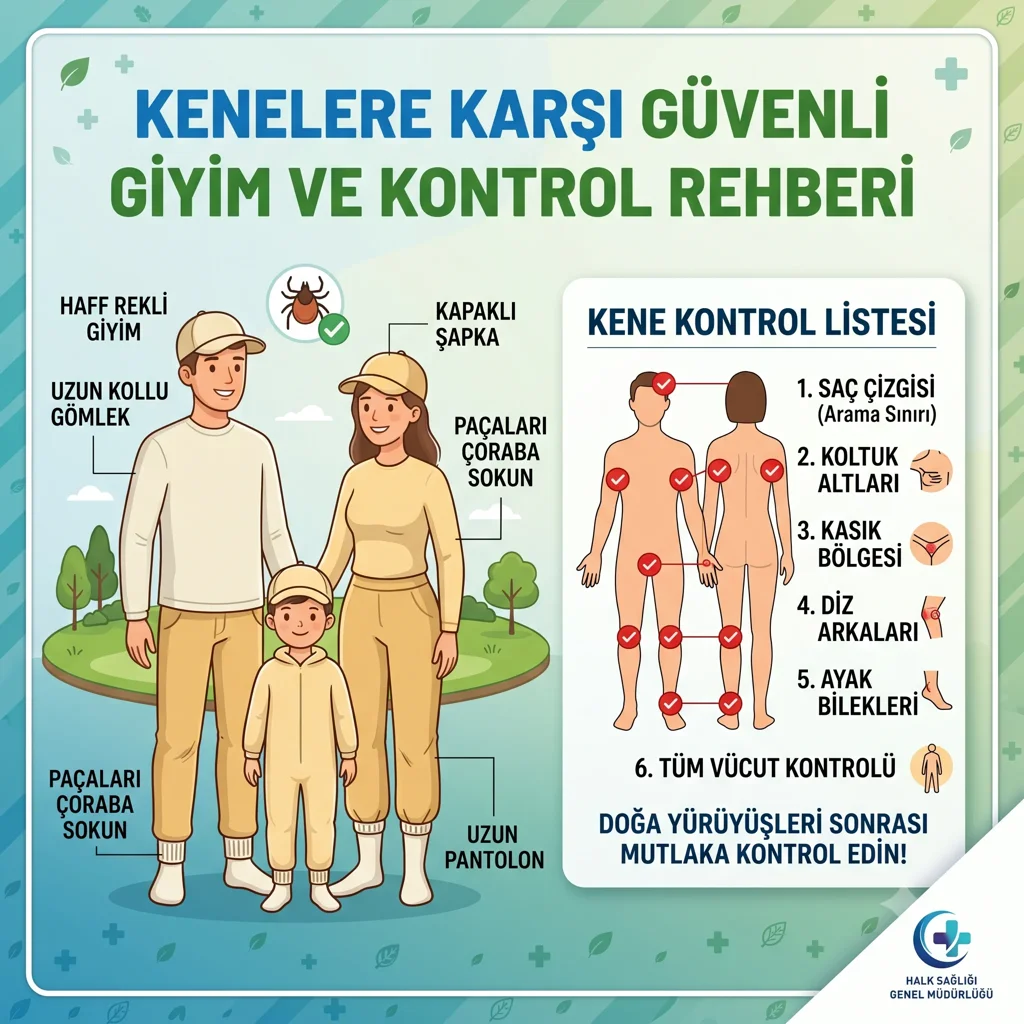
Among tick prevention methods, the simplest but strongest step is clothing. Choose long sleeves, long trousers and light-colored clothes. Light colors let you see a tick more easily. A small tick disappears on a dark color; on a light color it is easier to pick out.
Tucking your trousers into your socks looks old-fashioned, but it works. A tick climbs from the bottom up; a trouser leg tucked into the sock disrupts this journey. A cap also sets up a good barrier for the hairline and the nape of the neck. If you will be moving through areas of tall grass, this detail makes a serious difference.
The texture of the clothing matters too. Tightly woven fabric gives a tick less surface to grip. Still, no fabric provides one hundred percent protection. That is why clothing is considered not on its own but together with repellent. When heading outdoors, saying “I’m wearing something long” is not enough; the right combination is needed.
Habitat: what should you avoid?
Ticks love moisture and edge lines. Meadows, tall grass, forest edges and the edges of rocks are high-contact areas. That is why you should not stray from the path. Don’t sit at the base of bushes. Don’t leave the path to take a short cut. A tick usually doesn’t chase you; you enter its territory.
The same logic applies in the garden or on a picnic. Lying down in tall grass, crouching next to rock piles or sitting on accumulated leaves increases the risk. Children need to be taught this too. “Playing close to the ground” is not a good idea; what’s on the ground is not always visible.
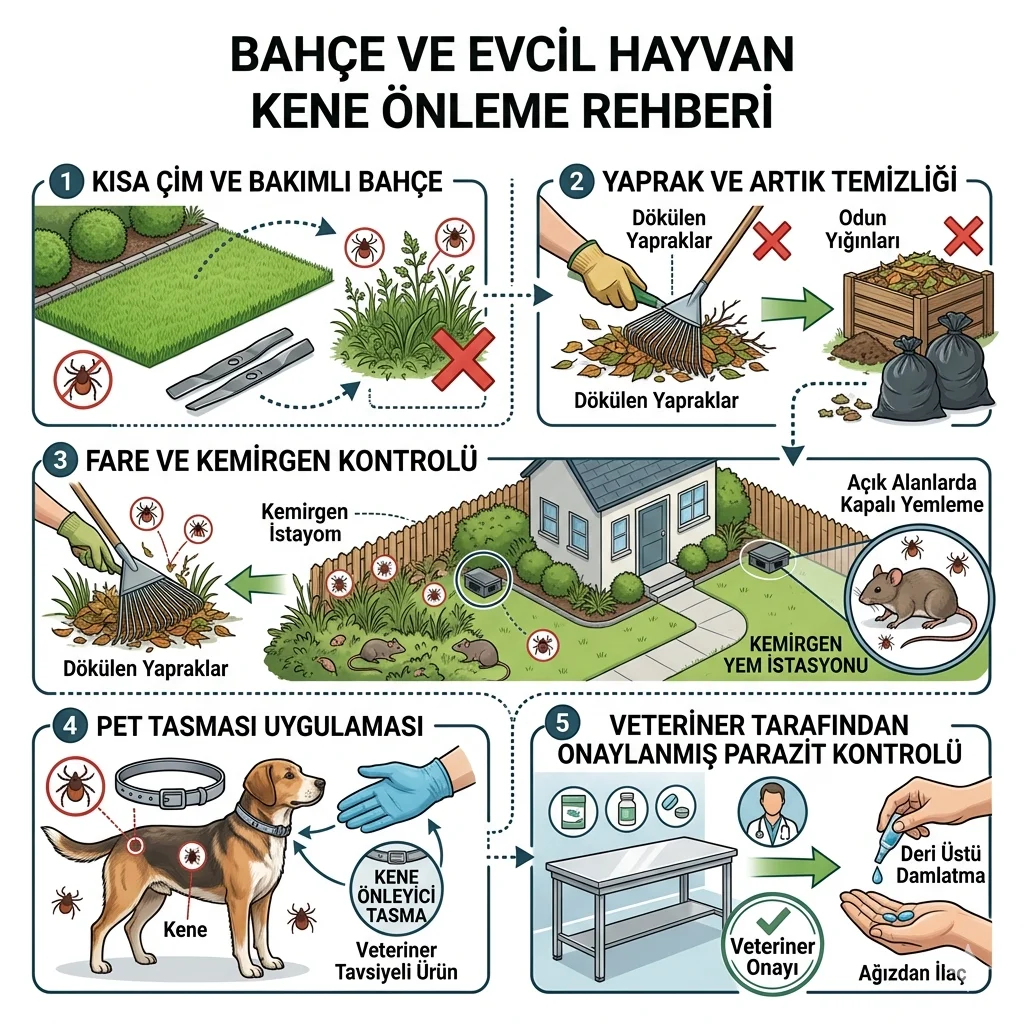
The risk doesn’t stop around the home either. The outdoor area needs to be kept simple with ticks in mind. The grass should be short, the weedy borders cleared, and leaves and branches should not be piled up. The issue is not aesthetics; it is reducing the places where ticks can hide.
Check routine: look every 2 hours
The most critical habit when in contact with the outdoors is the check routine. The body, the hairline, the armpits and the groin should be checked every 2 hours. This interval matters especially if you are staying out in the field for a long time. The earlier a tick is noticed, the easier the job becomes.
Don’t break the order when checking. First the legs, the back of the knees and the waistline, then the armpits, behind the ears, the nape of the neck and the hairline. In children, behind the ears and the hairline are even more important. If the hair is long, part it with your fingers, use a light and, if needed, get help from someone. A quick glance is not enough; a systematic check is needed.
When you get back, shake out your clothes. If possible, take them off outdoors. Then take a shower and check again. A shower doesn’t make it easier to see ticks, but it strengthens the routine. The real job is not to miss what can’t be seen. That is why checking is repeated not only at bedtime but also during the day.
The pet and garden line
If there is a pet, the risk comes in through the door. Dogs and cats can pick up ticks on a walk or in the garden and bring them into the home. That is why a collar, veterinarian-approved treatment and regular checks are needed. The inside of the animal’s ears, the underside of the neck, the armpits and the base of the tail are checked. Looking only at the body is not enough.
In the garden, the goal is simple: don’t let ticks set up home. Keep the grass short, remove accumulated leaves, and check rubbish and woodpiles. Take mouse control seriously; because this is one of the links that feeds the environment that carries ticks. If you only try to kill ticks and leave the environment open, the cycle continues.
If you are someone who works in the garden, the boundary of shoes and trousers becomes even more important. When the work is done, change your clothes and keep the dirty outer layer separate rather than carrying it into the home. If there is a tick on your pet, don’t crush it with your bare hands. Safe removal and veterinary guidance are the better course. The boundary between garden and home should also be a boundary for ticks.
A short field plan for the outdoors
- Before going outdoors, have DEET 20-30 percent or picaridin 20 percent ready.
- Use permethrin 0.5 percent on clothing; don’t apply it to the skin.
- Wear long sleeves, long trousers, light colors and a cap.
- Tuck your trousers into your socks.
- Stay away from meadows, tall grass, forest edges and the edges of rocks.
- Do a body check every 2 hours.
- When you get back, take a shower, shake out your clothes and check the hairline.
- Inspect your pet and your garden as a separate line.
This list is short. But a list that works in the field should be this long. It doesn’t get stronger by being longer; it gets stronger as it is put into practice.
Frequently asked questions
Is using spray alone enough?
No. Spray is important but not enough on its own. Without clothing and checks, gaps remain.
Why do light-colored clothes matter?
Ticks are easier to see. It is hard to pick out a small creature on a dark background.
Why is the hairline checked separately?
Because a tick can stay here unnoticed for a long time. This area is often missed in a visual check.
If there is no garden at home, does the risk go away?
No. Parks, picnic areas, roadsides and contact with pets also carry risk.
Sources
- CDC — Preventing Ticks on People
- CDC — Tick Bite Bot: Choosing a repellent
- EPA — Find the right insect repellent for you
- CDC — Preventing Ticks on Pets
- Tick: Biology, Life Cycle and Health Perspective
- What to Do After a Tick Bite? An Evidence-Based Guide
- Tick Removal Method: The Correct Pull with Tweezers
- CCHF: Crimean-Congo Symptoms and Emergency Triage Guide
Tick prevention methods are not a single trick; they are a chain of regular habits. When the right repellent, the right clothing, the right choice of area and frequent checks come together, the risk drops. If in doubt, don’t wait; go back to the page on correct removal and follow-up.