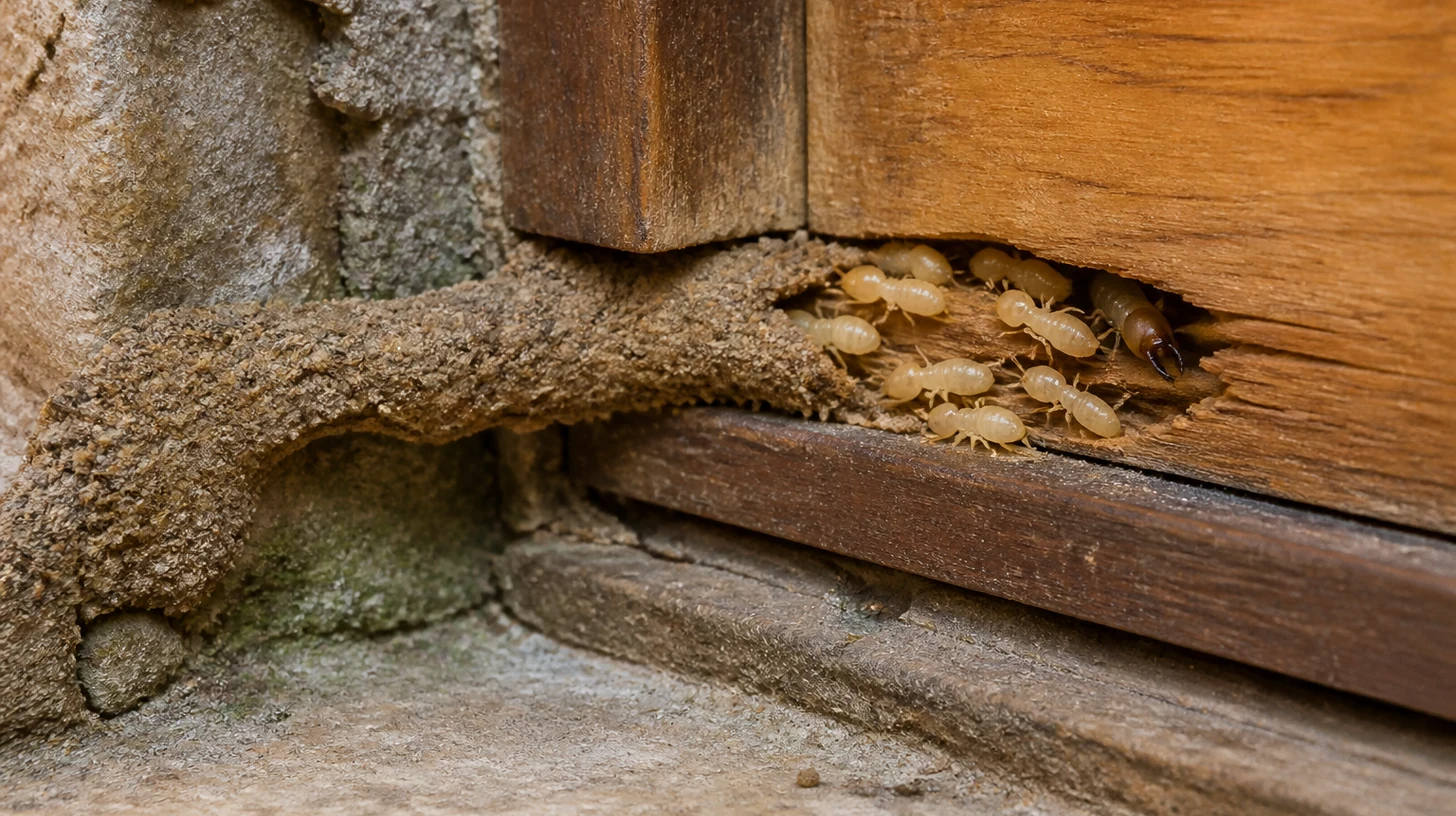
When you suspect termites in the house, the first job is not to spray the insect you see but to record the traces. If you see a thin tube made of mud at the base of a wall, wood that has been hollowed out, or wings shed along a window sill, the entry point and the damage should be investigated. Not every hole in wood is a termite; termites are easily confused with the ant, especially winged individuals. Fix the source of moisture and ask for an expert inspection without interfering with load-bearing wood. The colony may remain inside the wall or the soil.
What is a termite, and which kind are we talking about in the house?
Although the termite is popularly called the “white ant”, it is not an ant. It is a group of social insects that consume cellulose-containing material. In modern classification it is placed together with cockroaches in the order Blattodea. There is no single “house termite” species: subterranean termites connected to the soil and other groups that can found colonies inside wood leave different traces. In describing subterranean termites, this article takes the genus Reticulitermes as an example; it does not confirm the species of an individual seen at home by looking at a photo.
The pale color of termite workers is the reason they are likened to ants. In the colony, workers carry food and dig the galleries; soldiers play a role in defense; winged reproductives can disperse to found new colonies. If there is a hidden line between the source underground and the wood in the building, the few insects in plain sight are only the visible face of the problem. The examples in the ant nest architecture article on the division of labor and nest layout of colonies help in understanding social insects; termite identification and structural damage still require separate expertise.
How do you tell a termite from a flying ant?
Seeing a winged insect does not on its own lead to a termite diagnosis. A termite has four wings of roughly equal length; its antennae are straight and its waist is relatively broad. In a winged ant, the front wings are longer than the hind wings, the antennae are elbowed and the waist is distinctly pinched. The worker termite is wingless and pale. A worker ant can also be wingless, but the structure of the antennae and waist makes the distinction easier. Because the details are small, a sample collected without crushing into a closed container or a clear photograph is more useful to an expert.
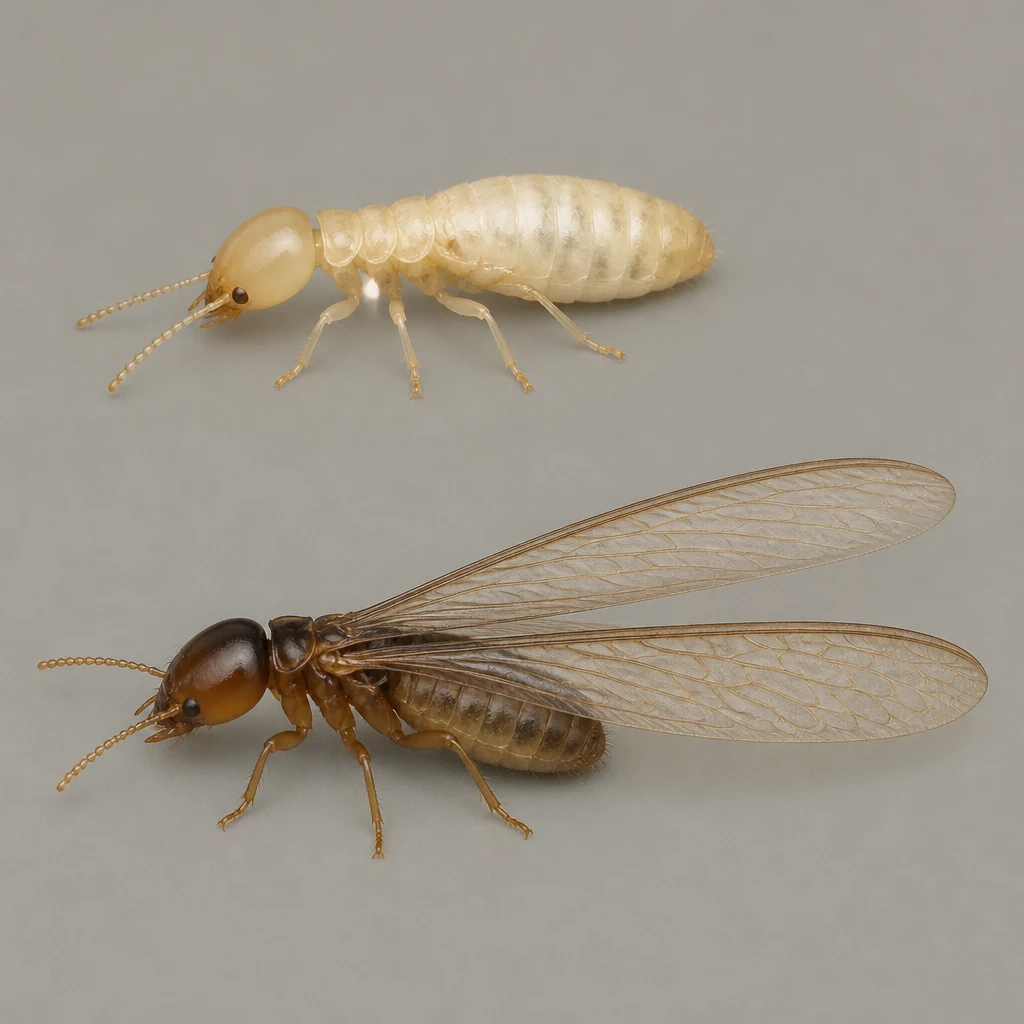
Seeing winged individuals in the house once is not necessarily proof of a colony inside the house; they may have come from outside. But if repeated emergence from inside, wood damage and a mud tube occur together, it should be taken seriously. The image of a “white bug” is not enough either: other organisms can be found in damp wood. Identification is made by assessing the live sample and the pattern of damage together.
Signs of termites in the house: where should you look?
As subterranean termites travel from the moist environment of the soil to wood, they can build sheltered mud tubes made of soil, saliva and secretions over open surfaces. Check around the foundation wall, the basement, the base of columns, door frames and utility penetrations. Photograph the thin line of soil where the wall meets the wood and note its location; don’t scrape it off at random and paint over it. A single tube remnant alone does not prove an active colony, but it does require inspection.
The surface of the wood may look sound while the inside has been hollowed out. If a baseboard, door threshold or frame has gone soft, sounds hollow when lightly probed, or internal galleries are seen during repairs, document the location and show it to an expert. Wood rot, moisture and other wood pests can produce a similar picture. Sawdust-like debris is not in every case subterranean termite droppings; drywood termite pellets, woodworm traces and ordinary construction dust must be told apart.
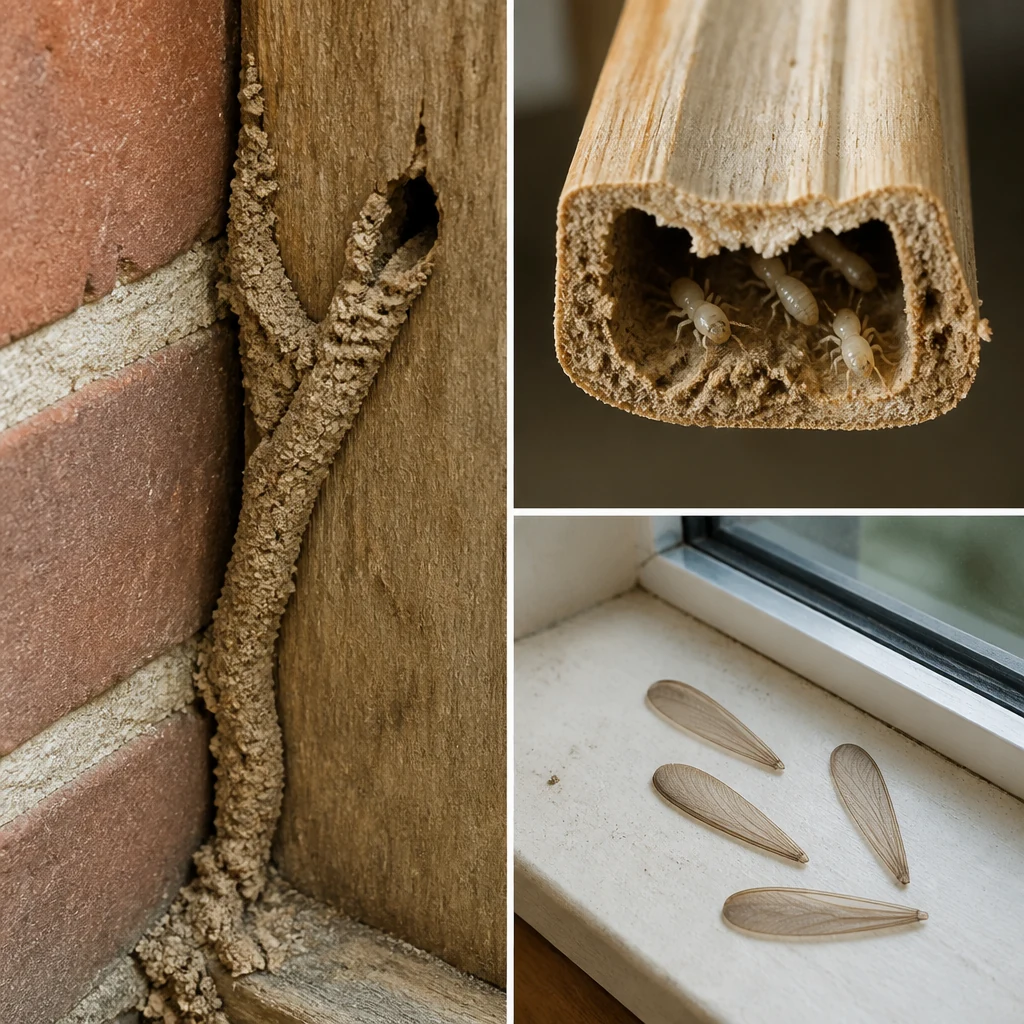
Fine wings collected on a window sill can also suggest that winged individuals have emerged. Assess the wings not on their own but together with a body sample and the traces around them. Especially if there is weakening around a load-bearing beam or a staircase, don’t gloss over it with a cosmetic repair; have the structural safety inspected by a construction expert as well.
Why do the life cycle and the colony matter?
A termite develops from the egg into a juvenile, and from there into individuals assigned to the tasks of the colony. Unlike the moth, it does not undergo complete metamorphosis in the form egg–larva–pupa–adult; there is no pupal stage. Workers, soldiers and reproductives are different roles within the same colony. The examples in the article on ant trail pheromone language offer a comparison for the trail and communication patterns of colony members; the mechanism and identification in termites must be assessed separately. Under suitable conditions, winged reproductives can make swarm flights and start new colonies. The flight season depends on the climate and the species; no single date can be considered valid for all of Türkiye.
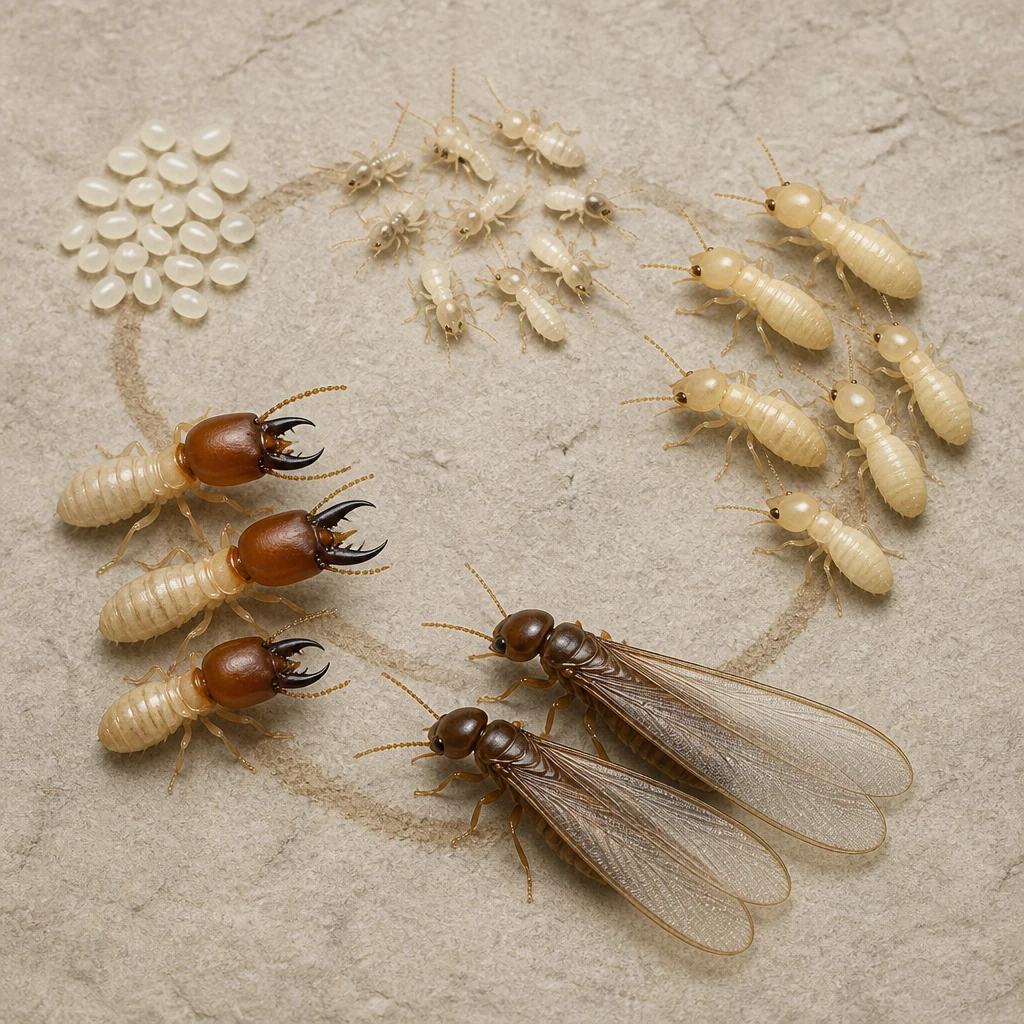
Sweeping up the few winged individuals you can see does not stop the workers connected to the soil or the damage inside the wood. On the contrary, stopping the checks because “the surface is clean” can lead to delays. Recording in an observation log the date of the first sighting, the room, photos and whether there are new wings or tubes helps the person doing the inspection tell activity from old damage.
Habitat and the situation in Türkiye
In nature, termites take part in the nutrient cycle by breaking down dead wood. In the home, the problem is when a wooden structure or stored wood connected to the soil and a damp environment turns into a food line. An article by Türkiye Yaban Hayatı mentions Reticulitermes lucifugus and Kalotermes flavicollis as examples in Türkiye; however, this general list does not show that the insect in your home is one of these species. Region, building material and climate are no substitute for identification. We could not find a reliable statistic giving the indoor termite occurrence rate across Türkiye; we do not carry another country’s rate over to Türkiye.
Basement dampness, a leaking rain gutter, firewood leaning against a wall and wood in direct contact with soil are risk conditions. Moisture management also matters for the question why do cockroaches come indoors; but with termites, the wood-soil connection must be investigated separately. In a multi-story apartment building, too, the problem may not be limited to the inside of the apartment. Basement storage rooms, the shared utility shaft, the garden wall and wooden pieces on the ground floor can form a connection. For this reason, instead of spraying in a single apartment, plan a common-area inspection with the building manager. Don’t apply chemicals in a neighbor’s apartment without their knowledge.
Health perspective: risk and prevention
Termites do not feed on human blood; the main threat in the home is not a bite but damage to wood and the structure. The risk is a weakened stair or beam, the cost of repairs and the chemical exposure that can result from incorrect pest treatment. The US Environmental Protection Agency (EPA) reports that termites cause billions of dollars of structural damage in the US every year. We could not find a reliable statistic giving the indoor termite occurrence rate across Türkiye; we do not carry another country’s rate over to Türkiye.
For prevention, do the following tasks in order:
- Repair roof and gutter leaks; don’t let water collect around the foundation.
- Fix water leaks in the basement, and don’t block ventilation openings.
- Don’t store firewood, pallets or wood waste against an exterior wall.
- Have wooden parts in direct contact with soil inspected; plan suitable physical separation with an expert.
- Seal foundation cracks and openings at utility penetrations with suitable material.
- Periodically check the door threshold, baseboards, basement and window surroundings.
- Photograph any tube and insect you find, and keep a record of the date and location.
- Inform the building management about shared storage rooms and the garden wall.
These steps do not mean you are treating an existing colony. Reducing moisture and controlling entry points lower new risks; if there is an active infestation, a thorough inspection and an appropriate intervention are needed. Don’t use borax, diesel, acid or general-purpose sprays at random in the home. Off-label application in an environment with children, pets and drinking water can also cause harm.
Pesticides and the professional intervention threshold
Because termites feed on cellulose, there are bait systems aimed at subterranean termites; this does not mean taking the ordinary ant bait from the how to get rid of ants article and placing it at the base of a wall. Professional termite baits are run with monitoring and a suitable active ingredient. A barrier treatment applied to the soil and wood protection are also separate options. The EPA stresses that incorrect soil application carries the risk of contaminating the house or nearby drinking water sources. A US product approval does not count as a permit for use in Türkiye; verify local label and authorization conditions with the applicator.
| Observation | First move | Professional threshold |
|---|---|---|
| A single winged insect, no damage | Keep a sample and photo, tell it apart from an ant | Inspection if indoor emergence recurs |
| Mud tube at the base of a wall | Record its location and date | Call an expert for termite identification |
| Internal hollowing in more than one piece of wood | Don’t cover the damage, look for the moisture source | Call a pest expert and a structural expert together |
| Weakness in a load-bearing beam or stair | Stop putting stress on the area | Have the structural safety inspected without delay |
| New traces in the apartment basement | Inform the management and the neighbors | Ask for a comprehensive inspection of common areas |
Ask the company in writing not just for a price for “spraying” but for the species or group identification, the entry points, the scope of the method to be used, child/pet safety and a monitoring plan. The label of the product to be used and the applicator’s authorization must be clear. If new traces are seen after a treatment, have it reassessed with the records rather than having the treatment blindly repeated.
Frequently asked questions
How can you tell if you have termites in the house?
Mud tubes, wood hollowed out from the inside and shed wings are the main signs. A single sign is not a definitive diagnosis; wood rot or a flying ant can also be confused with it. Keep the image and the sample and ask for a professional inspection.
What is the difference between a termite and a flying ant?
A termite’s wings are roughly equal in length, its antennae are straight and its waist is broad. An ant’s front wings are longer, its antennae are elbowed and its waist is pinched. A close-up photo and a sample are useful for telling them apart.
Do termites bite people?
It is not an organism that sucks blood from people in the home. The real problem is damage to cellulose-containing material and the structure, plus the risk of inappropriate chemical application. Rather than handling the insect with bare hands, have it identified from a sample.
Can termites in the house be destroyed with a spray?
Killing the visible insects does not prove the hidden colony has been reached. Repair the leak, record the traces and ask for a plan to be prepared according to the species and the building conditions. Don’t spray pesticides at random.
Can termite bait be used in every home?
No. There are suitable bait systems for subterranean termites; but the species, the entry line and the building conditions determine the method. Don’t confuse it with general ant bait; turn to a licensed product and a trained applicator.
Sources
- US Environmental Protection Agency (EPA): Termites — How to Identify and Control Them. Identification, prevention, bait and soil treatment safety; economic damage data is for the US.
- University of Kentucky Entomology: Termites and Your Home. Structural signs and the context of professional inspection.
- Türkiye Yaban Hayatı: Termites, Their Social Lives and Their Species in Türkiye (in Turkish). Species examples from Türkiye; not used as a nationwide prevalence statistic.