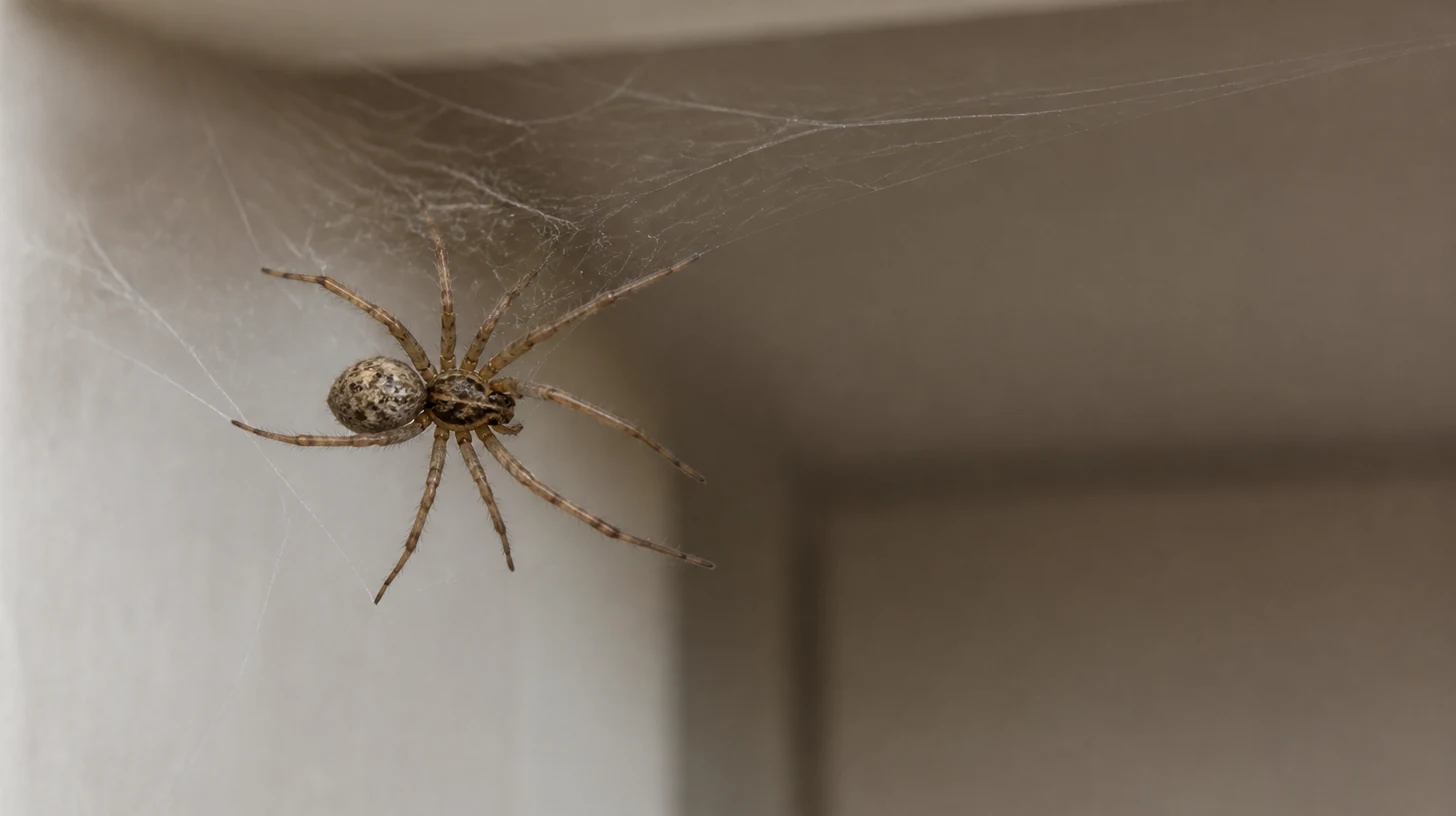
When you see a spider in the house, the first question is usually “Is it harmful?” Most spiders stay away from people and hunt small arthropods in the home; still, it is not right to pin down the species and the health risk just by looking at a photo. Don’t touch the spider with bare hands. If there are a few webs or repeated sightings, first check entry gaps, cluttered hiding places and other small insects in the home. In this article, you will start with the basic ways of identifying insects in the house and find the steps for managing a spider problem calmly and safely.
What are spiders in the house?
“Spider” is not the name of a single species. Spiders make up the order Araneae; they belong to the class Arachnida, within the arthropods. Scorpions and ticks are also in the arachnid class, but they are not spiders. The basic clues for telling them apart from insects are body plan and number of legs: spiders have eight legs and two main body regions in the adult stage; insects have six legs and three body regions.
In everyday language, “house spider” describes different spiders seen inside the home. On its own, this expression does not identify a specific species such as Tegenaria domestica. Different species may be found in different climates and habitats in Türkiye; giving a family or species name without a photo, location, size and behavior information would not be reliable. For the basic features that separate insects from arachnids, you can also look at the insect identification guide. For this reason, this guide does not present size, color or life cycle information as if it belonged to a single species.
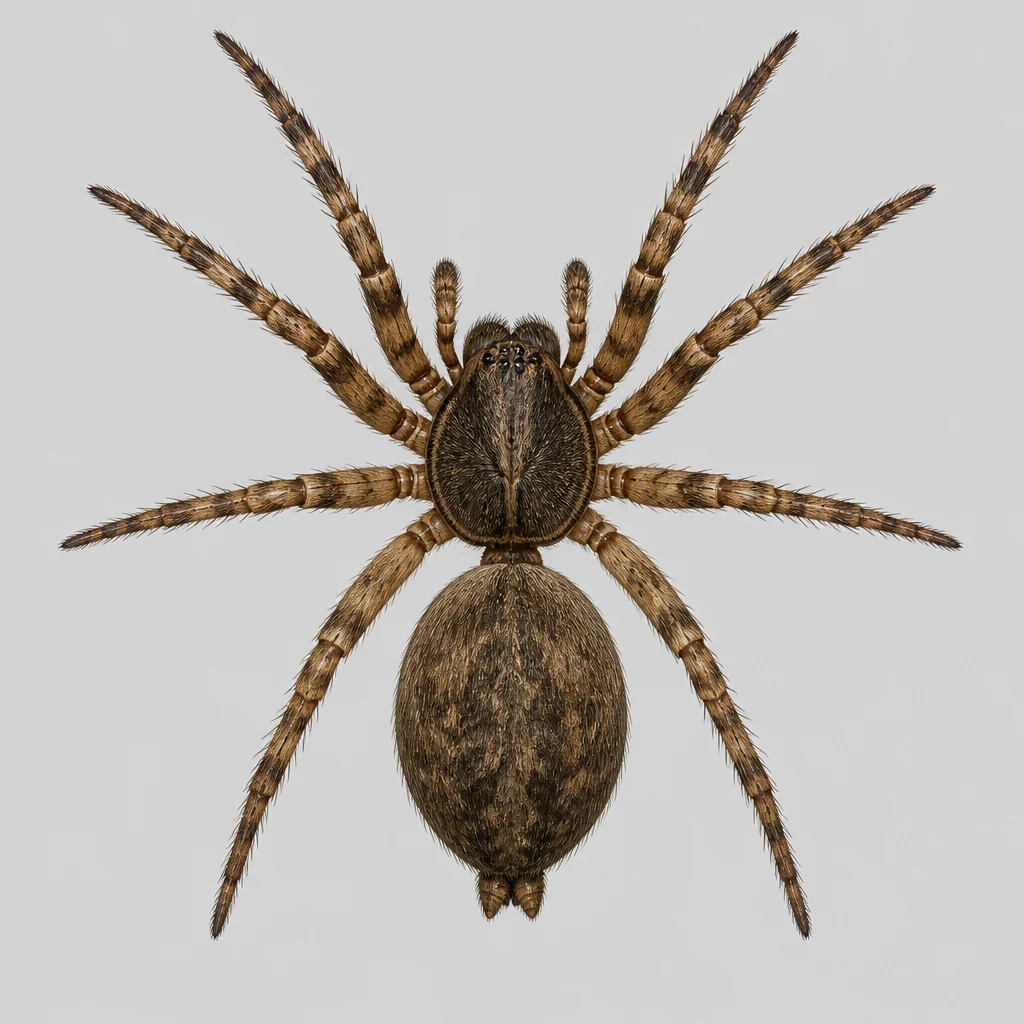
Spiders may build webs, actively search for prey or wait in a suitable corner. Not every web has the same shape; the web of some species resembles a funnel, some make irregular webs, and some spiders do not use a regular web to catch prey. The absence of a web does not prove that there is no spider in the room; seeing a web does not necessarily mean breeding or infestation either.
How can you tell there are spiders in the house?
The most visible sign is the web. Ceiling and window corners, behind furniture, storage shelves, the basement and rarely used rooms can be checked regularly. Dust building up on a web shows that it has not been cleaned for a long time; on its own it does not tell how long the spider has been there or how many individuals there are. Small egg sacs near the web also suggest that new individuals may emerge; instead of crushing the sac by hand, clean it up in a closed way.
The place where you saw the spider is not enough on its own to identify the species. Color and size can overlap between species; light, angle and a phone camera also change its appearance. A clear photo taken up close but from a safe distance, plus the province where it was found, the room, its approximate size and the shape of the web can help an expert identify it. Don’t try to catch or pick up a spider you suspect may be dangerous.
Confusing them with insects is also common. A spider has no antennae and no wings; it has eight legs. However, counting legs can be hard on a young, damaged or unclearly visible animal. If you are not sure, it is safer not to handle it and to show its photo to an expert.
Why do spiders appear in the house?
There are several possible explanations for a spider being in the house: it may have come in from outside through a gap around a door, window or plumbing; there may be other small animals in the room for it to hunt; there is a quiet, rarely disturbed area where it can hide. It is also possible for it to be carried in with firewood, boxes, plant pots or stored items. None of these on its own means the house is dirty.
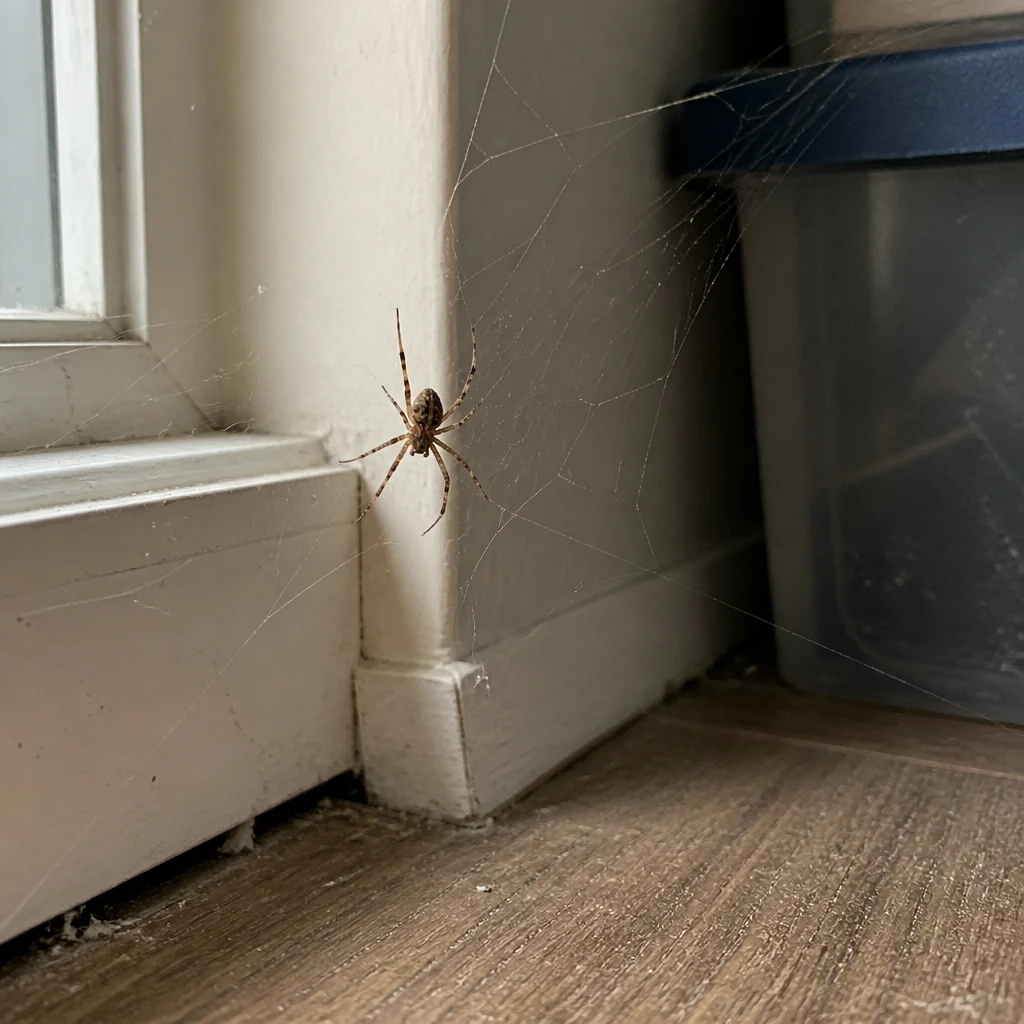
A web at the edge of a window does not prove that the entry point was necessarily the window. The spider may have been somewhere else in the room and moved there. Random sightings of individual spiders and frequent, recurring web building in the same area are different situations. In the second case, examine the small insects that support the spiders, the entry gaps and the hiding places together.
I could not find nationally comparable prevalence data measuring what share of homes in Türkiye have spiders. For this reason, it would not be right to generalize spider or bite rates from other countries to homes in Türkiye.
The spider life cycle
The spider life cycle varies from species to species. The female spider may protect her eggs inside a silk sac; the shape of the sac and how it is carried differ between species. The young that hatch from the eggs are small spiders and molt as they grow. There is no single value applicable to all spiders for time to maturity, number of eggs and number of generations per year.
Seeing an egg sac in the house does not mean hundreds of spiders will spread through the room. The number of eggs in the sac and the young’s chances of survival vary. If there is a sac, using gloves or a tool, put it in a closed bag out of reach of children and pets and place it in the trash outside the home; don’t squeeze it with bare hands. If recurring sacs are seen in the same area, also check the surrounding cracks and stored items.
Do spiders bite people, and is there a health risk?
Spiders use venom to hunt and defend themselves; this does not mean every spider seen in the house is dangerous to people. A bite mostly happens when the spider is cornered or held. The bite of some species can be medically significant, but calling a skin mark a spider bite based only on its appearance is not reliable. Redness, pain and swelling can also occur for other reasons.
Don’t hold a spider with bare hands; check clothes, bedding or shoes before using them. If a bite is suspected, keep the area clean and don’t try to catch the spider. If there is severe or rapidly increasing pain, widespread swelling, difficulty breathing, fainting or a deterioration in general condition, get emergency medical help. Even if the symptoms are mild, consult a health professional if they are getting worse. Don’t rely on internet photos or home remedies for diagnosis and treatment.
How do you get rid of spiders in the house?
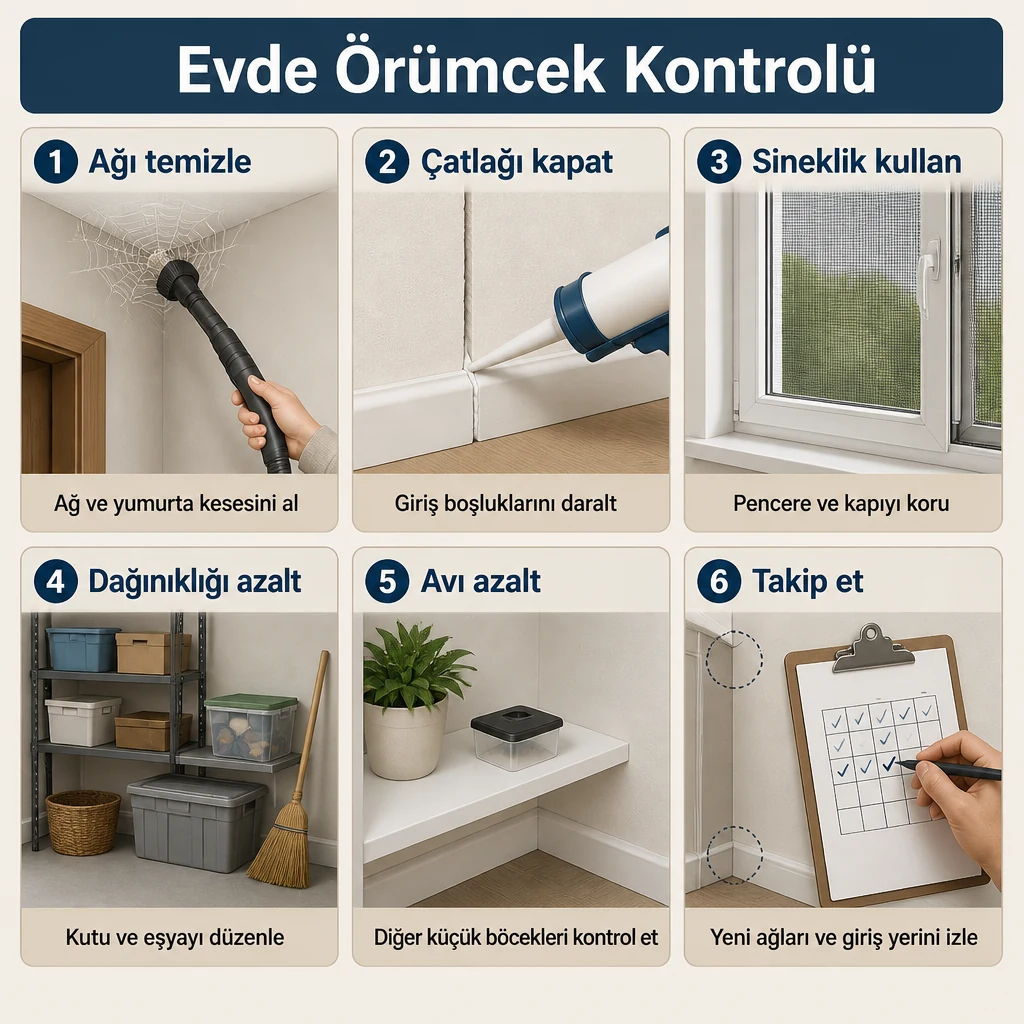
If you have seen a single spider, the lowest-risk way is to pick it up with a container and cardboard, without bringing your hand close, and release it outside. While doing this, don’t clap your bare hand over the spider; don’t approach an animal you are not sure about or one that moves fast. Alternatively, you can pick up an accessible web and spider with the narrow nozzle of a vacuum cleaner, then empty the canister or bag in a sealed way.
For prevention and control, apply these concrete steps:
- Repair tears in window and door screens; seal the gaps under doors and around plumbing with suitable material.
- Regularly clean webs in ceiling corners, along baseboards, behind furniture and on storage shelves.
- Don’t pile boxes, firewood and rarely used items against walls; store them closed and orderly.
- Check shoes, gloves and textiles that have not been used for a long time before putting them on.
- Reduce the small insects that could be the spider’s prey; don’t leave spills and uncovered food out.
- Check corners and cracks in the basement, storage areas and unused rooms at set intervals.
- Don’t handle a spider or egg sac with bare hands; keep children and pets away during cleaning.
- Note the location and frequency of new webs; if they keep forming in the same spot, investigate the entry area.
This approach, as in flea control in the house, focuses not only on the visible animal but on the conditions that keep the problem going. The logic of reducing the insect source also matters in moth control in the house. You can also find the approach of dealing with the surroundings of the house and the entry points together in the guide to getting rid of cockroaches. However, the bait method carried back to a colony, as with ants, is not used for spiders. Placing bait stations for spiders is not a suitable general solution.
Pesticide use and the threshold for professional support
Spraying aerosol throughout a room for a single spider or web creates unnecessary exposure in most cases; it also does not remove the spider’s entry point or its prey. If you need to use a pesticide, apply only a product registered for the target use, in the place and at the dose written on the label. Protect children, pets, food and aquariums according to the label instructions; don’t mix products with each other and don’t fog at random indoors.
| Situation | What should you do? |
|---|---|
| An occasional single spider or an old web | Remove it safely, clean the web and check entry gaps. |
| Frequently recurring webs in the same room | Investigate prey insects, cracks and stored items; monitor for a while. |
| Many spiders or egg sacs | Also examine inaccessible areas and neighboring storage areas; call a professional if necessary. |
| A spider of uncertain species whose risk is a concern | Don’t touch it; take a photo from a safe distance and consult a local university, museum or qualified expert. |
| Severe or worsening symptoms after a bite | Go to a health facility instead of trying remedies at home. |
In apartment buildings, the basement, shared storage, the stairwell and plumbing penetrations can be shared hiding or entry areas. If removing the webs in a single apartment is not enough, cleaning the common areas and sealing the gaps can be discussed with the building management. Instead of treating every apartment at random, recording where and how often spiders are seen helps choose the right intervention.
Frequently asked questions
Does seeing spiders in the house mean the house is dirty?
No. A spider may be in the house because it found an entry gap or prey; on its own it does not show the level of cleanliness. Regular cleaning makes webs visible and can reduce hiding places.
Are there no spiders in a room without spider webs?
There may be. Not every spider builds a visible web to catch prey, and webs can be built in places that are not easily noticed. Not finding a web is not proof that there are no spiders at all in the room.
What should I do if I find a spider egg sac in the house?
Without touching it with bare hands, put it in a closed bag with gloves or a tool and take it out to the trash outside the home. If it recurs in the same area, also examine boxes, cracks and stored items.
How can I tell a spider bite?
A spider bite cannot be diagnosed from redness or swelling alone; other bites and skin problems can look similar. With severe, widespread or worsening symptoms, get medical help.
When is pest treatment needed for spiders?
When a single spider is seen, routine pest treatment is generally not the first option. If there are recurring high numbers, inaccessible nesting areas or unidentifiable animals, ask an authorized pest control professional for an on-site assessment.
Sources
- TÜBİTAK Bilim Genç, “Venomous Spiders of Türkiye” (in Turkish): https://bilimgenc.tubitak.gov.tr/yeryuzu-turkiyenin-zehirli-orumcekleri
- University of California Statewide Integrated Pest Management Program, “Spiders”: https://ipm.ucanr.edu/PMG/PESTNOTES/pn7442.html
- Türkiye Yaban Hayatı (Türkiye Wildlife), “Tegenaria domestica” species record (an example species record only; not an identification for every house spider in this article; in Turkish): https://turkiyeyabanhayati.org/species/detail/tegenaria-domestica
- CDC/NIOSH, “Venomous Spiders at Work”: https://www.cdc.gov/niosh/outdoor-workers/about/venomous-spiders.html