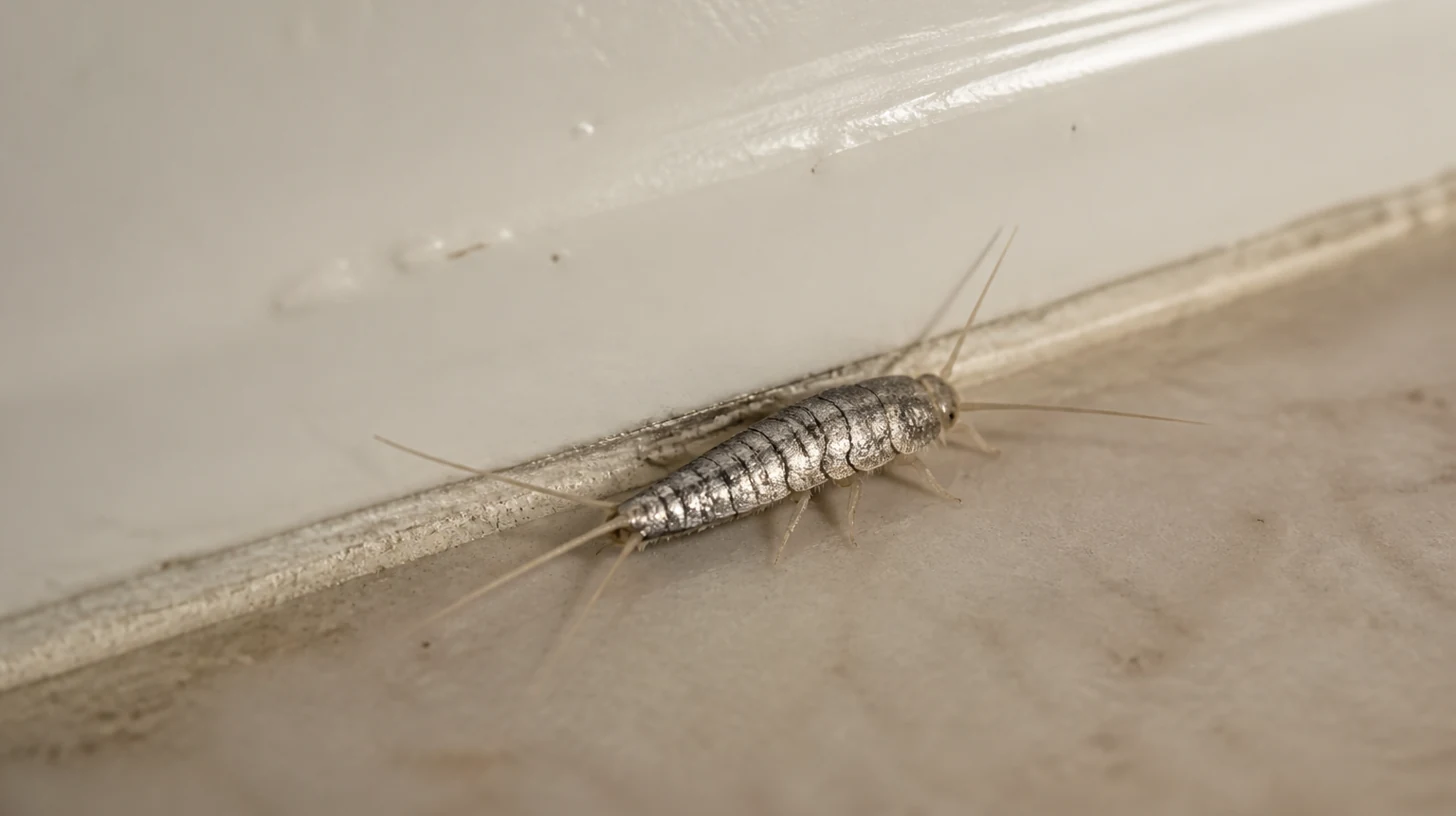
Silverfish in the house usually do not mean the house is dirty; they show that moisture, dark cracks and starchy sources such as paper and cardboard have gathered along the same line. The short answer is this: don’t confuse this animal with a blood-feeding bed pest like bed bugs or a species that jumps and bites like fleas in the house. The silverfish is not an insect that targets people; the real issue is that a suitable hiding and feeding area for it persists in the home.
What are silverfish in the house?
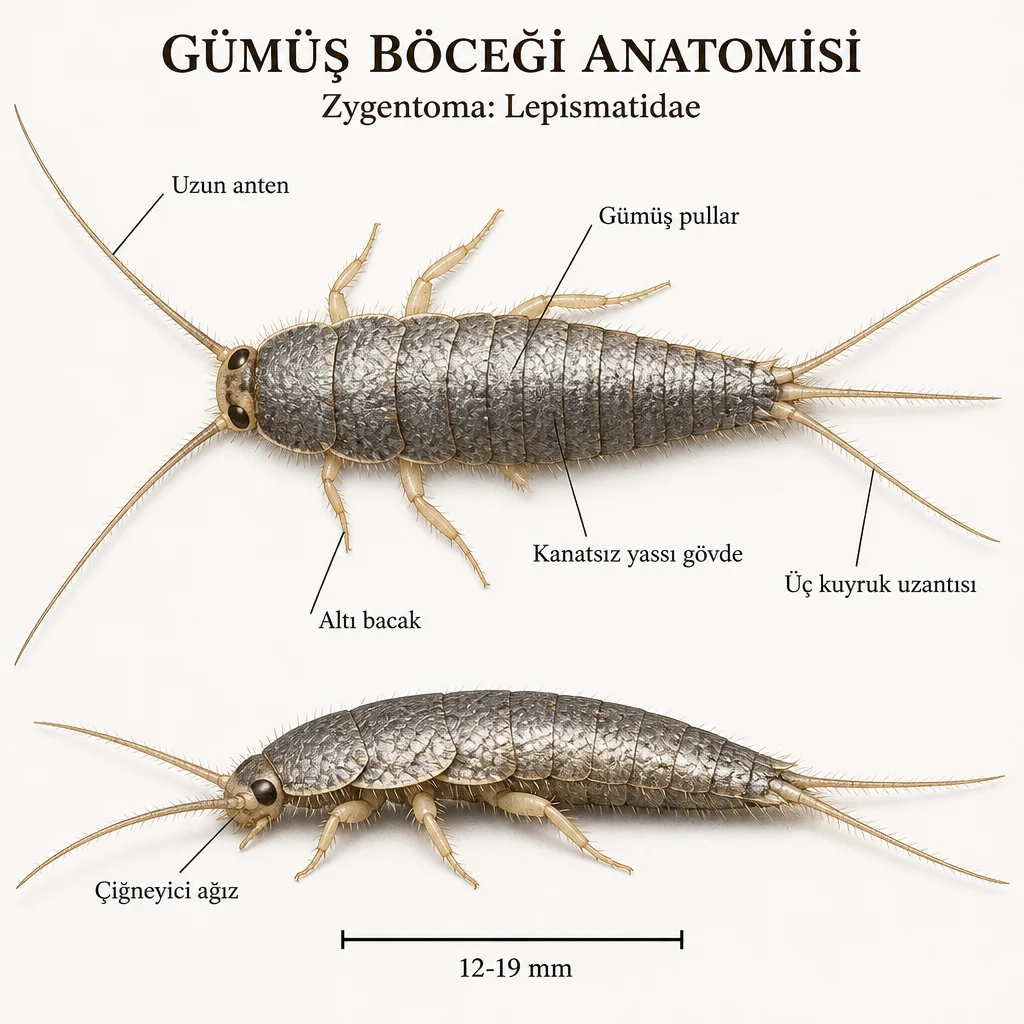
The silverfish, scientific name Lepisma saccharina, is a wingless insect belonging to the order Zygentoma and the family Lepismatidae. In everyday Turkish it is also known by names that translate as “silverfish bug”, “damp bug” or “moisture bug”. Its body is flat, tapers toward the rear and is covered in silvery scales. It has long antennae and three tail filaments at the rear end. These three tail filaments are a practical sign for telling it apart from a small cockroach nymph or an earwig.
The adult is usually active at night. When the light is turned on, it quickly escapes into a baseboard gap, under a bathroom cabinet, behind a cardboard box or into a crack in a bookshelf. That is why seeing the odd one during the day may suggest wider activity at night; but a single sighting does not mean the house is infested.
Why do silverfish appear in the house?
The basic line is moisture. The silverfish does not like dry, open and frequently disturbed areas. The bathroom, under the kitchen sink, the basement, the laundry room, under the washbasin, a wall with a plumbing leak, behind baseboards and cupboards that are not opened for a long time make more suitable areas. If there is a musty smell, bubbling paint, mold traces or a silicone seal that stays wet all the time in the house, you have created a haven for silverfish.
The second line is food. The silverfish goes for materials containing sugar and starch; that is why paper, book bindings, wallpaper paste, cardboard, some textile fibers, crumbs and dust lines matter. Old document boxes, moving boxes, the undersides of bookshelves that are not opened for a long time and the insides of bed bases can provide not just hiding places but feeding areas too.
The third line is quiet. It is hard for it to get a foothold in a place that is cleaned often, ventilated, gets light and where items are moved. On the other hand, if the back of a cupboard, under the washing machine, a pile of books and boxes and a cracked baseboard line stay undisturbed for a long time, the same area remains available to new individuals as well.
How can you tell you have silverfish?
The most reliable sign is reading the insect’s shape correctly. The silverfish is wingless, flat, moves fast and escapes with a fish-like wriggle. Its color is a grey-silver tone; juveniles may look paler. If the long antennae and the three filaments at the rear are seen together, the identification becomes stronger.
The indirect signs in the home are these:
- Small, irregular surface feeding marks on books, paper, cardboard or wallpaper.
- A fast, silver-colored insect seen at night along bathroom and kitchen baseboards.
- Recurring activity under the bed base, behind cupboards and around cardboard boxes.
- Small fecal spots or shed scales in a damp area.
- Occasional sightings that recur in the same room over weeks.
The important distinction here is this: silverfish are not read through blood traces on the bed, bites in a line or host-seeking behavior. If these signs are present, the possibility of bed bugs is considered separately. If the line of kitchen counter, food crumbs and egg capsules dominates, you need to look on the cockroach side.
Why does the life cycle drag things out?
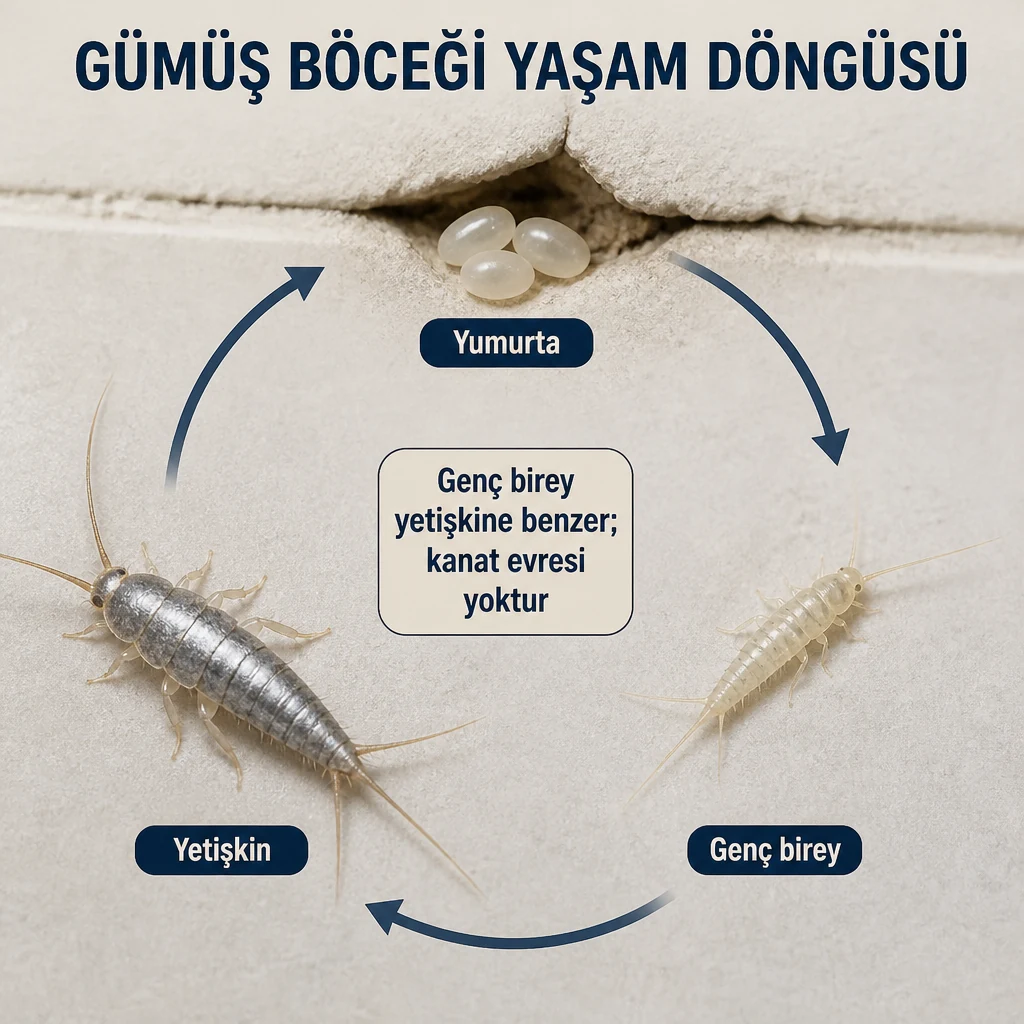
The silverfish hatches from an egg, becomes a juvenile and grows in a way that resembles the adult. It has no distinct larva-pupa transformation like butterflies or flies. The juvenile can be small and paler, but its general body plan is close to the adult’s. That is why saying “I only saw small ones” does not mean you saw a different species.
What prolongs the life cycle is that the hiding place is preserved. Crushing a few adults or spraying may not deal with the eggs and juveniles inside the crack. Unless the moisture, the cardboard load, the dust and the crack gaps are reduced, the problem reappears along the same line. The common emphasis of UC IPM and university extension sources comes together here too: lasting control is not a single move but management of the environment.
Health perspective
Risk
The silverfish is not considered an insect that bites, stings or sucks blood from people. That is why, when you see itching, a raised bump or a line of spots on the skin, silverfish are not the only explanation. In such a case, why mosquito bites itch, fleas, bed bugs, allergies or other skin causes are assessed separately. If there is widespread redness, signs of infection, shortness of breath or a severe reaction in a child, you need to see a health professional.
No robust, Türkiye-focused human health rate could be found for a topic-specific health prevalence statistic. For this reason, data on another species was not carried over here. The numerical information that can be verified is mostly about identification and biology: the adult silverfish is reported to be in the range of about 12-19 mm; university extension sources give high-humidity, dark indoor spots as typical habitat. From the home’s point of view, the practical risk is damage to paper, books, archives, wallpaper and some textile surfaces rather than disease.
Prevention and control
The backbone of control should be “environment first”. Targeting only the insect while the moisture continues gives weak results. If there is a leak in the bathroom, it is repaired, the area under the washbasin is dried, the fan or ventilation is run, and a wet mop is not left in a closed space. Boxes and old documents are reduced. Food crumbs, flour, sugar and dry pet food are kept in closed containers.

First control steps at home
The steps below are a safe first line of response:
- Look for leaks in the bathroom, under the kitchen sink, in the laundry area and in the basement; repair the leak.
- Dry surfaces that keep getting damp; increase ventilation.
- Move cardboard boxes into plastic boxes with lids or throw out the unnecessary ones; reduce old documents.
- Vacuum the dust under old newspapers, archive paper and books.
- Seal baseboards, wall cracks and pipe penetration gaps with suitable filler.
- Keep flour, sugar, dry pet food, textiles and starchy food in closed containers.
- Disturb the area under the bed base and behind cupboards at set intervals; don’t leave areas quiet for a long time.
- If you see them again in the same spot, note the date and place; don’t treat the whole house with pesticides at random.
This logic is similar to the principle of cutting off the source in the how to get rid of ants guide: you manage the route, the food and the entry together. The moisture-food-crack trio in the How to get rid of cockroaches article applies here too; only the target species and the choice of product are different.

Pesticides, bait and the professional threshold
With silverfish, pesticides are not the first or only solution. If a labeled product is to be used, nothing is done without reading the target pest, the application area, child and pet safety and the waiting period. Products sold as boric acid, diatomaceous earth, gel or bait can create a risk when used without control, especially in homes with children, cats, dogs, birds and aquariums. It is not right to apply the product near drains, food bowls, toys, beds or food preparation surfaces.
The threshold for professional support is as follows:
| Situation | What does it mean? | The right move |
|---|---|---|
| A single individual, a single room | It may have come from outside or there may be a limited hiding place | Check moisture and cracks, keep monitoring |
| Recurring in the same spot for weeks | There may be an established hiding line | Open up the source area, clean, dry, seal |
| Several rooms and heavy activity at night | The likelihood of spread increases | Assess the apartment building/basement line too |
| Damage to books, archives or textiles | The food source may be continuing | Change the storage arrangement, use dry closed boxes |
| A home with a baby, pets or someone with respiratory sensitivity | Chemical risk is more critical | Don’t use products at random, consult an authorized professional |
In apartment buildings, thinking only about a single apartment is sometimes wrong. A basement, a shared storage room, a plumbing shaft, a laundry room or a damp space under the stairs can be the source area. If the problem comes from a shared line, treating only one bathroom gives a temporary result.
Frequently asked questions
Is it bad to see silverfish in the house?
A single individual is not a reason to panic. But if you keep seeing them in the same room, you need to check the line of moisture, cracks, paper and cardboard, and dust.
Do silverfish come to the bed?
The bed is not their main target. They may be seen if there is moisture, dust, cardboard, a bed base gap or paper storage around the bed. If there are complaints of bites, fleas and bed bugs should be ruled in or out separately.
Does bleach get rid of silverfish?
Bleach is not a lasting control plan. It may clean the surface, but it does not deal with the cracks, eggs, moisture source and hiding place. It also creates an unnecessary risk of chemical fumes in a closed bathroom.
What is the best first move against silverfish in the house?
The best first move is to find the moisture source, dry the area, reduce the load of cardboard and paper, and seal the baseboard/pipe penetration gaps. Product use is considered after this, and in line with the label.