The mosquito is a group of insects belonging to the family Culicidae within the order Diptera. There are more than 3,500 species worldwide; the fossil record goes back about 190 million years, to the Cretaceous period. Its Turkish folk name, “sivrisinek”, comes from its long, pointed proboscis. In other words, “sivri” (pointed) and “sinek” (fly) are combined; but this animal is not an ordinary fly — with its blood-feeding females, its water-dependent life cycle and its many vector roles, it forms a separate group. This article is a general guide; for the detail people ask about most often in daily life, see our article Why Do Mosquitoes Bite Some People More? The ETM Complex.
Mosquito Species: The 3 Main Genera Found in Türkiye
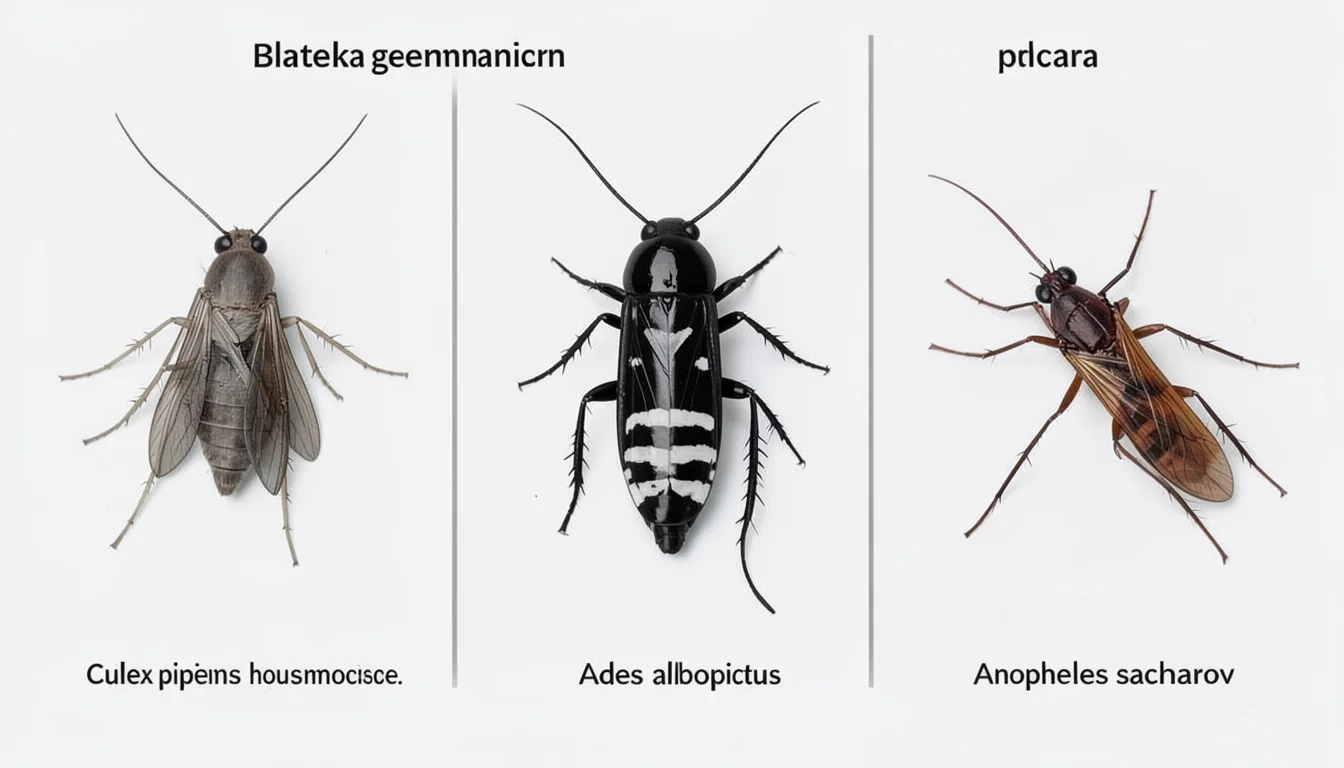
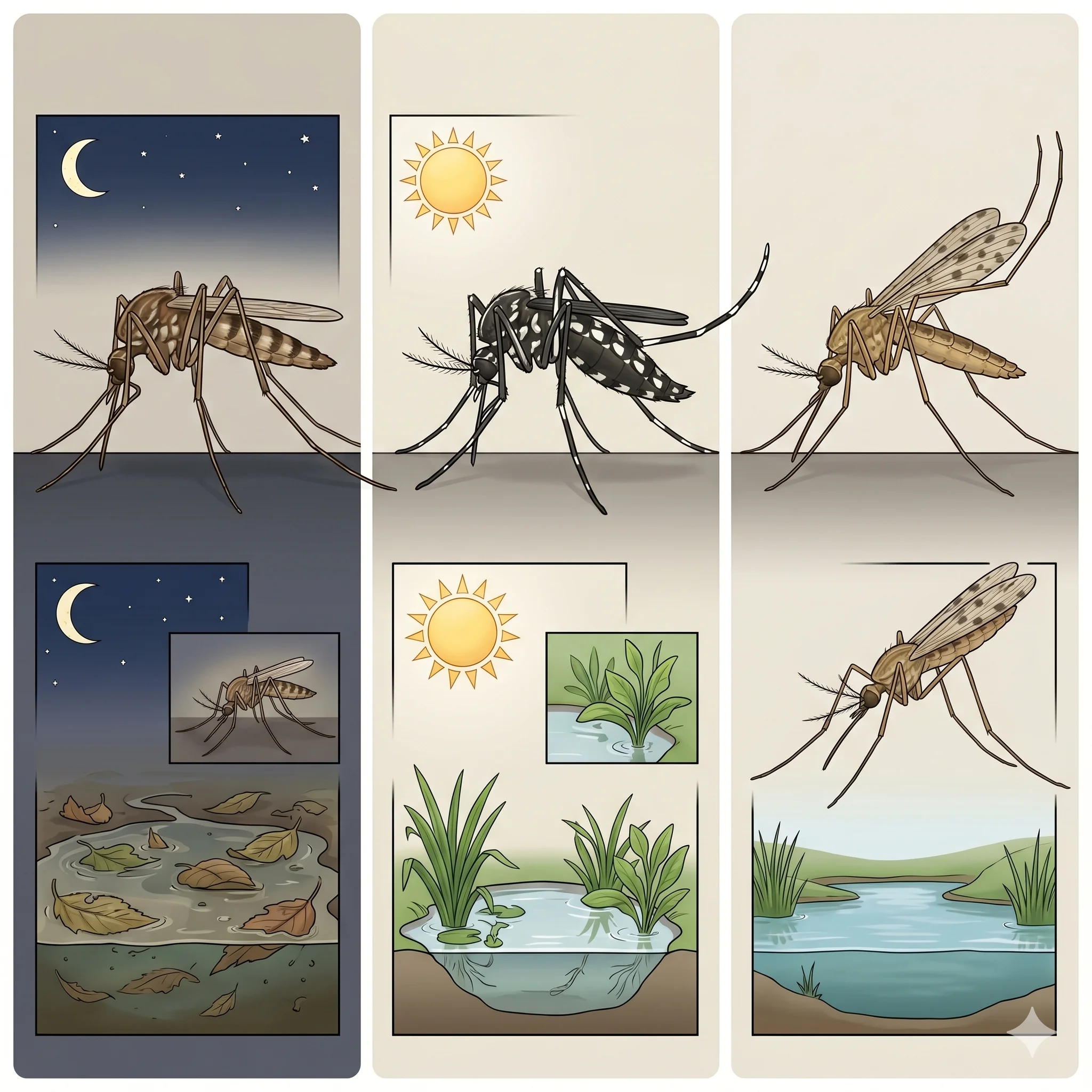
When it comes to mosquitoes in Türkiye, the three genera looked at first in the field are Culex, Aedes and Anopheles. Their appearance, the hours they are active and their breeding preferences differ. Knowing this difference matters, because under the same name “mosquito” there are both species that are a nuisance indoors and species monitored for health reasons. Telling species apart is not just an academic detail. In practice, it determines source control, surveillance and the method of protection. Culex is generally associated with the night, Aedes with its daytime peak, and Anopheles with its distinctive posture and with malaria.
Culex
Culex, especially Culex pipiens, is the most common type of house mosquito in Türkiye. It looks grey-brown, is active at night and loves stagnant water. Pot saucers, buckets left outside, rainwater puddles and the surroundings of drains are suitable sites for it. Females need blood for egg development; so biting behavior is related not to health but to the need to reproduce. The genus Culex is important with regard to West Nile virus. That is why its “small and ordinary” appearance is misleading; it is monitored for surveillance purposes.
Aedes
Aedes stands out especially through Aedes albopictus, the Asian tiger mosquito. Its black-and-white striped appearance is easy to recognize. It is more active in the morning and evening hours; it can hide throughout the day and feed at short intervals. It can use even the smallest pool of water. Small volumes such as pot saucers, the inside of tires, containers, buckets and gutters are enough for it. Its spread in Türkiye since after 2011 has made this genus important. It is a theoretical vector for dengue, Zika and chikungunya; but widespread local circulation and theoretical risk are not the same thing.
Anopheles
Anopheles species, especially Anopheles sacharovi and Anopheles superpictus, stand out with their long legs and their posture of resting with the body tilted upward. They are the classic vector of Plasmodium spp., the cause of malaria. In Türkiye, malaria has been considered absent in terms of local transmission since 2012; the cases seen are imported cases. This information is important, because the right language of surveillance is needed instead of panic. Knowing Anopheles means reading the history of malaria and the success of its control correctly.
Mosquito Biology and Life Cycle
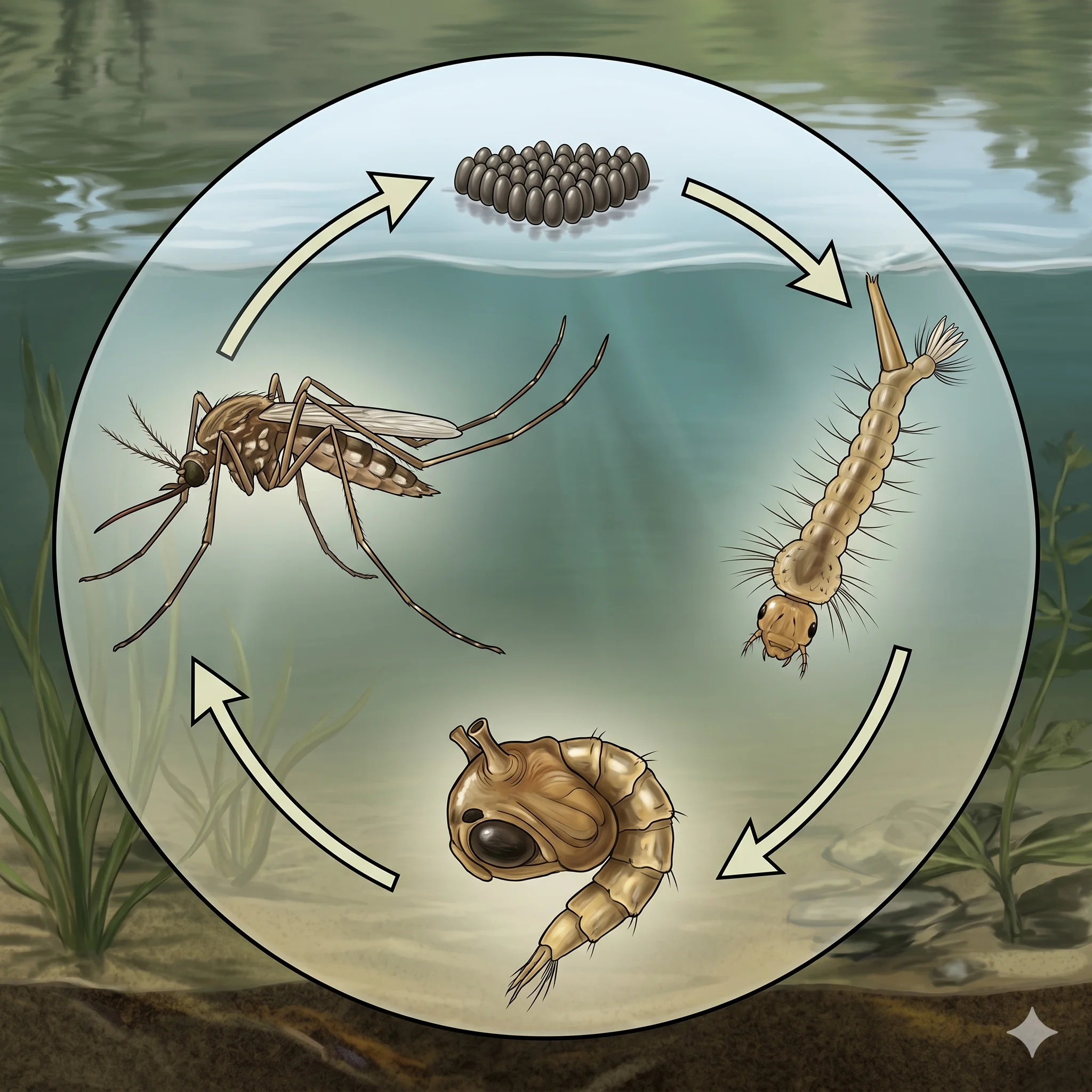
A female mosquito can lay roughly 100-300 eggs at a time. This number fluctuates with species, temperature and food conditions. She can produce several batches of eggs during her lifetime. That is why even a small water source can quickly make a problem bigger. The fact that the life cycle depends on water makes source control the most powerful measure. In other words, if you cut off the breeding site, you take the breath away from the population. This shows why the most effective and cheapest approach in the field is management of the physical environment.
Mosquito Behavior and Biting Mechanism
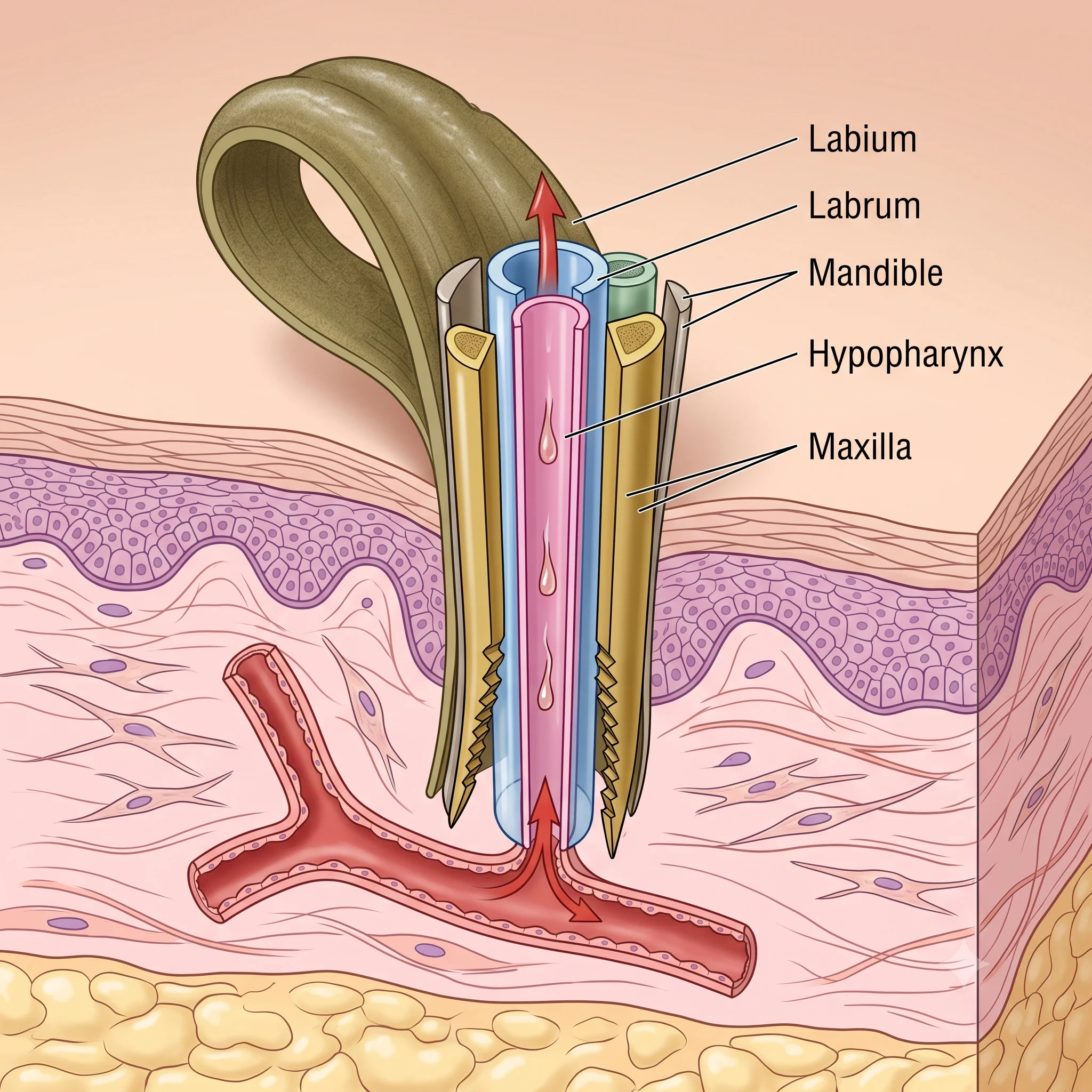
The biting mechanism is also more delicate than you might think. The proboscis is not a single-piece needle; it is a structure made up of six separate stylets. These pierce the skin, find a blood vessel and make feeding possible. At the same time saliva is secreted; this secretion slows blood clotting and triggers an immune response. The itch is the result of the histamine response that starts here. That is why swelling and itching after a bite are a normal immune reaction; but if there are persistent, severe or widespread symptoms, it is a matter for a doctor.
Mosquitoes and Humans
The relationship between mosquitoes and humans is long and harsh. This animal is one of the insect groups best adapted to living alongside humans. The “sivri” (pointed) part of its Turkish name comes from the proboscis; the “sinek” (fly) part comes from people placing it in the general class of flying pests. In domestic life, bed nets, doors and windows and the management of water containers have been the basic defense throughout history. The use of bed nets above and below the bed in old Anatolia is a cultural trace of this.
Mosquitoes are also vectors in direct contact with human health. WHO’s framework for vector-borne diseases and the World Malaria Report 2024 clearly show the global burden of this group. Malaria is the main part of this burden; other diseases also have regional effects. That is why the mosquito is not just a summer-evening nuisance. It is a link in the global health chain. But this needs to be read not in the language of panic but in a measured language of risk.
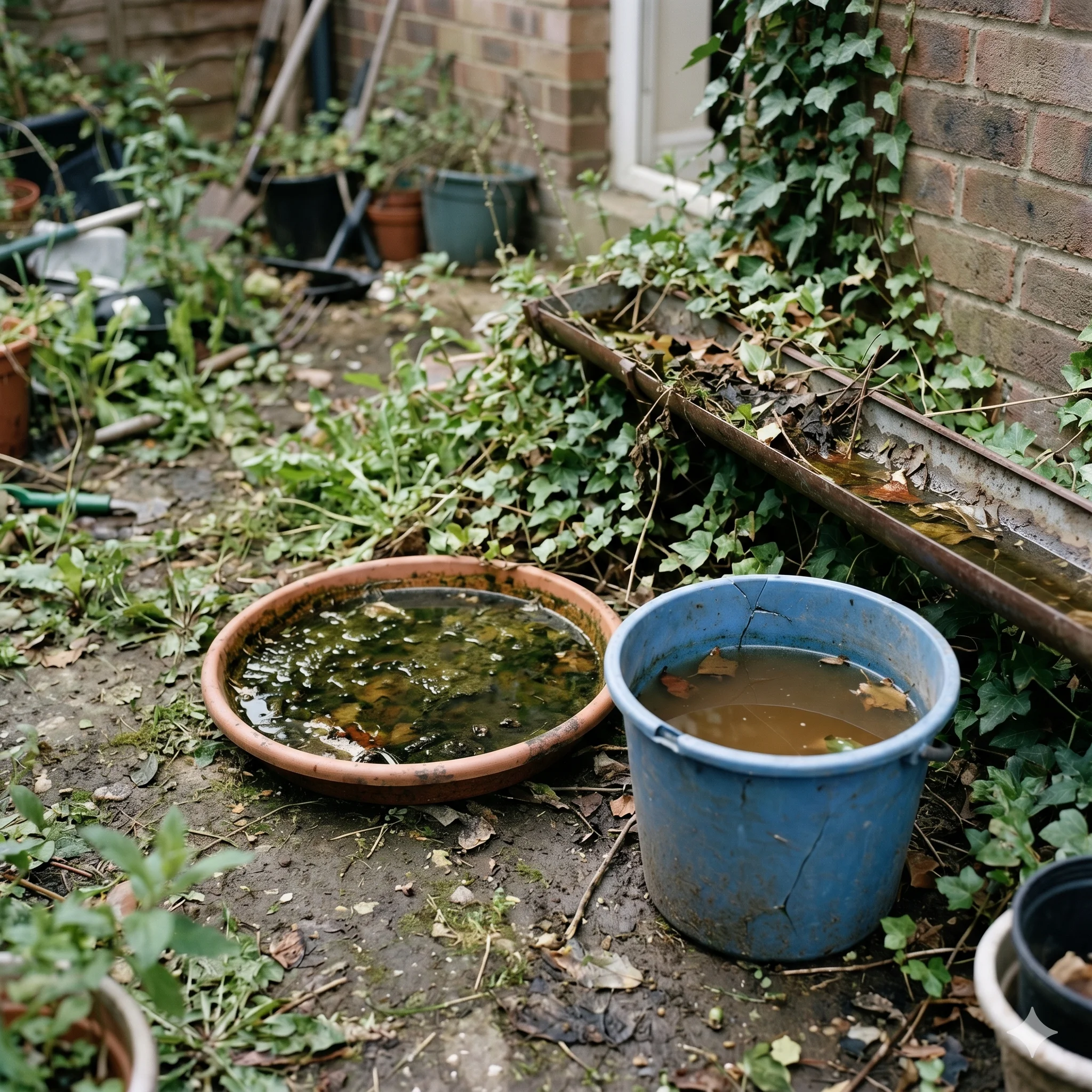
Around the home, a growing risk usually does not start with the “it bit me one night” moment; it starts with unseen accumulations of water. Roof gutters, balcony drains, pot saucers, storage buckets and containers forgotten in the garden quietly set up the breeding chain. That is why mosquito management relies on breaking the cycle rather than killing adults one by one. A container of water placed by the front door can cause a problem at neighborhood scale. Especially for Aedes species, even small-volume pools of water are enough. The right reflex for a homeowner is to check the surroundings before looking for pesticide spraying.
In neighborhoods with high mosquito pressure, one home’s precautions are sometimes not enough; the neighboring area, the shared garden and the surroundings of the building are part of the same chain. That is why collective action is needed: removing containers that hold water in common areas, reducing the build-up of garbage and waste, keeping storage lids closed and keeping the areas where children play dry. These simple-looking steps are the sturdiest barrier, coming before chemical intervention. Mosquito control is the sum of small habits; not a single big move.
Mosquito Health Perspective
When it comes to mosquitoes, the health topic gathers in three main places: malaria, arboviruses and surveillance. Malaria is the classic relationship between Anopheles and Plasmodium. The interruption of local transmission in Türkiye is an important success; the surveillance approach of the General Directorate of Public Health of the Ministry of Health of Türkiye also supports this. Imported cases can still be seen, but a local chain is another matter.
The picture is different for Aedes albopictus. This genus has vector capacity for dengue, Zika and chikungunya. ECDC observations and national field studies make it meaningful to monitor Aedes along the Mediterranean and Black Sea belt. Still, “it is being observed” and “there are widespread local cases” are not the same sentence. In Türkiye, the correct statement right now is this: the risk is being monitored, but there is no wide local circulation. On the West Nile virus side, Culex-focused sporadic cases and active monitoring are more visible.
Giving medical advice here is unnecessary. The rule is clear: if there is fever, rash, joint pain and recent travel, a doctor is consulted. Mosquito-borne diseases are managed not in the language of fear but in the language of quick recognition and correct referral. The basic defense is removing standing water, closing off entry points into the home and using protective products wisely.
When reading this picture under Türkiye’s conditions, three distinctions are kept in mind: Culex stands out more for the night and stagnant water, Aedes more for small containers and a daytime peak, and Anopheles for malaria surveillance and its resting posture. Recognizing the right species in the field leads you to choose the right measure. Because the same pool of water does not mean the same thing for every species; the difference in habitat changes the control plan.
Mosquito FAQ
Why do mosquito bites itch?
The anticoagulant and foreign proteins in the female’s saliva trigger a histamine reaction. The itch is the result of this response.
Why do some people get bitten by mosquitoes more?
The ETM complex comes to the fore here: sweat chemistry, blood group association and the skin microbiota. Pregnancy and alcohol can also play a role.
How can you protect yourself from mosquitoes?
Use a bed net, close doors and windows, fit insect screens, use a repellent containing DEET or picaridin and clear away pools of water.
How long do mosquitoes live?
In most species, adult females live 2-4 weeks and males 1-2 weeks. Climate shortens or lengthens this period.
Are there dangerous mosquitoes in Türkiye?
Malaria is considered eradicated in terms of local transmission, but Aedes and Culex species are monitored for health reasons. Risk management continues.
Topics Related to Mosquitoes
This main page links to narrower subtopics. From here, the reader goes deeper into topics such as why mosquitoes bite some people more, the Asian tiger mosquito and mosquito eggs. This way the pillar structure works; the main page provides the basic information, and the spoke pages focus on a single question. This structure also keeps search intent clean.
- Why mosquitoes bite some people more — the spoke page of YD-1.
Mosquito Sources
The line of reliable sources for mosquito information is short and clear. WHO’s vector-borne diseases pages and the World Malaria Report, CDC’s life cycle page, the surveillance information of the Ministry of Health of Türkiye and ECDC’s notes on the spread of Aedes form the main backbone.
- WHO Vector-borne diseases
- WHO World Malaria Report 2024
- CDC Mosquito Life Cycle
- Ministry of Health of Türkiye, General Directorate of Public Health (in Turkish)
- ECDC
- TÜBİTAK (in Turkish)
Related Topics
If you want to read about this topic in a broader context, see the cluster articles: Tick: Biology, Life Cycle and Health Perspective, House Fly: Biology, Behavior and Seasonal Effects.