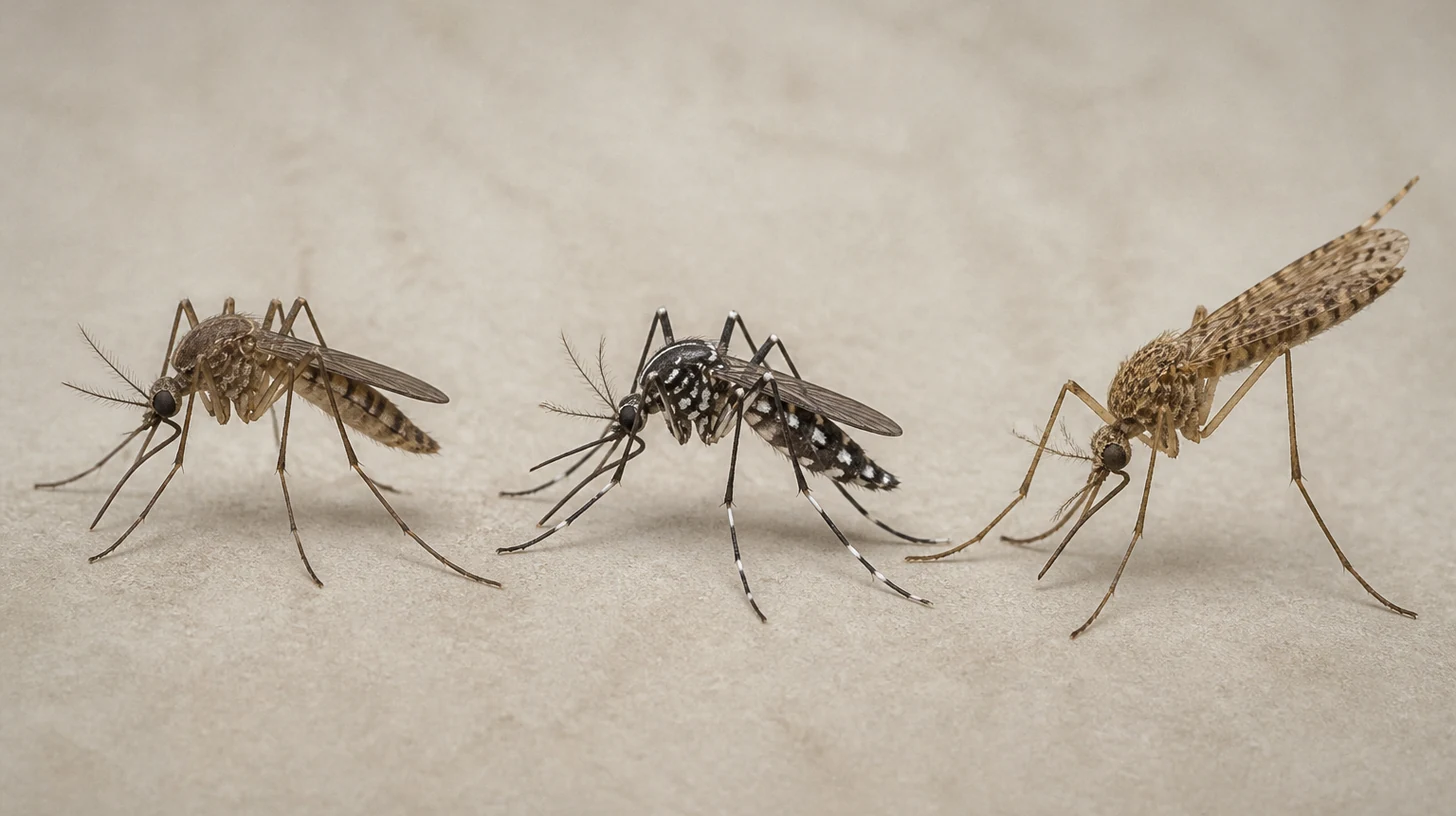
Mosquitoes are not all the same: in Türkiye you mainly come across the Culex, Aedes and Anopheles genera. The three differ in appearance, the hours when they are active and their breeding sites; however, it is not possible to say for certain what species a mosquito is, or whether it carries disease, just by looking at its color. The most surprising difference is that a small stripe or a resting posture can point to biologically different groups. For general information on the life cycle and protection, you can take a look at the main mosquito guide.
Which mosquito species stand out in Türkiye?
First, a distinction: Culex, Aedes and Anopheles are not species but genera; each genus contains more than one species. The diversity of species recorded in Türkiye is wider than these three genera. In a study carried out in central Edirne in 2017–2018, 11 species belonging to five genera were identified, and the Culex pipiens group was the most numerous among the sampled individuals. This is a field result from a single province and a specific period; it does not mean the same distribution applies everywhere in the country.
Recognizing the three genera is useful for everyday observation; a definitive identification, however, often requires examining the wings, legs and other morphological features under a microscope. A bite alone does not allow species identification.
How do you recognize a Culex mosquito?
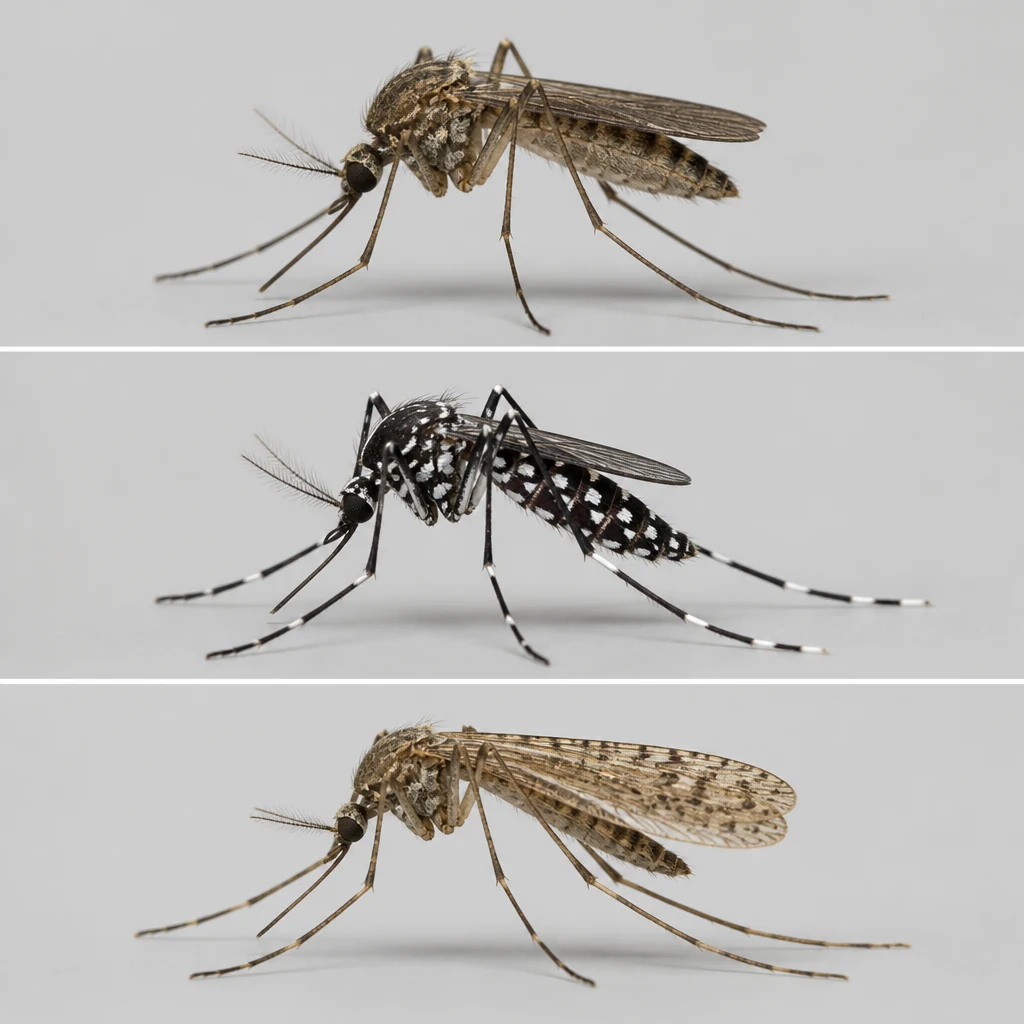
The Culex pipiens group usually looks plain brown-grey; it is recognized not by distinct black-and-white stripes but by its inconspicuous color. Culex species are mostly active in the evening and at night. Depending on the species, they breed in different water environments; stagnant puddles and areas close to human settlements can be suitable.
In the Edirne study, most of the mosquitoes caught belonged to the Culex pipiens group. The researchers considered this group relevant to public health surveillance for West Nile virus. This finding does not mean that every Culex individual carries the virus or that transmission necessarily occurs in the region. Whether mosquitoes can act as vectors depends on the species, the pathogen and local conditions all coming together.
Why does the Aedes mosquito attract attention?
Aedes albopictus, the Asian tiger mosquito, is easier to spot thanks to the white-silver markings on its black body. It can also bite during the day; its ability to use water collected in small containers as breeding sites makes environmental control in cities important. The European Centre for Disease Prevention and Control (ECDC) treats this species as one of the invasive mosquitoes whose spread in Europe is monitored; its current distribution map for Türkiye shows regional records.
The striped appearance is a clue for identification, not definitive proof on its own. Also, seeing an Aedes does not show that dengue or another disease is spreading in the area. A species’ capacity to carry disease and the presence of active transmission in a particular place are different things.
How do you tell an Anopheles mosquito apart?
Some species in the genus Anopheles can hold their body at an angle to the surface when resting; spotted patterns can also be seen on their wings. For Türkiye, Anopheles sacharovi is important in scientific and public health surveillance as a malaria vector. However, it cannot be concluded that every species in this genus transmits malaria everywhere. The malaria parasite, a suitable mosquito species and the conditions for transmission all need to come together.
The CDC’s resource on the Anopheles life cycle explains the egg, larva, pupa and adult stages. This water-dependent development also shows why breeding sites matter in control efforts.
What are the key differences between the three genera?
| Feature | Culex | Aedes | Anopheles |
|---|---|---|---|
| Visual clue | Usually brown-grey, little distinct pattern | Black-and-white contrast in some species | Spotted wings and a different resting posture in some species |
| Typical activity | Mostly evening-night | Can also be active during the day | Evening-night in many species |
| Breeding site | Stagnant water; varies by species | Various water collections, including water in small containers | Varies by species and local water habitat |
| Known health link | Some species linked to West Nile virus surveillance | Some species may be arbovirus vectors | Some species are malaria vectors |
The features in the table are general tendencies, not fixed rules for every species and region. In the health row, the phrase “may be a vector” does not mean that the mosquito necessarily carries a pathogen. Health risk is assessed using local official announcements and surveillance data.
Can I identify a mosquito I see at home with certainty?
Most of the time, no. Size, color or a bite mark alone do not provide a reliable identification; different mosquitoes can look alike, and lighting and crushing can also make the appearance misleading. A black-and-white pattern may be a clue for Aedes albopictus, but naming the exact species requires examination of the specimen by an expert. If you develop a fever or noticeable signs of illness after a bite, see a healthcare provider instead of trying to guess the mosquito species.
A practical step you can take around the home is to empty water-holding containers regularly and keep water tanks covered. If you are curious why mosquito bites affect some people more than others, you can move on to our article on biting preferences and human odor. For a broader framework on biology, the life cycle and protection, see the main mosquito guide.
Why is it important not to confuse species names with genus names?
In everyday speech, when people say “mosquito species” they usually mean mosquitoes that look different. In scientific naming, however, Culex and Aedes are genera; names such as Culex pipiens and Aedes albopictus indicate the species level. This distinction becomes especially important when reading sources: one study may have examined a single species in a particular province, while another source gives general information about the whole genus. It is not correct to extend the result of a provincial study to the whole country, or to attribute the characteristics of a single species to all members of the genus.
For this reason, use the appearance table as a first screening tool; for definitive identification and health risk, rely on regional expert data. Since records in Türkiye may also change over time, it is safer to check official surveillance and the current ECDC map for up-to-date distribution.
Sources
- Şakacı, Z. & Camlitepe, Y. (2022). A mosquito survey of Culicidae species at Edirne central district for disease vector. Trakya University Journal of Natural Sciences, 23(Special Issue), S41–S51.
- ECDC: Aedes albopictus factsheet
- CDC: About mosquitoes
- CDC: Anopheles life cycle