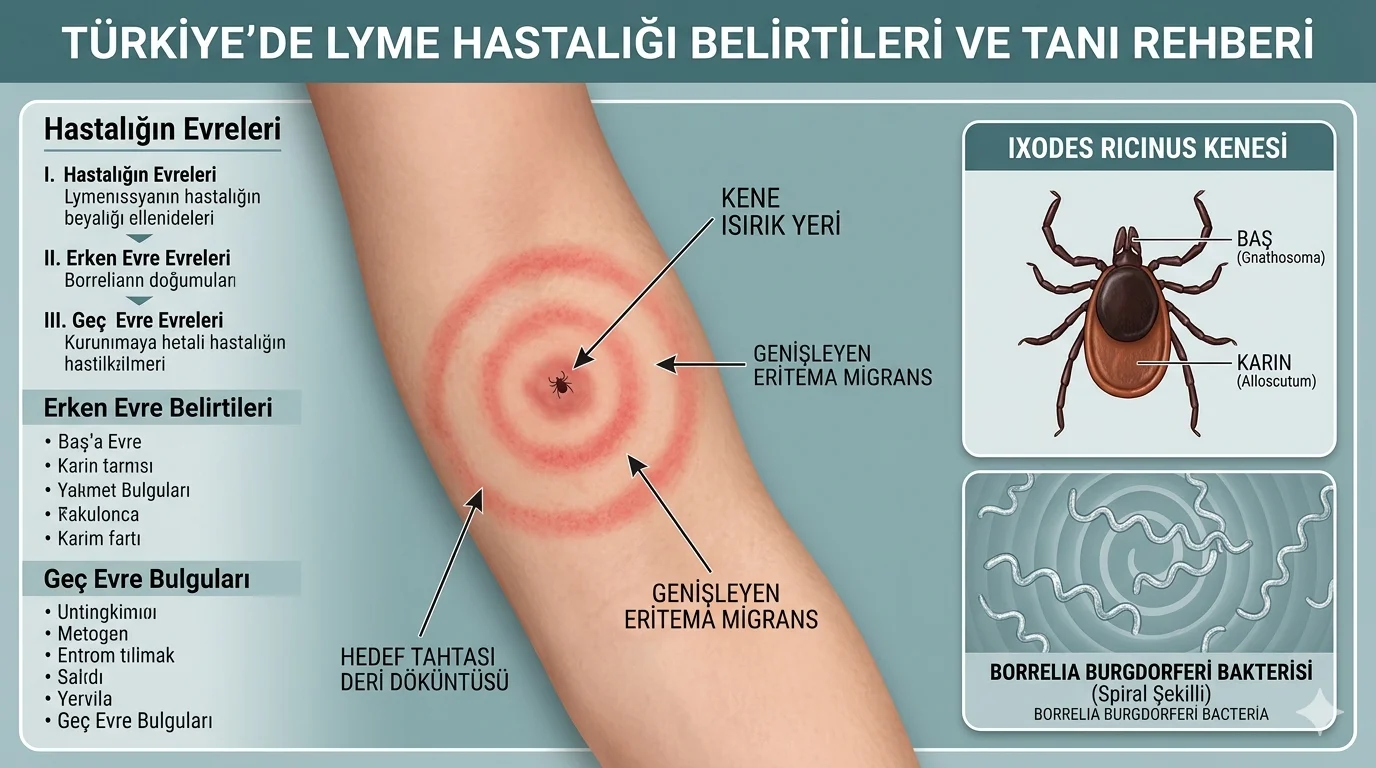
This page is the Lyme branch of the Tick: Biology, Life Cycle and Health Perspective article; if you want to see tick removal separately, look at the Tick Removal Method: The Correct Pull with Tweezers page. The aim here is to recognize erythema migrans correctly and not to miss the late stage.
Short rule: if there is only typical EM, a same-day outpatient clinic; if fever, a neurological finding, palpitations, chest pain or rapid deterioration is added to EM, the urgency rises.
Why does the Lyme disease symptom matter?
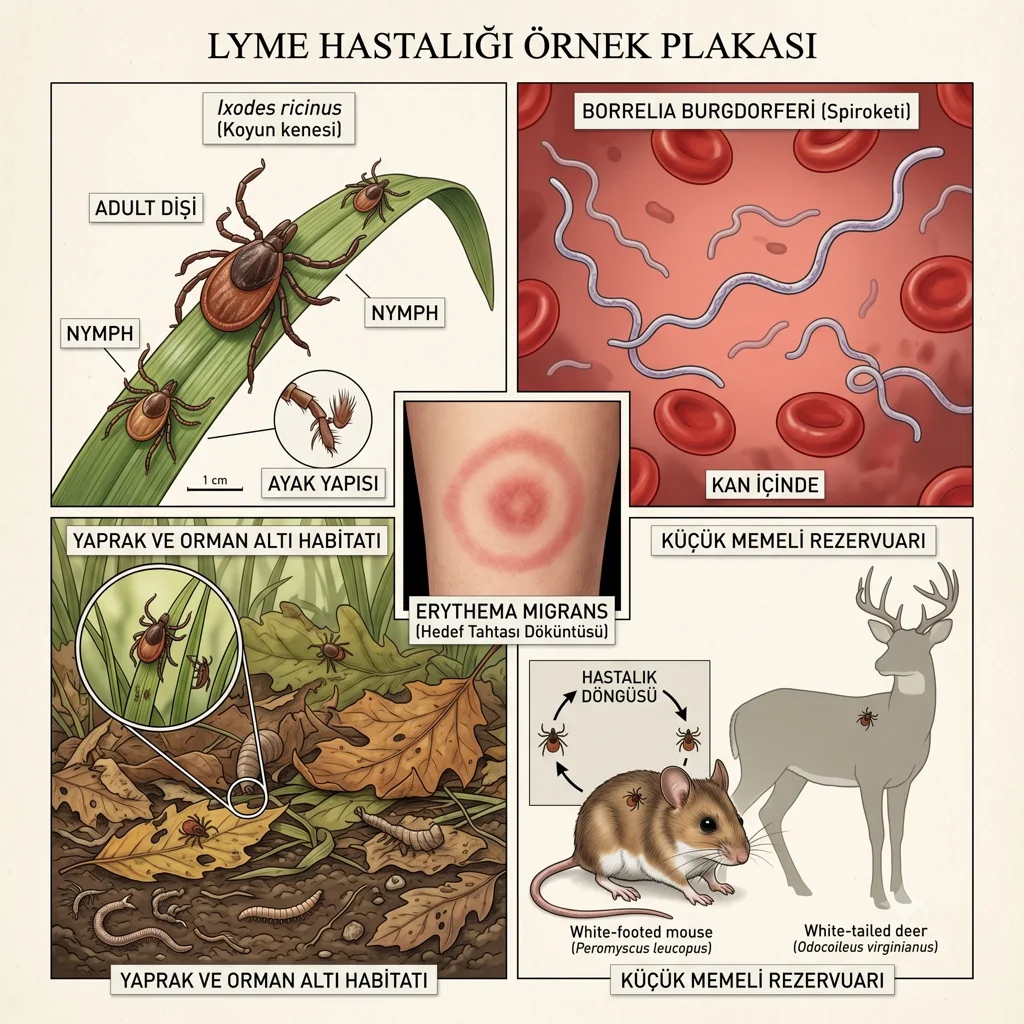
Lyme disease is an infection caused by the tick-transmitted Borrelia burgdorferi complex. The agent is a bacterium; more precisely, a spirochete with a coiled structure. Under the microscope it looks thin, spiral and coiled. This biology matters, because the skin, nervous system, joint and heart pictures are linked to one another. People often think “the bite is over.” Yet this is where the clinical story begins.
On the vector side, the classic name is Ixodes ricinus. In Türkiye, moist microhabitats, forest edges and areas with leaf litter are discussed; some belts of the Black Sea, Marmara and Central Anatolia regions are part of this discussion. A tick does not live on its own; small mammals, deer, birds and damp ground carry its cycle. Through a biologist’s eyes, the issue is the question “which creature is staying where.”
Incubation: the 3-30 day window
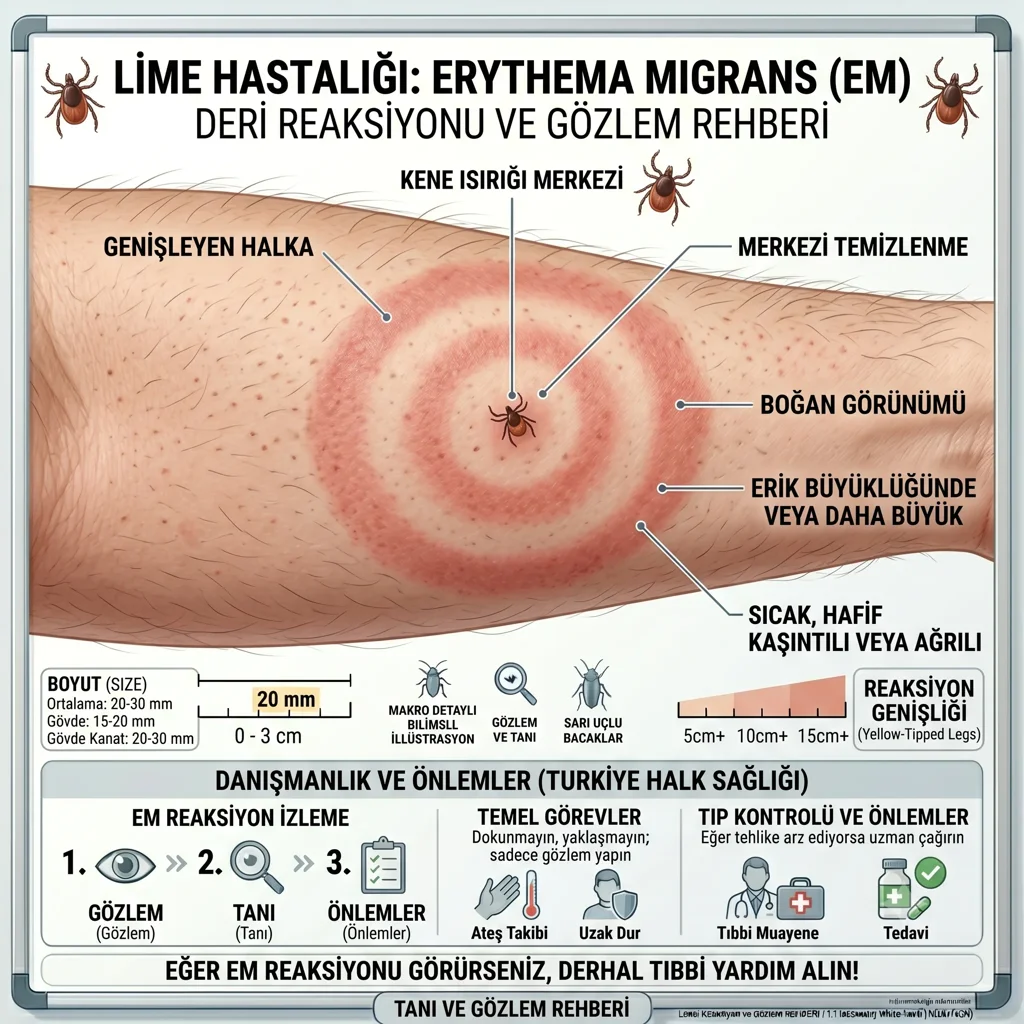
In Lyme, incubation is usually 3-30 days; an average band of 7-14 days is often cited. Don’t miss this window, because the symptom may not appear right away. The tick bite is forgotten, the patient thinks they are fine and the first skin sign comes later. This is EM’s most valuable aspect: it is an early alarm.
EM is usually larger than 5 cm and grows over days. It starts at the tick site, then expands ring by ring. The center sometimes clears; the outer edge stays redder. It doesn’t always have to have the classic target appearance, but the “growing annular rash” line is very typical. In most cases itching and pain are mild or absent. That is why the person doesn’t take the rash seriously; and that is the real mistake.
What else comes with erythema migrans?
EM may not come alone. The accompanying systemic findings are: fever 38+ , weakness, myalgia, joint pain and headache. In line with the picture drawn by the CDC, the patient sometimes goes through a flu-like picture. At this stage, the “I’ll wait, it’ll pass” approach is risky. Because if early treatment is delayed, the chance of the bacterium spreading increases.
At this point, set up the alarm like this: the ring on the skin is growing, and fever and malaise are being added on top. If, in addition, there is shortness of breath, chest pain, palpitations, fainting or a marked neurological change, the line is sharper.
Late stage: what comes weeks and months later?
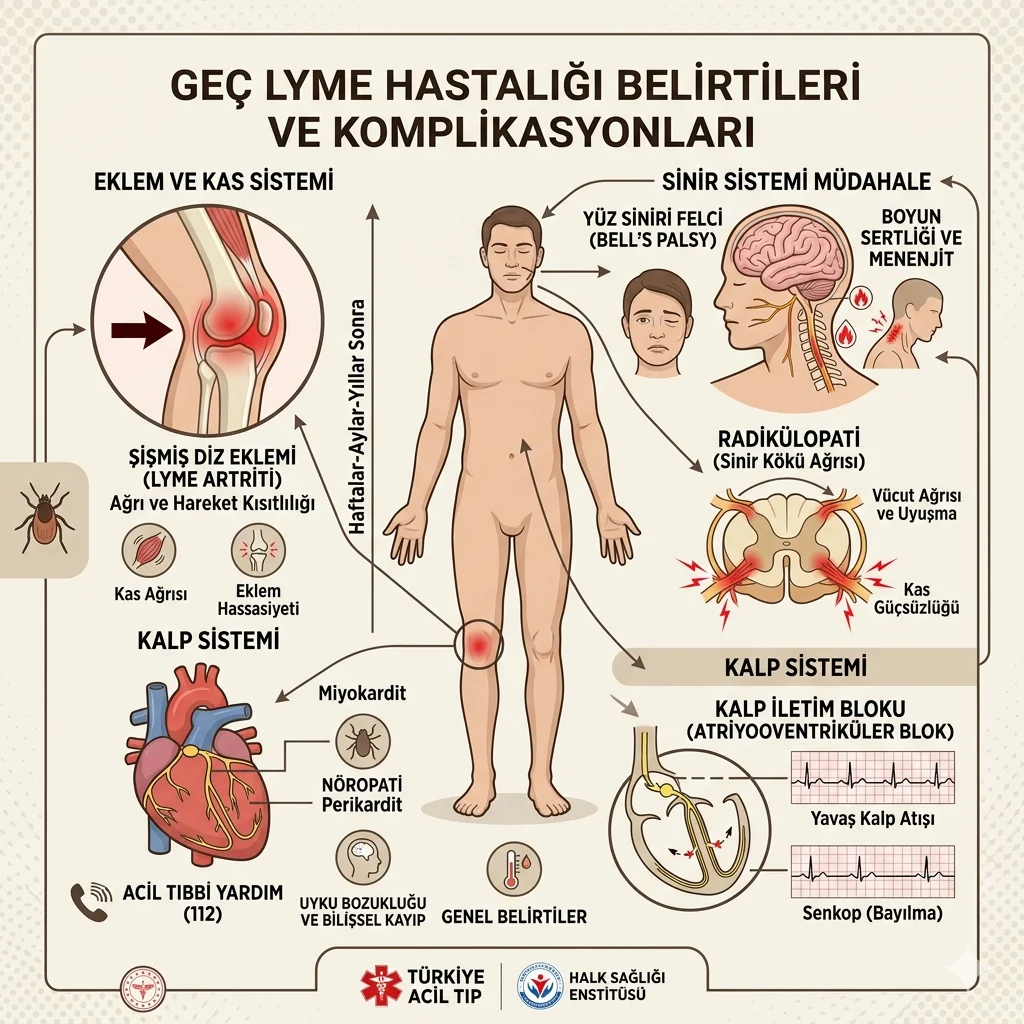
If treatment is delayed or the diagnosis is missed, the picture can deepen weeks-months later. The classic late-stage headings are three: Lyme arthritis, carditis and neurological involvement. Lyme arthritis often shows up as knee swelling. The patient describes it as “my knee suddenly filled with fluid.” In carditis, atrioventricular block can be seen; palpitations, fainting and chest discomfort may accompany it. In the neurological picture, Bell’s palsy, meningitis and radiculopathy are discussed.
The field distinction matters here. Bell’s palsy on its own can also have other causes; but if there is a recent tick history and EM, the Lyme side becomes stronger. Painful, neurological findings such as meningitis or radiculopathy increase the seriousness of the situation.
Diagnosis: ELISA, confirmation and clinical reasoning
In diagnosis, two things go side by side: the clinical appearance and serology. If there is typical EM, the clinical diagnosis usually carries the most weight. In the early weeks, ELISA/antibody tests can come back negative; this is normal. The CDC clearly states that antibody tests can be falsely negative in the first weeks. That is why second-step confirmation is needed; in practice, two-tier serology is used, that is, ELISA/EIA followed by an immunoblot or Western blot.
A biologist’s view matters in this article: a negative test does not mean that the microorganism is gone; the timing may be wrong. If the case has disseminated, or if there is a joint or neurological finding, don’t think of the laboratory independently of the clinic. Serology gains value at the right time. In early EM, the eye, the history and the examination are more valuable than a test.
Treatment: if caught early, the game changes
In early Lyme, oral antibiotics are the main weapon. In adults, a commonly used regimen is doxycycline 100 mg 2 times a day for 14-21 days; in children, amoxicillin is one of the leading options. The IDSA 2020 guideline also accepts shorter courses for typical EM; but the clinical picture, age and spread change the treatment. In late neurological or cardiac involvement, on the other hand, the use of IV ceftriaxone for 2-4 weeks comes into consideration.
A short note here: the physician decides the choice of drug and the duration. Because pregnancy, age, allergy, neurological involvement and cardiac findings change the picture. Even so, if early EM is caught, the outcome is much better.
What do we confuse in Türkiye?
The Türkiye note matters. After tick contact, the first thing that comes to everyone’s mind is CCHF; that too is a correct reflex. But Lyme is a separate story. Along the HSGM reporting line, it is said that Lyme cases remain in the low hundreds band and that this may not fully show the real burden. In particular, agents that share the same ecology, such as Borrelia, anaplasma and babesia, can get mixed up.
The possibility of co-infection does not rule out Lyme on its own; on the contrary, it confuses the picture. With high fever, marked weakness and unusual laboratory findings, anaplasma and babesiosis come to mind. The IDSA also considers these accompanying pathogens separately. So after a tick bite, don’t settle for a single label; in the field, the same vector can carry more than one agent.
When to call your country’s emergency number, when to go to an outpatient clinic?
If there is only typical EM and the general condition is good, a same-day outpatient clinic is the right line. But if a 38+ fever, palpitations, chest pain, shortness of breath, fainting, a marked neurological finding, facial palsy or rapid deterioration is added to EM, an emergency assessment is needed; the case moves closer to calling your country’s emergency number. This distinction is practical, because some patients consider the signs mild. Yet fever and a systemic finding show that things have moved from a rash alone into a different lane.
The critical point here is this: the fact that EM on its own is a matter for an outpatient clinic does not mean taking it lightly. On the contrary, it is a chance for early detection. Fast diagnosis and the right antibiotic lower the later risk of arthritis, carditis and neurological complications. The small ring that starts at the tick site is sometimes the first sentence of a big story.
Short conclusion
When the Lyme disease symptom comes up, erythema migrans should come to mind first. A redness that expands like a target, often doesn’t itch or hurt, and goes above 5 cm; if fever, weakness and muscle-joint pain are added on top, the picture becomes stronger. Weeks-months later, knee swelling, carditis and neurological findings may follow. The diagnosis is made with clinical reasoning + two-tier serology; treatment is much easier if it is caught early.
Sources
- CDC — Signs and Symptoms of Untreated Lyme Disease
- CDC — Testing and Diagnosis for Lyme disease
- CDC — Treatment and Intervention for Lyme disease
- IDSA — Lyme Disease Clinical Practice Guideline
- ECDC — Tick-borne diseases
- Ministry of Health of Türkiye, HSGM — Crimean-Congo Hemorrhagic Fever (in Turkish)
- Tick: Biology, Life Cycle and Health Perspective
- What to Do After a Tick Bite? An Evidence-Based Guide
- Tick Removal Method: The Correct Pull with Tweezers
This article is for information. If there is typical EM, fever, facial palsy, palpitations, fainting, shortness of breath or rapid deterioration, a physician’s assessment is needed.