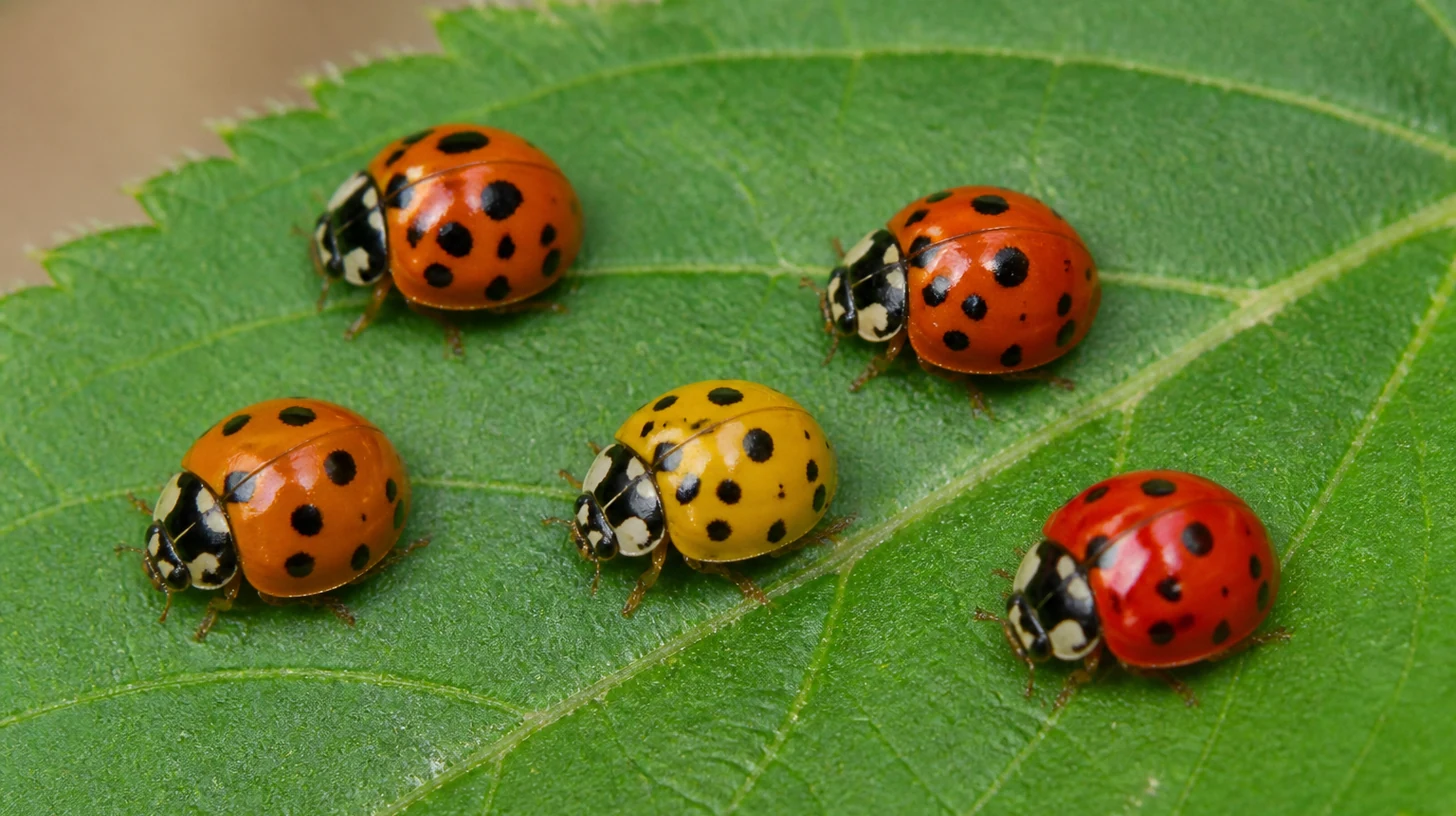
A yellow ladybug is not a special sign of luck, age or danger; yellow is one of the natural colors of some species in the family Coccinellidae. What is really surprising is that within the same family, colors range from yellow to orange, red and even black, and the number of spots can vary too. That’s why seeing the color and immediately putting a species name on it is misleading. You can find the general features of the family in the basic ladybug guide; here you can learn what yellow tells you and how to compare species.
Which species could a yellow ladybug be?
Yellow does not point to a single species. For example, some species known as the fourteen-spotted ladybug carry black spots on a yellow background; in other species the wing covers can be yellowish, orange or red. In species with variable coloring such as Harmonia axyridis, the wing covers can range from yellow-orange to red, and the spots from very few to a large number. These examples are described in detail in North American sources; this does not mean that every yellow individual seen in Turkey is the same species.
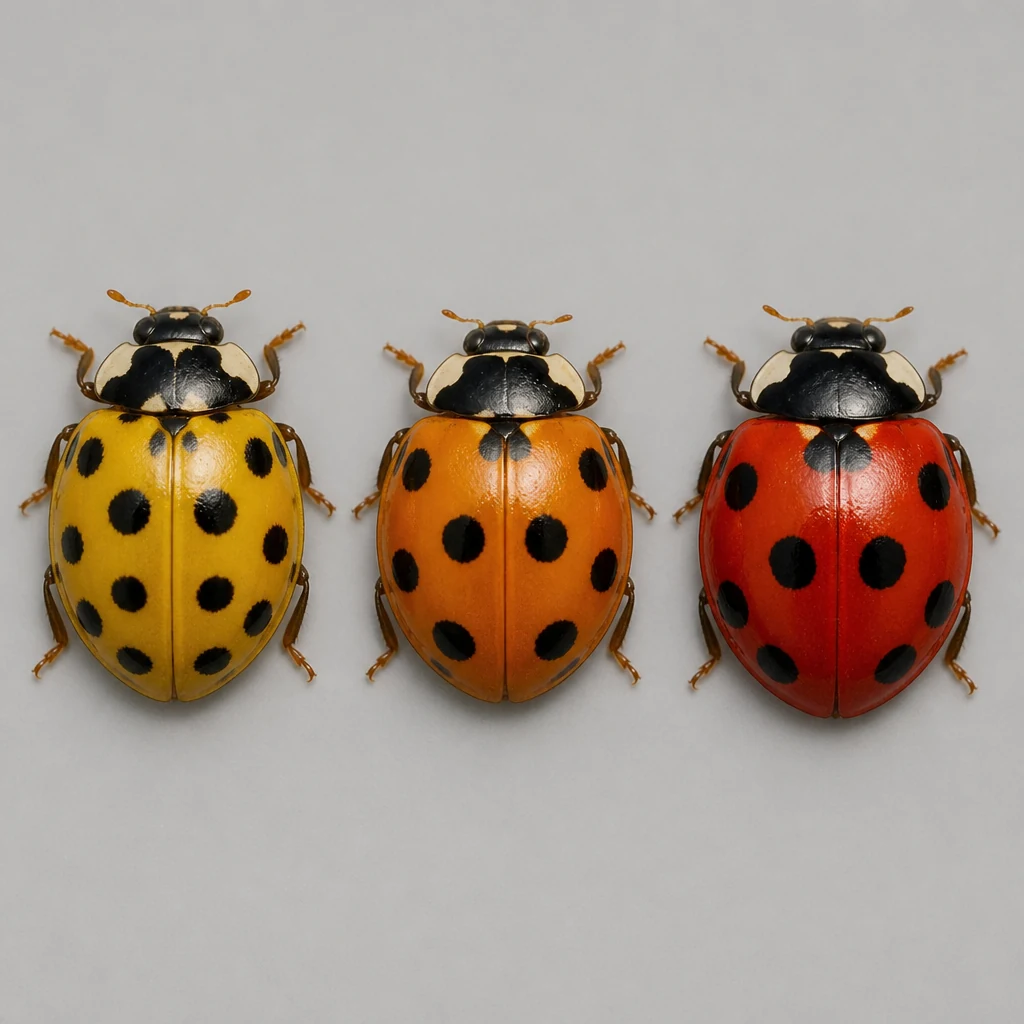
In an identification, you look not only at the wing-cover color but together at the shape and arrangement of the spots, the markings on the pronotum (the shield behind the head), the body shape and the place where it was observed. A clear close-up photo helps; even so, it is not always possible to tell similar species apart from a photo alone. The article explaining why ladybugs come indoors also points out that color and spots alone do not provide a species identification.
What do color and spot count tell you?
Color and pattern are features that help with species recognition; however, they are not always enough on their own. In some species the pattern is relatively stable, while in others clear differences can be seen between individuals of the same species. That’s why rules such as “if it’s yellow, it’s this species” or “if it has few spots, it’s young” are not reliable. Spot count is not an indicator of age; ladybugs’ spots do not increase or decrease over the years as they grow.
In some species, bright colors can be a defensive signal against predators. When threatened, some ladybugs can release a yellowish, smelly fluid from their leg joints. This behavior does not mean that every yellow species is poisonous or dangerous to people. Species, defense method and interaction with humans are separate topics; you shouldn’t read color alone as a danger label.
How do you compare ladybug species?
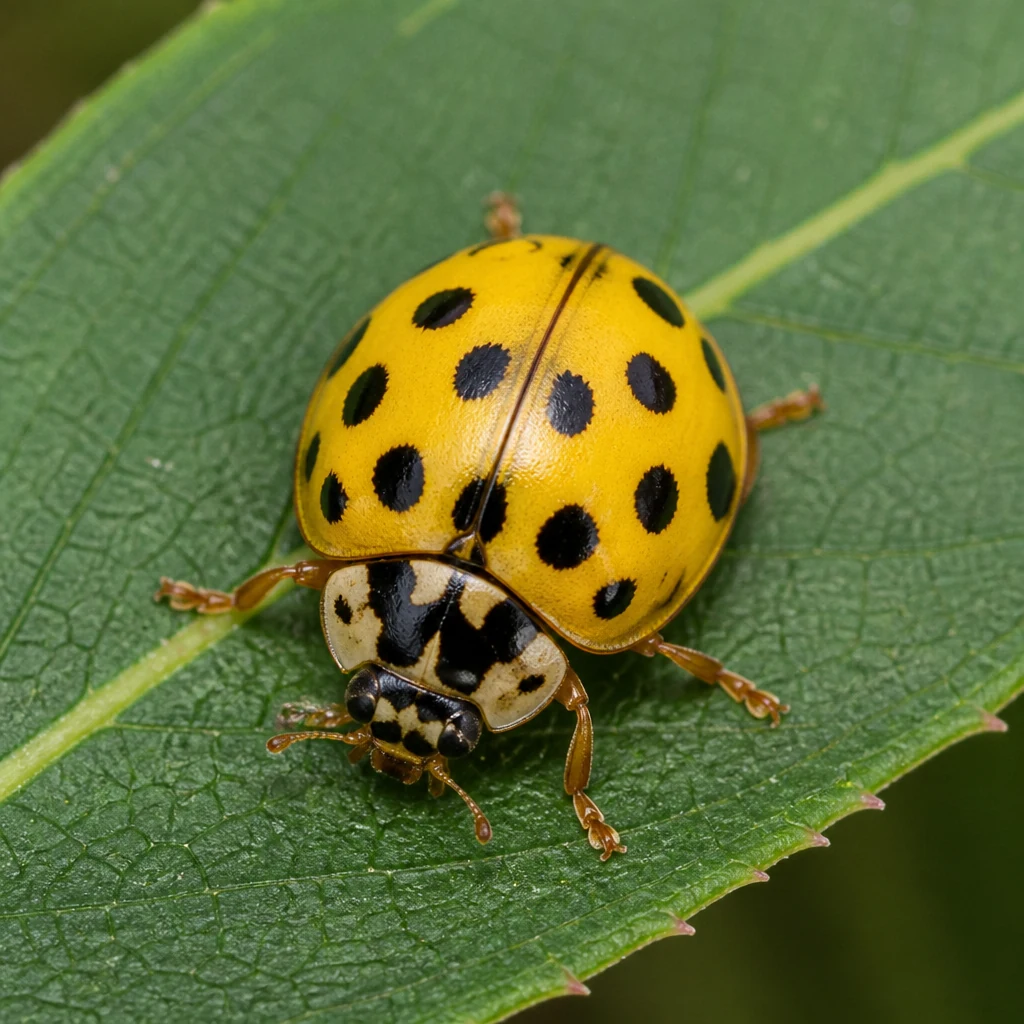
The examples below show why species-level identification requires more than color and spot count. The examples are for general recognition; geographic distribution can vary by region.
| Example | Standout feature in appearance | Color/spot interpretation |
|---|---|---|
| Seven-spot ladybug (Coccinella septempunctata) | Usually seven black spots on red-orange wing covers | Spot count helps with naming; it does not show age |
| Fourteen-spotted ladybug group | Black, often angular spots on a yellow background | Yellow alone is not a species identification |
| Asian lady beetle (Harmonia axyridis) | Color and spot pattern very variable; markings on the pronotum are also examined | Yellowish, orange, red or dark forms can be seen |
| Spotless ladybug examples | There may be no distinct spots on the wing covers | Being spotless does not mean it isn’t a ladybug |
This comparison shows that spots are a useful clue but not a definitive ID card on their own. The pronotum, body shape and regional species information are also needed. For more about the Asian lady beetle’s variable appearance and its ability to enter homes in large numbers, you can look at the Harmonia axyridis guide.
Is a yellow ladybug harmful?
It is not considered harmful because of its color. A large share of ladybugs prey on small creatures such as aphids, scale insects or mites; however, not all members of the family share the same diet. Some species can feed on plants, some on molds. That’s why killing a yellow beetle you see in the garden without identifying it, and accepting every species as beneficial just because it’s a ladybug, are both the wrong approach.
If you couldn’t identify the species in the garden, you can photograph and observe the beetle without disturbing it. If there is clear damage to the plant, first identify the creature causing the damage; the ladybug’s color alone is not a reason to intervene. Tips for supporting ladybugs in the garden explains why the right prey, flowers and shelter conditions matter.
In short: what does yellow mean?
When you see a yellow ladybug, the most solid conclusion you can draw is that what’s in front of you may be a yellow or yellowish individual from the family Coccinellidae; beyond that, you need to look at other features. Color is a species clue, not a lucky omen, an age indicator or an automatic danger sign. Assess the spots, the pronotum and the body shape together; if you’re not sure, don’t present the species identification as if it were definite.
Frequently asked questions
Does a yellow ladybug bring luck?
This is a cultural belief; biologically, there is no meaning showing that yellow brings luck. You can read about the cultural side of how the ladybug became a symbol of luck in the article on why ladybugs are considered lucky.
Is a yellow ladybug poisonous?
Yellow does not prove that it is poisonous. Some species can release a defensive fluid; this trait cannot be determined by color alone.
Do a ladybug’s spots show its age?
No. Spot count is related not to age but to the pattern features of the species and the individual.
Sources
- University of Minnesota Extension — Lady Beetles: https://extension.umn.edu/garden-and-home/yard-and-garden/yard-and-garden-insects/lady-beetles
- USDA Agricultural Research Service — The Multicolored Asian Lady Beetle (archive): https://www.ars.usda.gov/oc/br/lbeetle/index
- University of Florida IFAS — Ladybirds, Ladybird beetles, Lady Beetles, Ladybugs of Florida: https://ask.ifas.ufl.edu/publication/IN327
- UC Statewide IPM Program — Spotless Lady Beetle: https://ipm.ucanr.edu/natural-enemies/spotless-lady-beetle