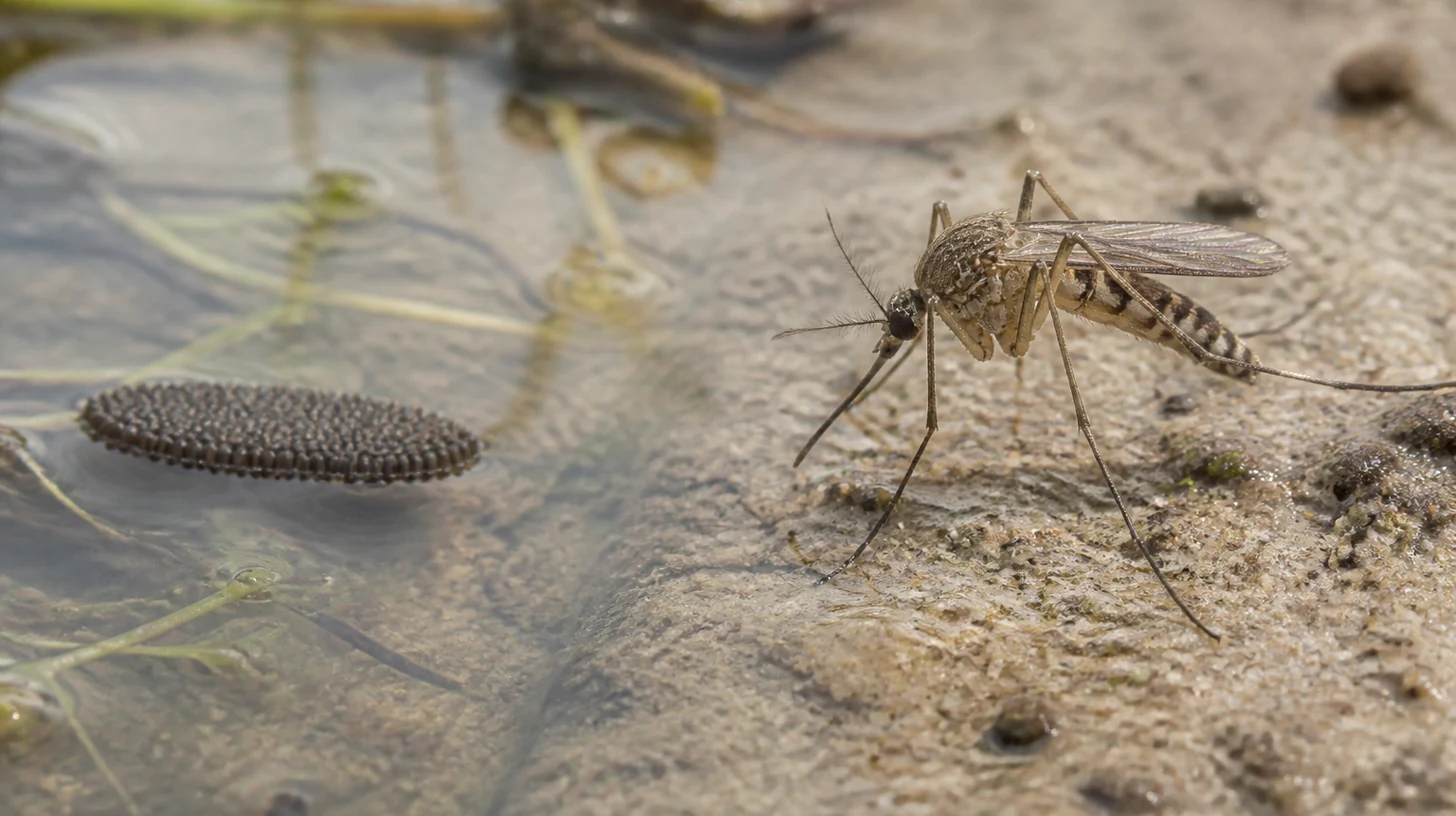
The adult lifespan of mosquitoes is usually measured not in days but, for females, in a few weeks; development from egg to flying adult can take about 7–14 days under suitable conditions. However, no single timeline applies to all mosquitoes: species, temperature and when the eggs come into contact with water change the duration. The most surprising point is that some eggs can wait without being in water, and the cycle starts again with water. For species and general life information, see the main mosquito guide.
How many days does an adult mosquito live?
Male mosquitoes usually live shorter lives than females; females can survive for a few weeks under suitable conditions. Penn State Extension states that most adults live a few weeks and that some species can overwinter in sheltered places. The American Mosquito Control Association likewise reports that Culex mosquitoes generally live a few weeks during the hot summer months, and that some females emerging at the end of summer seek shelter to overwinter. That is why giving a single number, as in “a mosquito lives exactly this long,” would be misleading.
A female mosquito does not die right after taking blood. The blood meal contributes to egg production; the female can lay eggs in a suitable water site and go on living. Males do not suck blood; they mostly feed on nectar and similar sugar sources. You can also read about how mosquitoes find and bite people in our article on which scents mosquitoes stay away from.
How many days does it take an egg to become a flying mosquito?
At a suitable temperature, development from egg to adult can be completed in some species in about one to two weeks. The CDC gives 7–10 days for an egg to become an adult in Aedes mosquitoes and 10–14 days in Anopheles mosquitoes. These durations are specific to the species and conditions; they are not a definitive timeline for all mosquitoes.
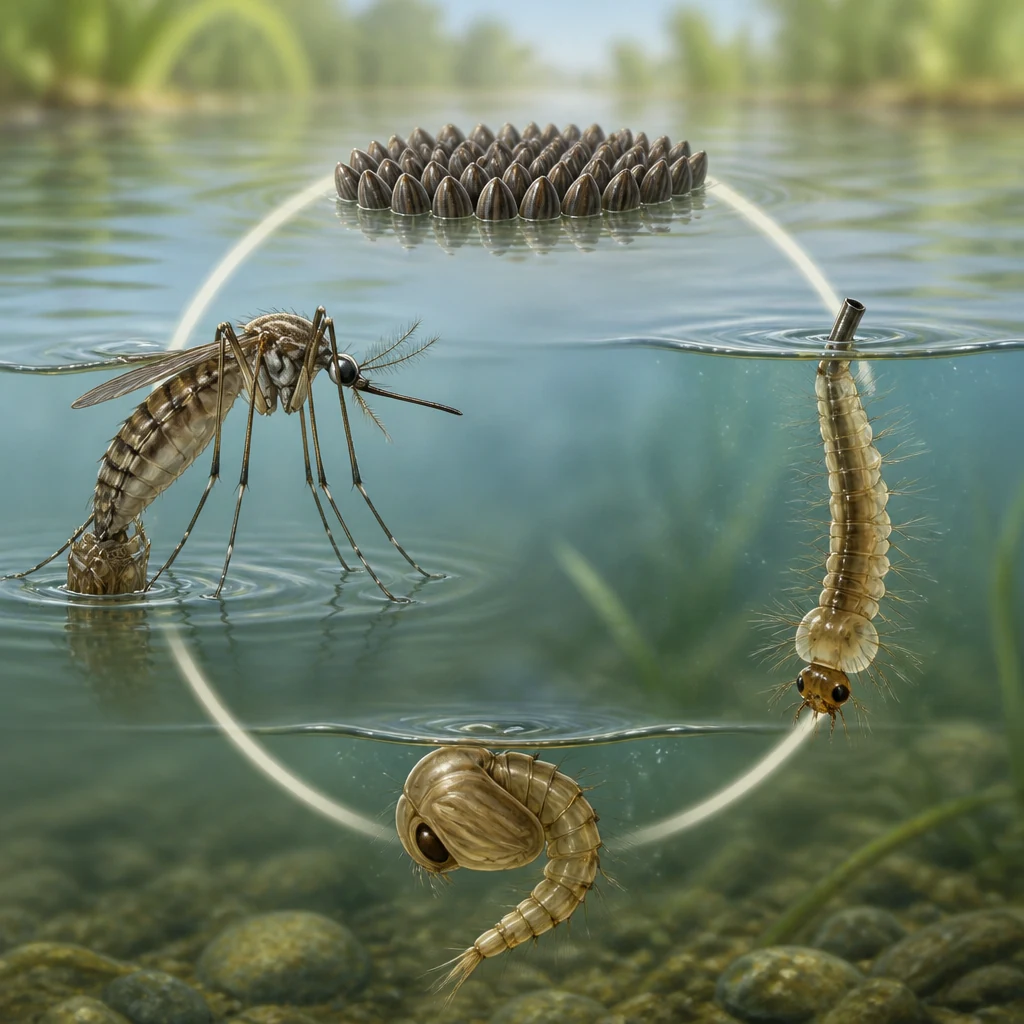
The cycle consists of four steps: egg, larva, pupa and adult. The first three stages are linked to water. The larva that hatches from the egg feeds and grows in the water; the transformation into an adult takes place during the pupal stage, and the adult mosquito emerges from the water surface. Development can speed up as temperatures rise; cool or unsuitable conditions slow it down.
How many days does it take a female mosquito to lay eggs?
The female lays her eggs once the conditions needed for mating and egg development are in place; the interval varies from species to species. For example, the American Mosquito Control Association reports that a Culex female can lay her eggs on the water surface in rafts of 100–300 eggs and can produce a new raft roughly every third night throughout her life. This example describes only that Culex behavior; it does not mean all species lay the same number of eggs or at the same interval.
Aedes species can often lay their eggs near the waterline; the eggs can survive dry conditions and hatch later when they come into contact with water. That is why eggs may remain even in a container that looks empty. Emptying and scrubbing containers regularly and removing water-collecting items from the surroundings help reduce the places where new larvae can develop.
Which conditions change the duration?
| Process | Approximate duration / example | Why does it vary? |
|---|---|---|
| Aedes egg to adult | 7–10 days (CDC) | Species, temperature and water conditions |
| Anopheles egg to adult | 10–14 days (CDC) | Species and developmental conditions |
| Adult female lifespan | Mostly a few weeks | Temperature, food, humidity and overwintering |
| Adult male lifespan | Usually shorter than the female’s | Species and environmental conditions |
These ranges are not a laboratory guarantee or the duration you will see in every home. Even the starting point differs between species whose eggs need water to hatch and species whose eggs can wait in a dry environment. If you see larvae in a puddle at home, this alone does not show how many days ago the adults emerged.
How do season and species affect the duration?
Even individuals of the same species do not live the same length of time. Temperature, rainfall, humid and sheltered places to hide, the sugar sources they can reach and natural enemies affect the likelihood of survival. In the warm season, larval and pupal development can speed up; but adult lifespan is not determined by temperature alone. Extreme dryness or heat can also shorten life. So seeing mosquitoes very early in a place does not show that every individual develops at the same speed.
Species differences matter too. The eggs of some mosquitoes can wait out a dry period; others need water to hatch. In winter conditions, some females overwinter as adults in sheltered areas, while other species or stages may have a different overwintering strategy. Because of this biological diversity, it is not correct to apply a single answer to “how many days does it take mosquitoes to breed?” to all species. The ranges the CDC gives for Aedes and Anopheles are species-based examples; you can read about the differences between these groups in our article on the mosquito genera found in Türkiye.
In everyday observation, the distinction that really helps is not to confuse adult lifespan with the time it takes for new adults to emerge. A female living for weeks does not mean every egg takes weeks to develop. Conversely, egg-to-adult development being short in the warm period does not show that adults will live only that long. These are separate time spans.
How long does a mosquito live after biting?
A bite does not automatically end a mosquito’s life. The blood-fed female rests and develops eggs and, if conditions allow, can feed again. To understand where new mosquitoes come from, you need to look not only at flying adults but also at standing water and larvae in containers. For a broader framework on the life cycle, species and protection, see the main mosquito guide.