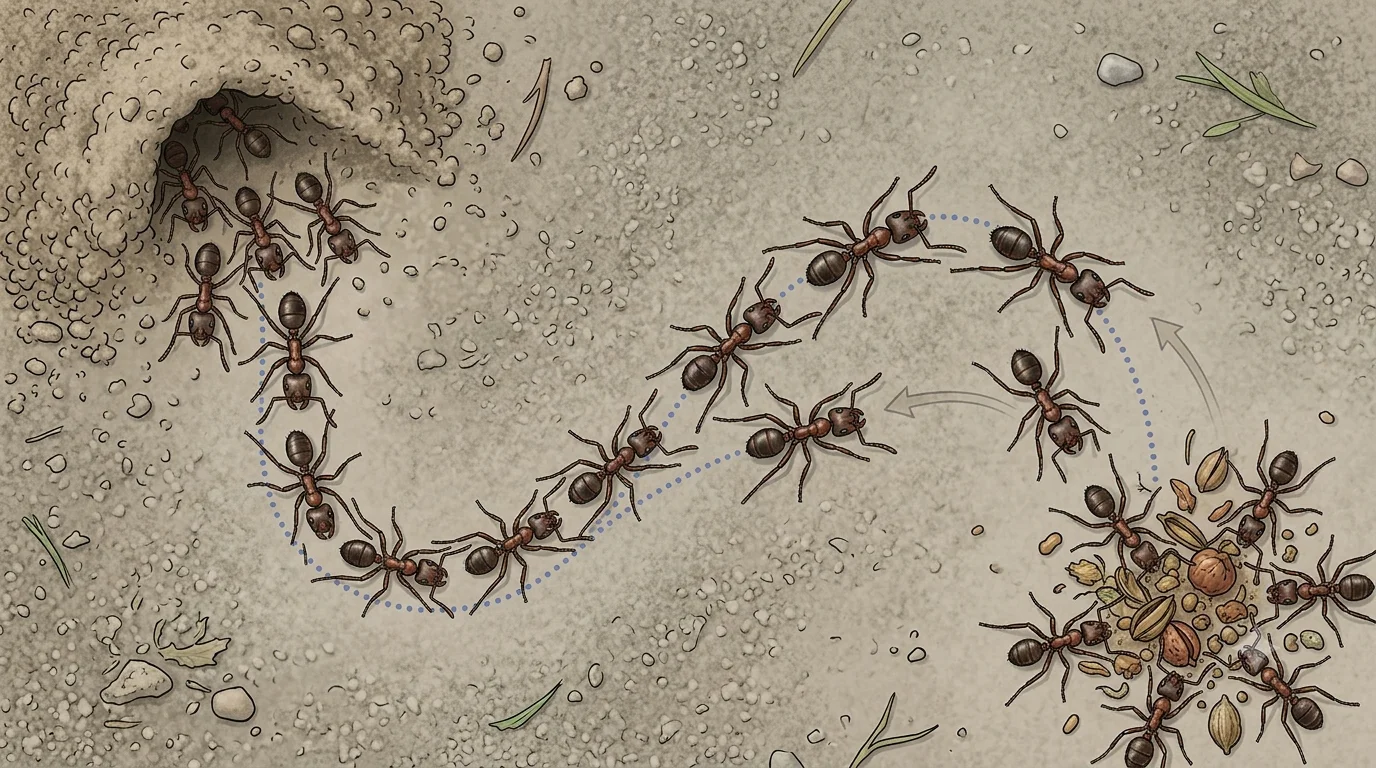
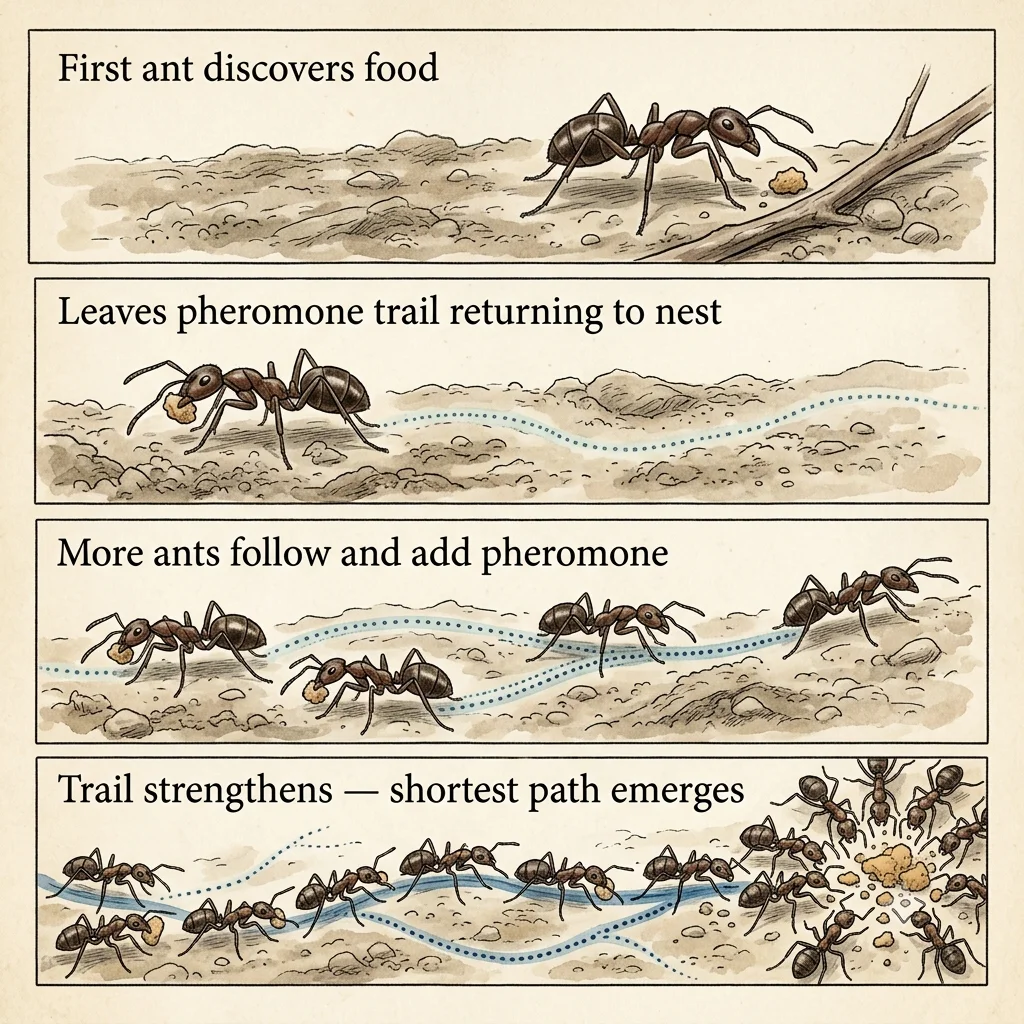
An ant trail is set up not by the intelligence of a single ant but by colony behavior. The first food discovery leaves a trail; this trail is read by the antennae of the other workers; then each passing individual adds a little more pheromone onto the trail. In this way a weak route turns into a strong line in a short time. This simple mechanism brings together efficient searching and signal amplification in nature. Nature doesn’t use brute force here; it makes distributed decisions. For the broader backbone, our main ant article is the main map.
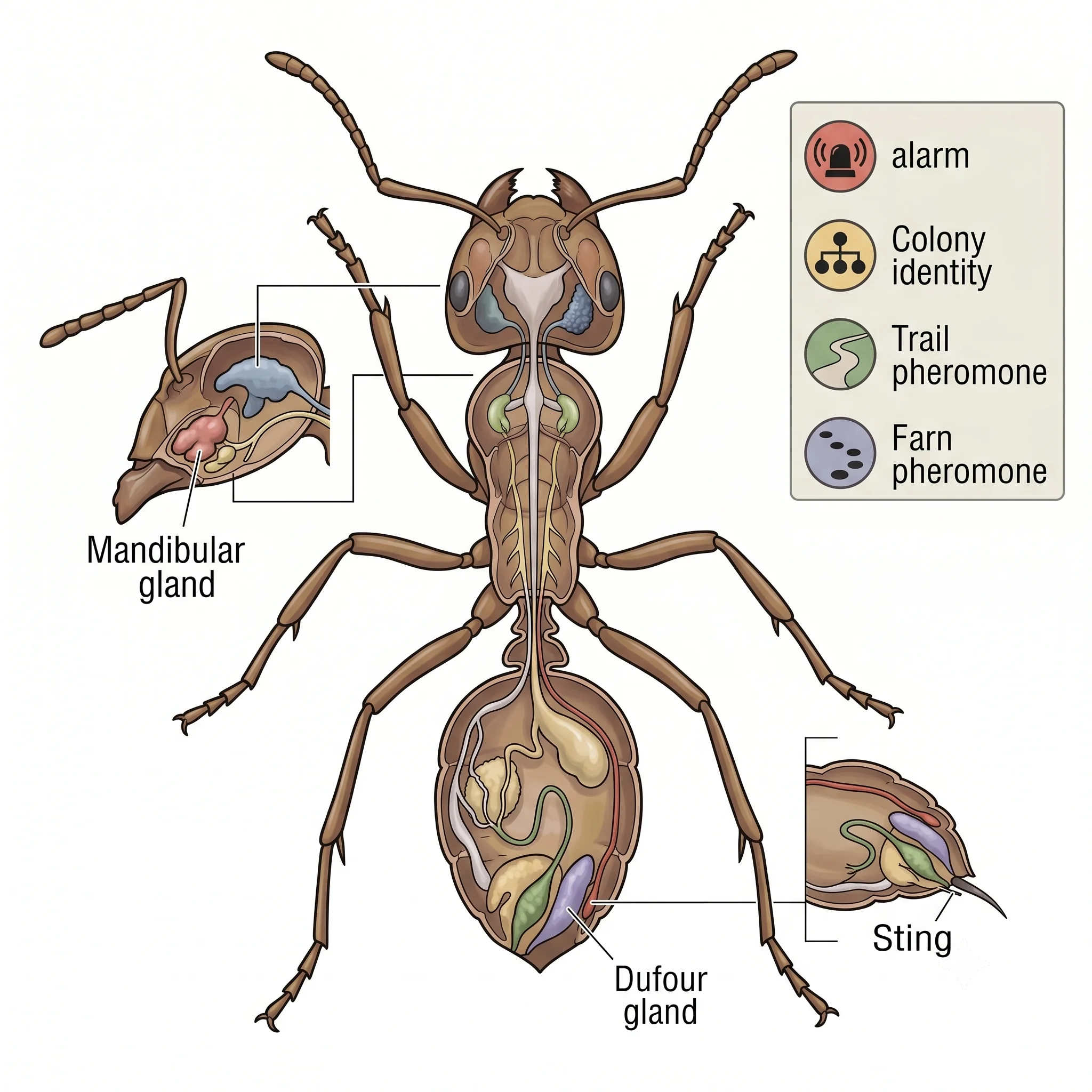
What is ant pheromone and which glands are used?
Ant pheromone is the chemical message the colony uses. Trail pheromone sets up the route to food, alarm pheromone announces danger, and queen pheromone, in turn, supports the colony’s identity and order. These messages don’t come from a single channel; different glands do different jobs. Dufour’s gland is associated with the trail and marking side, the mandibular gland plays a role on the defense and alarm side, and the postpharyngeal system is considered to be linked to colony identity.
The power of this chemical system comes not from the trail a human sees with the eye but from the difference the ant reads with its antennae. For the ant, pheromone works like an invisible arrow on the asphalt. In other words, the trail is not drawn like a map; it becomes more readable the more it is used. This is one of the clearest parts of the colony logic in the ant’s colony behavior.
Why does the mathematics of the ant trail work like the shortest route?
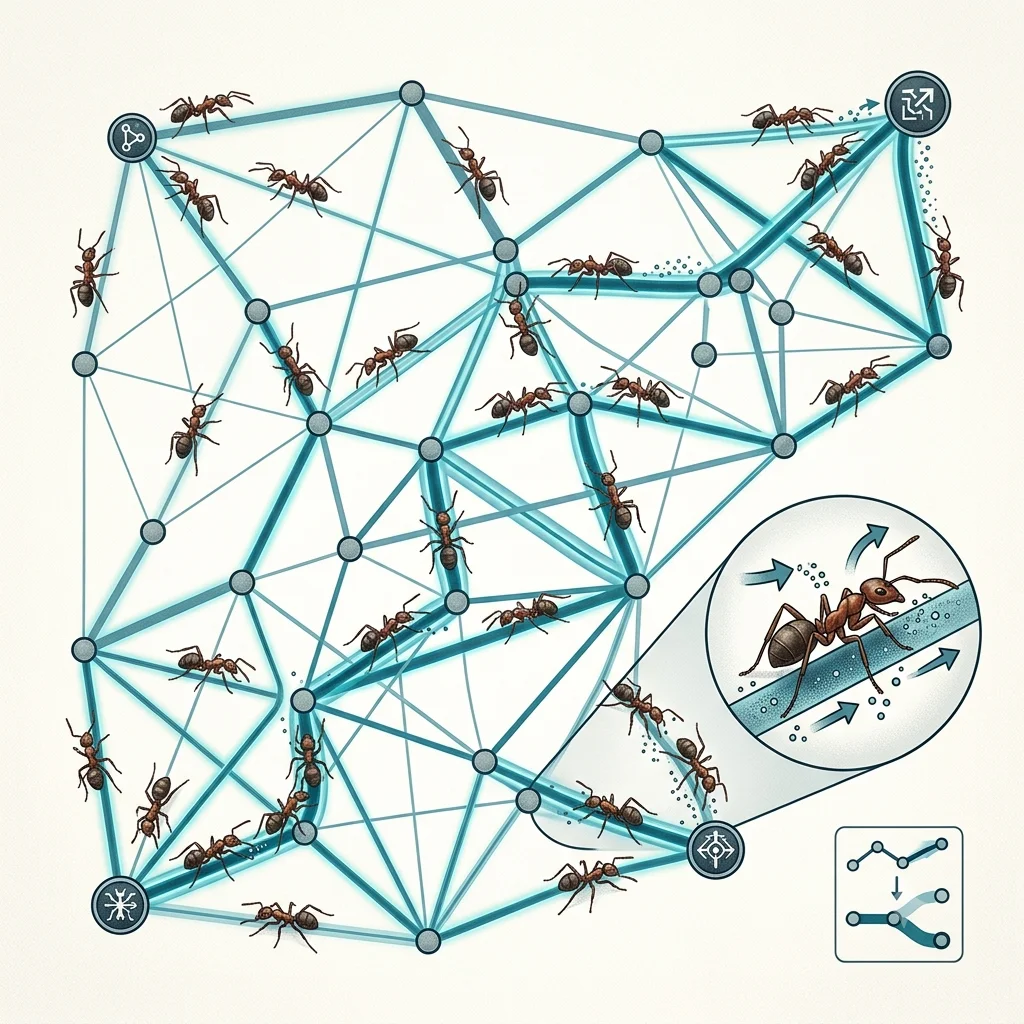
The mathematical side of the ant trail is simple but tough: the first individual tries a route and leaves a trail, then the others follow this trail, and the successful route grows stronger because it is used more. This is a positive feedback loop. In other words, the trail that works well gets even better because it attracts more traffic. The bad trail, on the other hand, weakens because it is not used. The colony doesn’t walk randomly here; it sets up a system that does half trial, half loading.
In computer science this behavior is modeled as Ant Colony Optimization, i.e. ACO. This idea is used in route optimization, logistics, network traffic and similar fields. In a sense, the ant did distributed optimization before humans did. This point shows how powerful the results of simple rules in nature are. If you like, you can match the rest with the pheromone and colony sections in the main ant article.
How does an ant follow the trail with its antennae?
The ant antenna is a sensor package that works like an organ of smell. The sensilla structures on its tip read the pheromone concentration. The ant perceives the right-left difference, turns toward the side where the concentration is higher and tries to keep the trail in the center. This method is not looking at a line seen with the eye; it is reading a chemical gradient. The strength of the trail is decisive here.
Another critical feature of the pheromone is that it is temporary. If an unused trail is not renewed, the signal weakens. Thanks to this, the system erases old and inefficient routes on its own. Nature doesn’t hold on to an unnecessary trail and keep it. It behaves rather like a self-cleaning network. This logic becomes clearer when read together with the nest and communication logic in the basic ant guide.
How is an ant trail broken and what is it good for?
Breaking an ant trail means disrupting the pheromone trail. Surface cleaners such as vinegar or lemon juice can weaken the chemical trail. Soapy water also helps disperse the residue on the surface. But the real issue is not wiping the trail away; it is closing off the source that feeds the trail. If there is open food, trash, poor hygiene and an entry point, the ants set up a new trail. In other words, the issue is not a single move but a system measure.
In practice these three links work together: close off the source, clean the surface, narrow the entry. These three steps break the trail in the short term and lower colony pressure. Loading up on chemical pesticides is an unnecessarily heavy move for a simple kitchen problem. For the wider context of the topic, Ant biology and the upcoming Ant nest architecture article can be read together.
Ant FAQ and related links
How long does an ant trail last?
If the pheromone trail is not renewed, it weakens in a short time. If there is an active line, it is constantly reinforced and the trail stays up longer.
Do ants have a leader?
Not in the classic sense. The colony works in a distributed way. The individual that finds it first leaves a trail, the others follow it.
Is wiping with vinegar enough?
It helps temporarily. But if the source is still there, a new trail is set up again.
Which ant species are seen in the house?
Small black species are seen most often; in the field, types such as Lasius niger and Tetramorium caespitum are often mentioned. For a broader species map, the article Ant species map is the main reference.
Related notes: the Argentine ant supercolony and Ant nest architecture are good complements for the next steps.
The source backbone is clear: Hölldobler & Wilson, The Ants, Marco Dorigo’s ACO work and AntWeb are the basic starting points for expanding this topic.