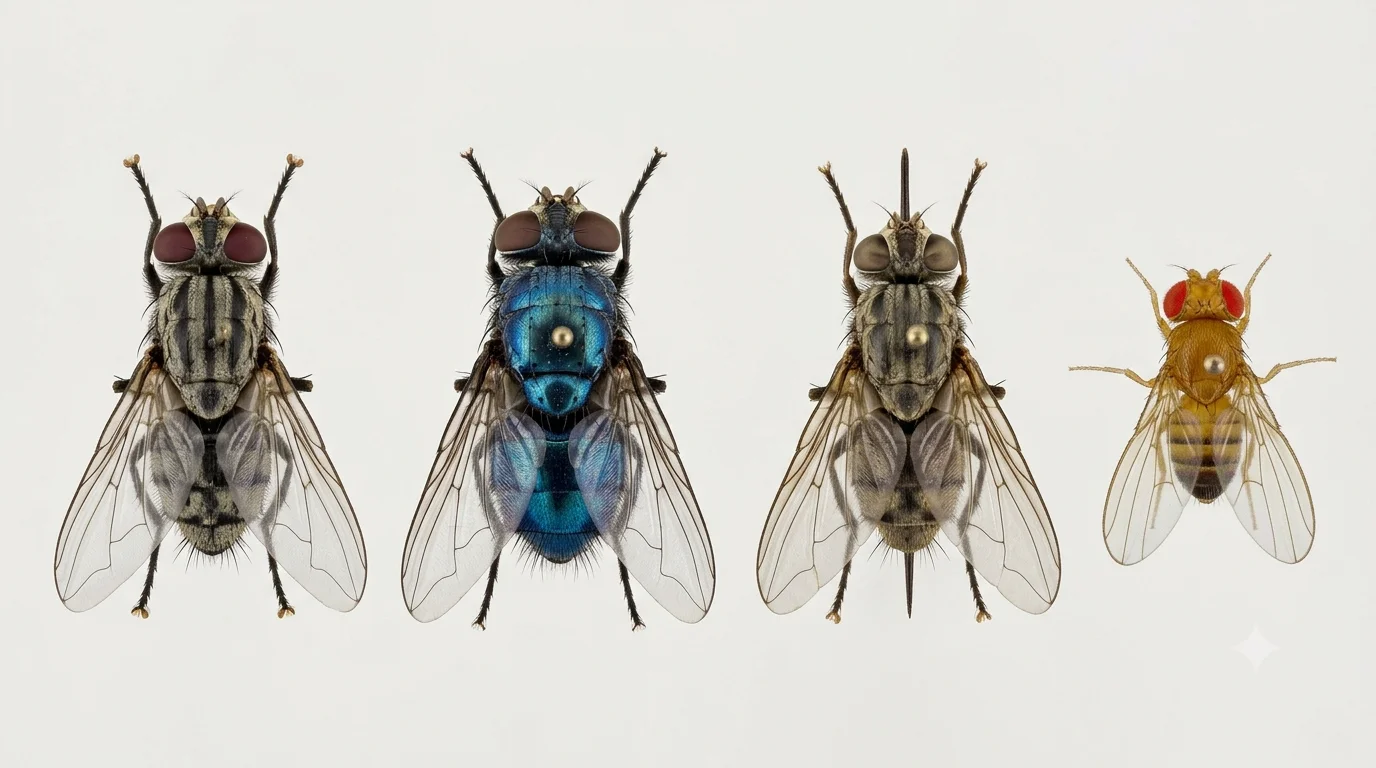
The house fly is a member of the Diptera that the public recognizes most easily but often names wrongly. The most commonly seen species is Musca domestica, and this species belongs to the family Muscidae. The roots of the house fly lineage go back about 50 million years; in other words, this creature is not a new guest of the city but a very old master of adaptation. Seeing it in the house is no coincidence. There is usually organic waste, open food, a damp surface or an attraction source coming in from outside in the immediate surroundings. This article is a general guide; for the detail asked about most often in daily life, you can look at our article Why Does the House Fly Escape So Fast? The Wonder of the Eye.
The main types of house fly seen in Türkiye
When we say house fly, we are not talking about a single creature. The small grey-black species you see in the house is one thing, the shiny metallic species is another, and the biting species is yet another. This distinction is essential for reading behavior correctly. If you keep the house fly label broad, you will choose the wrong repelling method. Knowing the right species speeds up finding the source and gets the job done instead of panic.
Musca domestica
Musca domestica, i.e. the common house fly, is the most widespread species. It looks grey-black, its length is usually around 6-7 mm, and it approaches kitchens, the surroundings of trash, animal shelters and areas with open food. This species’ mouthparts are sucking and lapping; they are suited not for biting but for taking in liquid and dissolved food. It is not surprising that this is the one seen most in the house, because human settlement means a feeding and breeding ground for it.
Calliphoridae
Calliphoridae is the group the public knows as the blow fly or the blue/green sheened fly. It looks larger than the house fly, and its body has shiny metallic colors. It usually turns up around meat, trash, carrion or open organic matter. Seeing it inside the house, especially in the summer heat, points to organic sources carried in from outside or left open. Its appearance is striking, but at the classification level it is not one and the same as the house fly.
Stomoxys calcitrans
Stomoxys calcitrans, i.e. the stable fly, is referred to as a house fly, but its behavior is different. This species bites, because it feeds on blood. It is seen more often in barns, farms, manure and areas dense with animals. It is rare inside the house, but you may come across it in the countryside or in regions where livestock farming is done. Not every case opened as a house fly problem may actually be this species; that’s why a biting complaint needs to be read separately.
Drosophila melanogaster
Drosophila melanogaster is known as the fruit fly and is used a great deal in scientific research. Its length is around 3 mm. It gathers around fruit that is starting to rot, fruit juice, vinegar and fermented products. In everyday language it sometimes falls under the house fly umbrella, but biologically it is a different reference species. If it shows up in the fruit crate at home, the problem is usually the way the kitchen storage is arranged.
House fly biology and life cycle
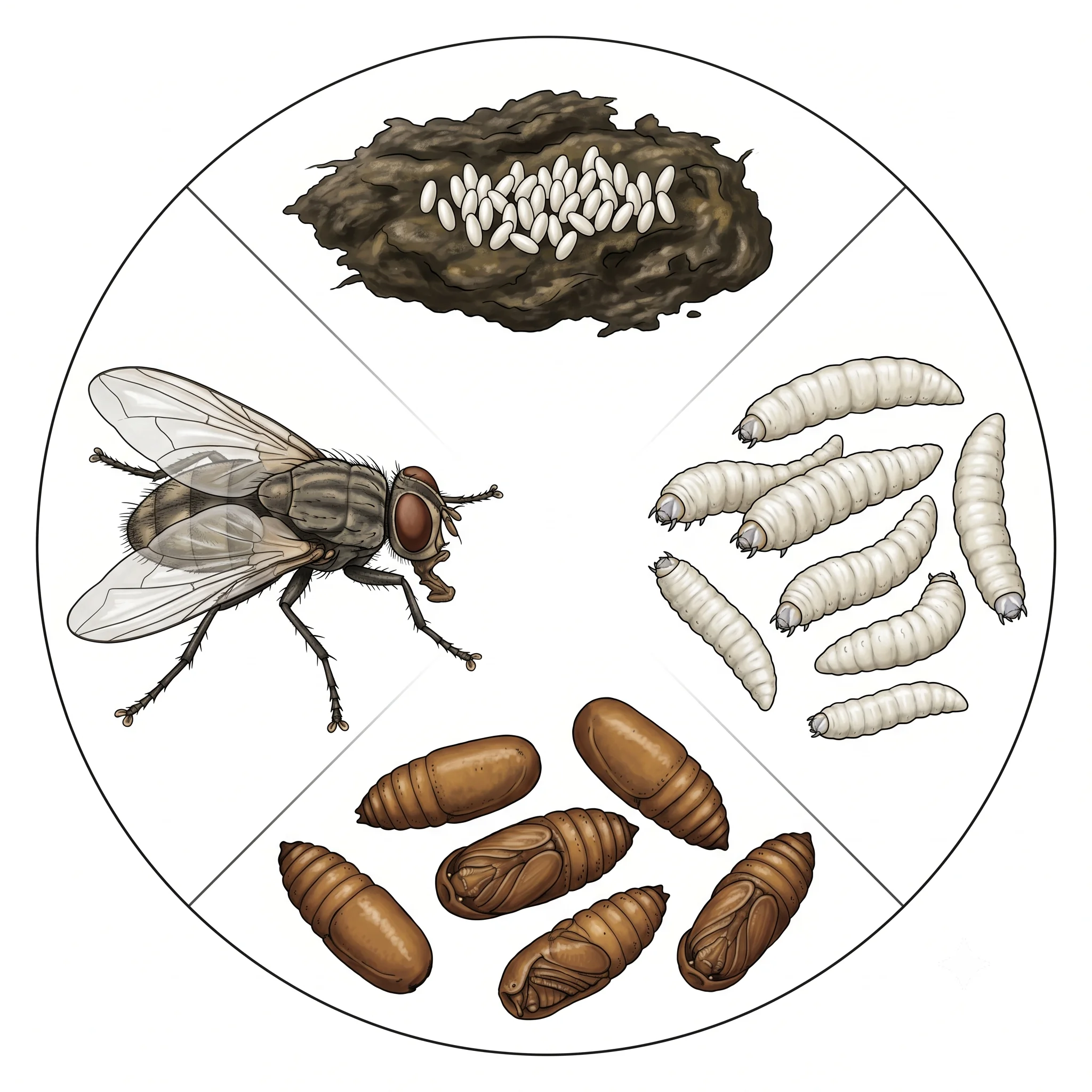
The house fly goes through complete metamorphosis. That is, it has egg, larva, pupa and adult stages. The eggs are usually laid on organic matter: trash, manure, spoiled food, dirty surfaces. The larva is the stage the public calls the maggot, and it feeds quickly. This period can progress within 4-8 days. Then comes the pupa; in this stage the body is rebuilt. The adult house fly, meanwhile, lives 15-25 days under most conditions. The fact that the female can lay about 500 eggs over her lifetime makes this insect effective despite its short life.
The house fly’s cycle is very sensitive to temperature. When the weather warms up development speeds up; in the cool period it slows down. That’s why the population increase becomes more visible in the summer months. If you see flies one after another inside the house, it is usually not a matter of single individuals but of a breeding line working in the immediate surroundings. Killing only the visible individual without cutting off the source is like skimming the foam off the water; the flow remains.
House fly anatomy and the wonder of the compound eye
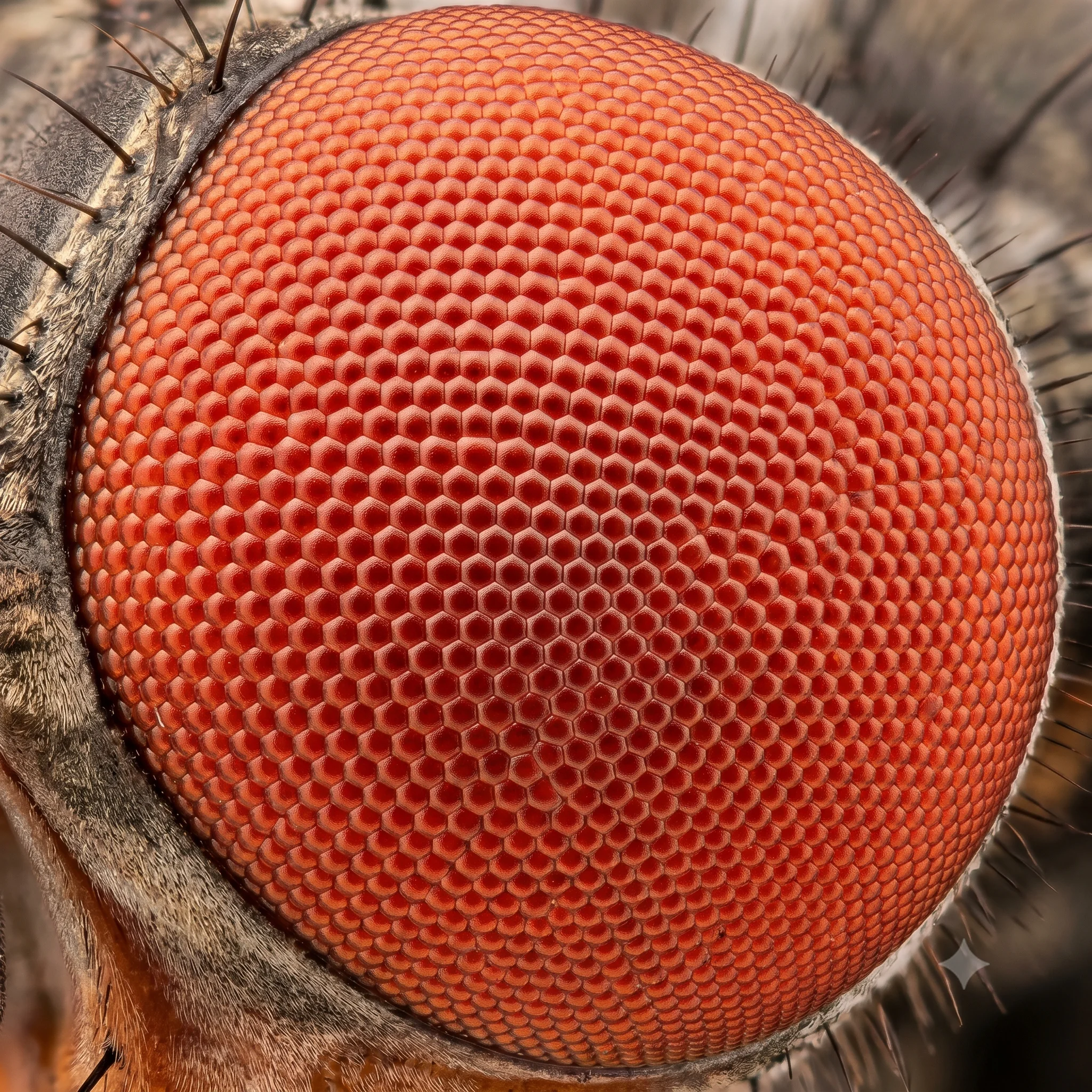
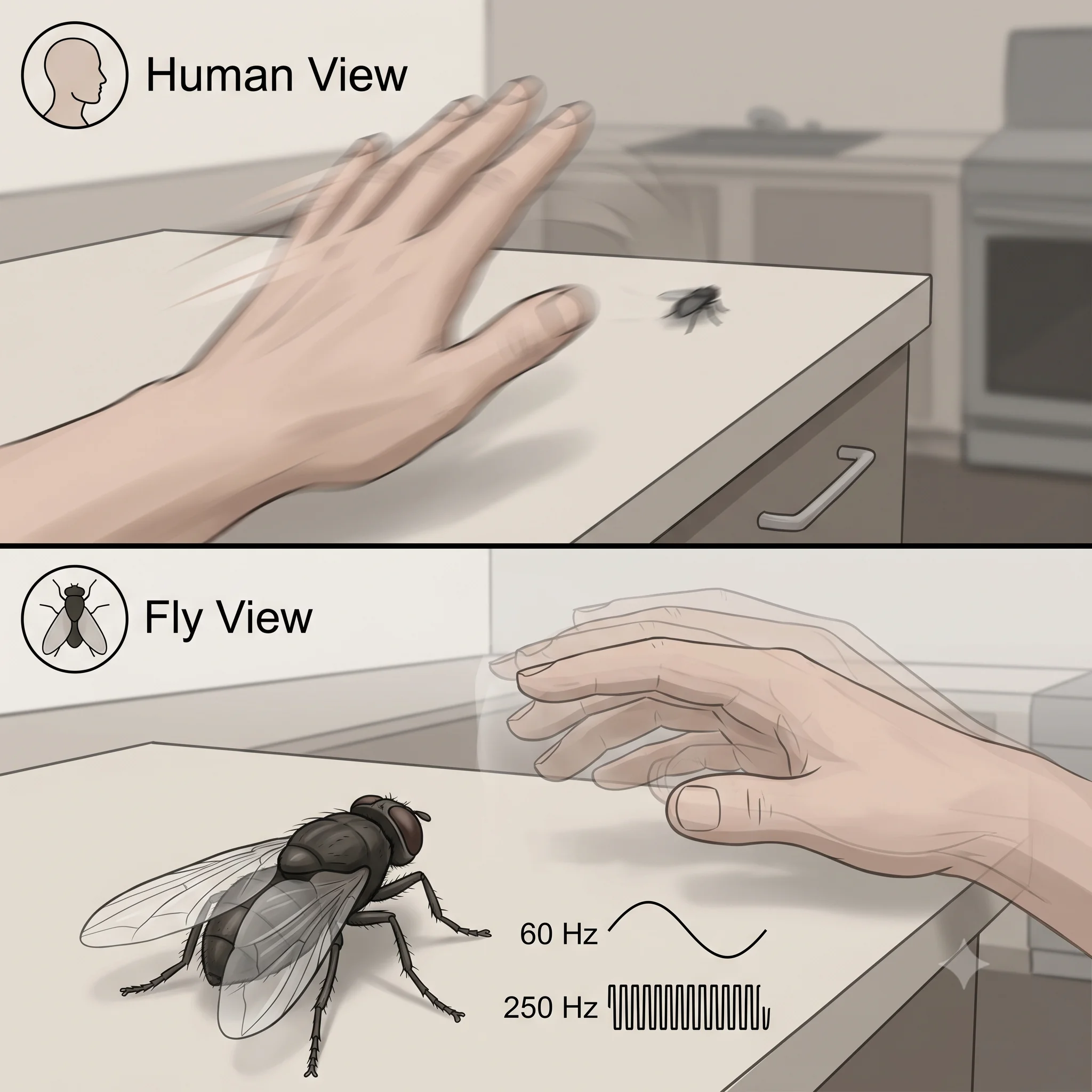
The house fly’s real skill is not its speed but its perception. Its compound eye contains 3000-4000 ommatidia. Each of these small lenses captures a separate part of the image. The result is this: the house fly follows motion with a higher temporal resolution. A hand movement that looks sudden to a human looks slower and readable to it. The value of about 250 Hz given for the flicker fusion rate also describes this; compared with the human level of about 60 Hz, the difference is large.
That’s why house flies are hard to catch. When you swing your hand, they usually receive the signal early enough to change direction and escape. There is no magic here. Eye physics, nerve conduction and flight muscles work together. The wing structure is light, balance is established quickly, and the legs are effective at gripping surfaces. In short, the house fly is not a small accident but a well-tuned flying machine.
House fly behavior and attraction factors
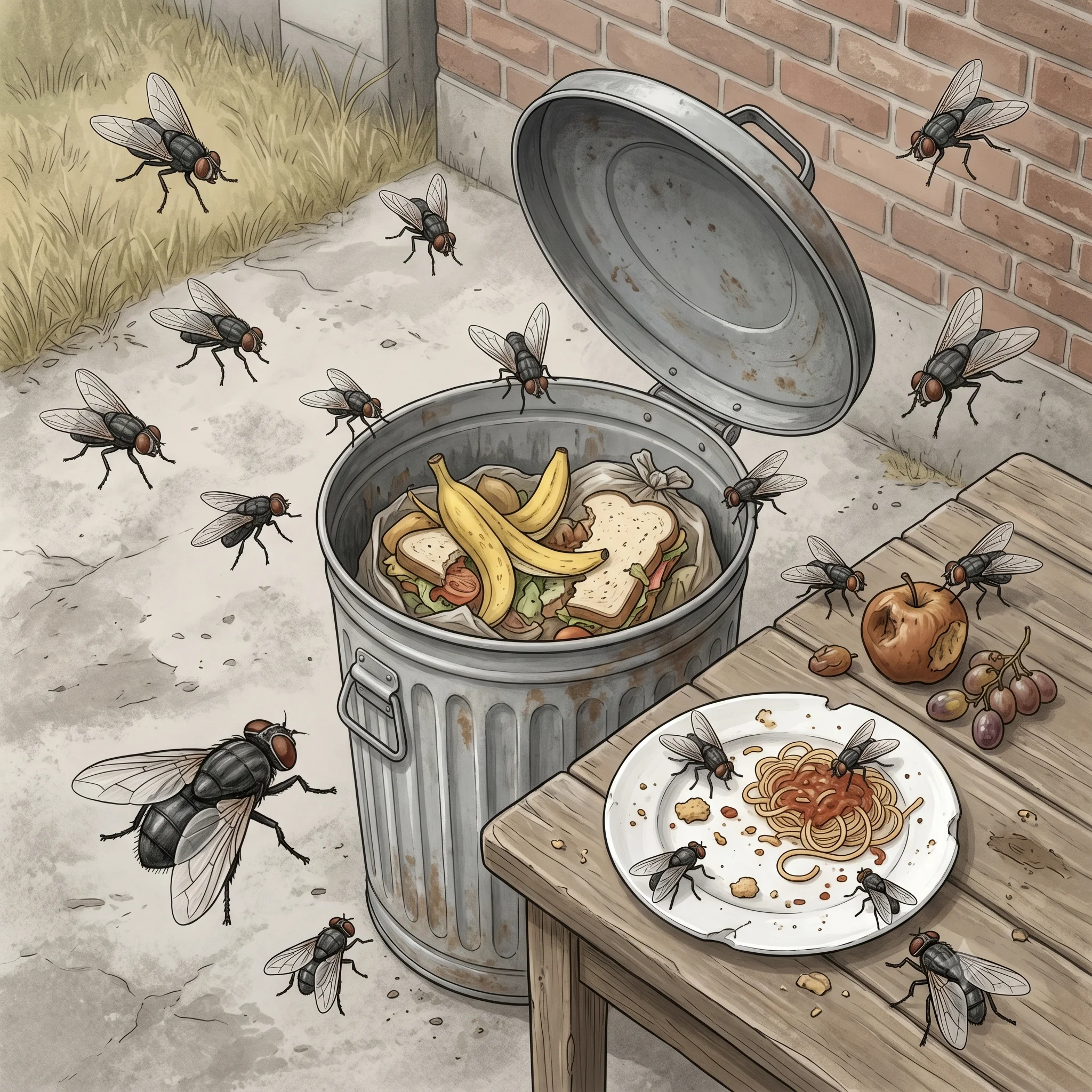
The house fly follows odor. Aldehydes, amino acids, urea fragments, sweet odors and protein odors in particular attract it. That’s why trash, fruit, meat scraps, feces and dirty surfaces create problems. It is active during the day; at night it tends to rest more. If there are house flies in the house, you have to accept that there is an attraction source there. This is the first rule of reading behavior.
The house fly’s habit of approaching is not random either. A window opening, a gap at the door, an area without a fly screen, an open trash can and uncovered food are like an invitation. That’s why source management is needed first, instead of aggressive chemical repellents. The trash will be closed. The kitchen surface will be clean. Food will not be left out. If flies are getting in, the household routine is usually also giving off a signal.
The seasonal effect is clear here. The increase starts at the end of spring, and the peak is seen in midsummer. Temperature speeds up the short cycle; open trash and outdoor areas also boost the breeding rate. The same house may look calm in winter but produce problems in summer. In other words, the issue is not a single insect but the source window that opens with the season.
The house fly is drawn not only to odor but also to light and warm surfaces. That’s why the area in front of a window, a bright kitchen and a balcony door left open all day become a good route for it. The individual seen inside is usually a scout that has slipped in from outside. Repeated entries, on the other hand, show that a route has been established. Rather than just following the fly, finding which opening is bringing it in is the smarter move.
The relationship between the house fly and humans
The house fly is an old traveler that has spread together with human settlements. Throughout history it has lived around cities, barns, markets and kitchens. That’s why its negative image is strong. It is associated with dirt, food hygiene and bad smells. But reading it one-sidedly is not right. The house fly is an indicator that responds to the waste patterns humans leave behind. In other words, it is usually not the cause but the result.
House fly-like species are frequently encountered in historical sources, because as human density increases this insect becomes visible too. Seeing one or two individuals in the kitchen does not mean a big crisis. But constantly repeated entry points to a nearby source. In this case, door-window checks, surface cleaning and trash management are considered together. Doing one and leaving the others is a half-done job.
In the city, the real risk is the apartment building’s trash area, basement dampness and food left out on the balcony. In the countryside, animal shelters, manure and feed stores come to the fore. In other words, when the place changes, the behavior changes too. Under the same house fly heading, a different reading of the field is needed.
House fly health perspective
The house fly does not carry a major direct biting risk; but it can be a mechanical carrier. That is, there is a possibility of it carrying microorganisms from surface to surface. For Salmonella, E. coli, Shigella, Campylobacter and some parasite eggs, this risk is theoretical but not insignificant. The issue is not fear but hygiene. If food is left uncovered, the problem grows. If a house fly that has walked over a dump, a manure area and a dirty surface then lands on the kitchen counter, the chain is complete.
This section is not medical advice. The basic approach is this: food hygiene should be ensured, food should not be left uncovered in an environment with many house flies, and a physician’s opinion should be sought for complaints such as fever or diarrhea. In Türkiye there is no current account of a large-scale outbreak linked to the house fly; the real issue is local sanitation and food safety. That’s why the food safety and vector control frameworks of the WHO and the CDC are important.
In food businesses, the issue is not a single fly but cross-contamination. If one individual gets into the production line, a chain of contact with surfaces, equipment and the packaging area begins. That’s why physical barriers, waste management and regular cleaning are more valuable than a one-off spraying.
House Fly FAQ
Why does the house fly escape so fast?
The house fly’s compound eye and nervous system catch fast changes in motion early. That’s why your hand looks fast to you and slow to it. The result is that the escape starts early.
What is the lifespan of the house fly?
The adult house fly lives 15-25 days under most conditions. Given temperature and food, this window can change. The egg and larval stages have a shorter cycle.
Does the house fly bite?
Most house flies do not bite. Musca domestica has sucking-lapping mouthparts. Among the biting species, Stomoxys calcitrans stands out.
How do you protect yourself from house flies?
The most solid way is source control. The trash will be closed, food will be covered, the fly screen will be intact and entry points will be sealed. A chemical solution comes last.
What is a maggot, and is it harmful?
The maggot is the larval stage of the house fly. It develops on organic matter. Seeing it in the house is a sanitation problem; in nature, it is part of the decomposition cycle.
Topics and sources related to the house fly
This page is the hub that opens onto narrower topics. Understanding the house fly ranges from compound eye physics to the larval stage, and from the difference from the fruit fly to the life cycle. The links below build the subtopic structure and deepen the subject without scattering it.
- Why Does the House Fly Escape So Fast? The Wonder of the Eye — subtopic #12
The backbone sources for reading external references are these:
For searching in Turkish, TÜBİTAK is a good gateway for the general reader. To clarify taxonomy and species differences Britannica is more useful, while for understanding the family level the Muscidae literature is. This is the way to close the house fly case correctly: know the species, find the source, fix the environment. The individual seen in the house is usually not the issue on its own; repeated entry means a permanent source. Seeing a fly is a reminder that there is a gap in the system; the solution is to close that gap. That’s why source control, household order and seasonal monitoring should be considered as one package; not a single measure but a three-part defense works. Without continuity the house fly comes back, returns again right away.
Related Topics
If you want to read this topic in a broader context, look at the cluster articles: Mosquito: Biology, Species and Health Information.