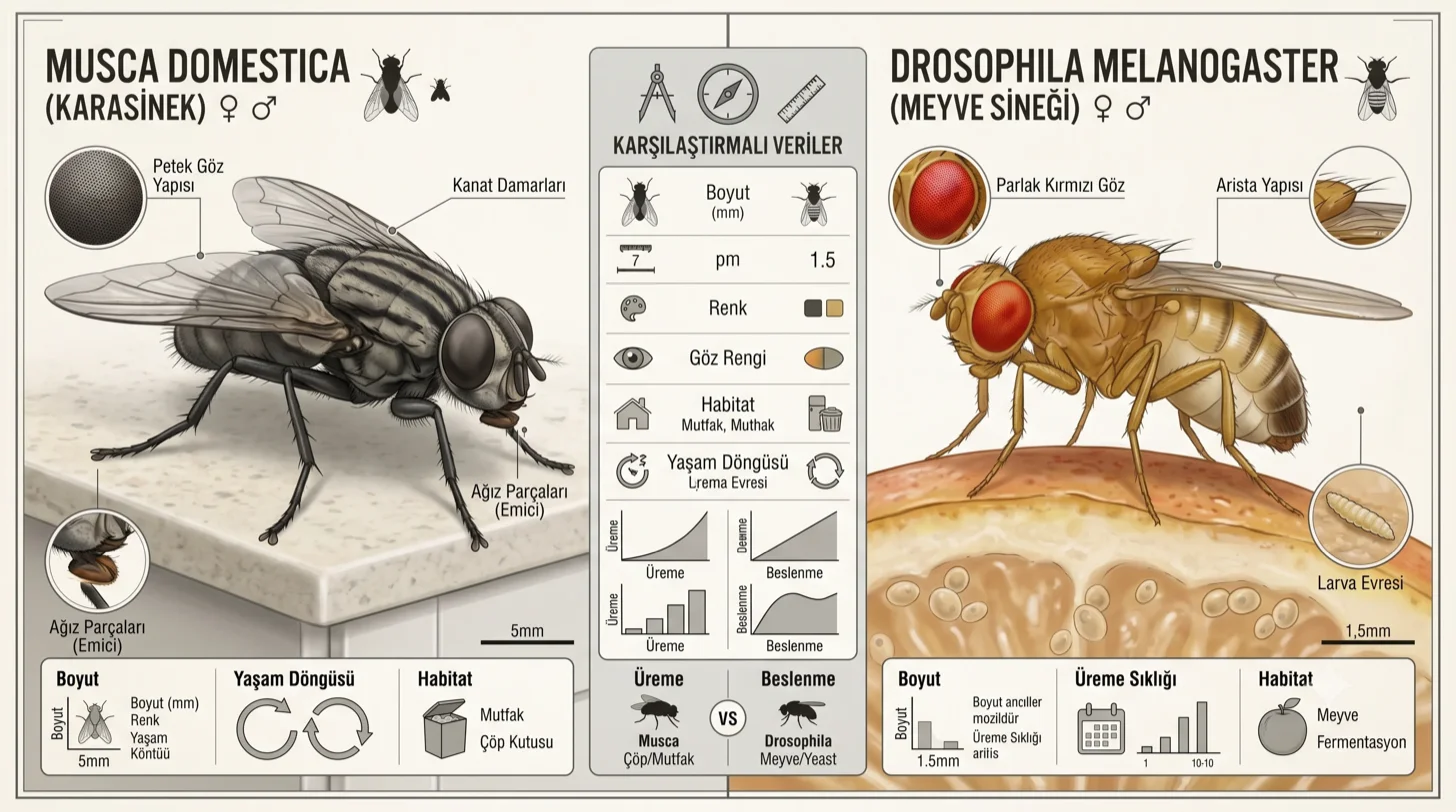
The difference between the house fly and the fruit fly falls fully into place when read together with the main house fly guide and the article explaining why the house fly escapes so fast. The issue here is not a single name; it is two separate biologies. On one side there is Musca domestica, on the other Drosophila melanogaster. One circles around trash and human living spaces; the other lives around ripe fruit, vinegar and fermentation.
This distinction matters, because a wrong identification produces a wrong solution. For the house fly, the trash line is targeted; for Drosophila, the fruit and fermented food line. Think of it as if two different problems had entered the same room. As much as what the eye sees, where the smell comes from also gives a clue.
| Sign | House fly | Drosophila |
|---|---|---|
| Size | 6-7 mm | 2-3 mm |
| Body | Gray-black, matte | Yellow-brown, matte |
| Eyes | Normal dark eyes | Red eyes |
| Typical source | Trash, restaurant waste, around drains | Ripe fruit, vinegar, wine |
| Type of risk | Mechanical carrier, hygiene risk | Food waste, spoilage |
A quick line of distinction
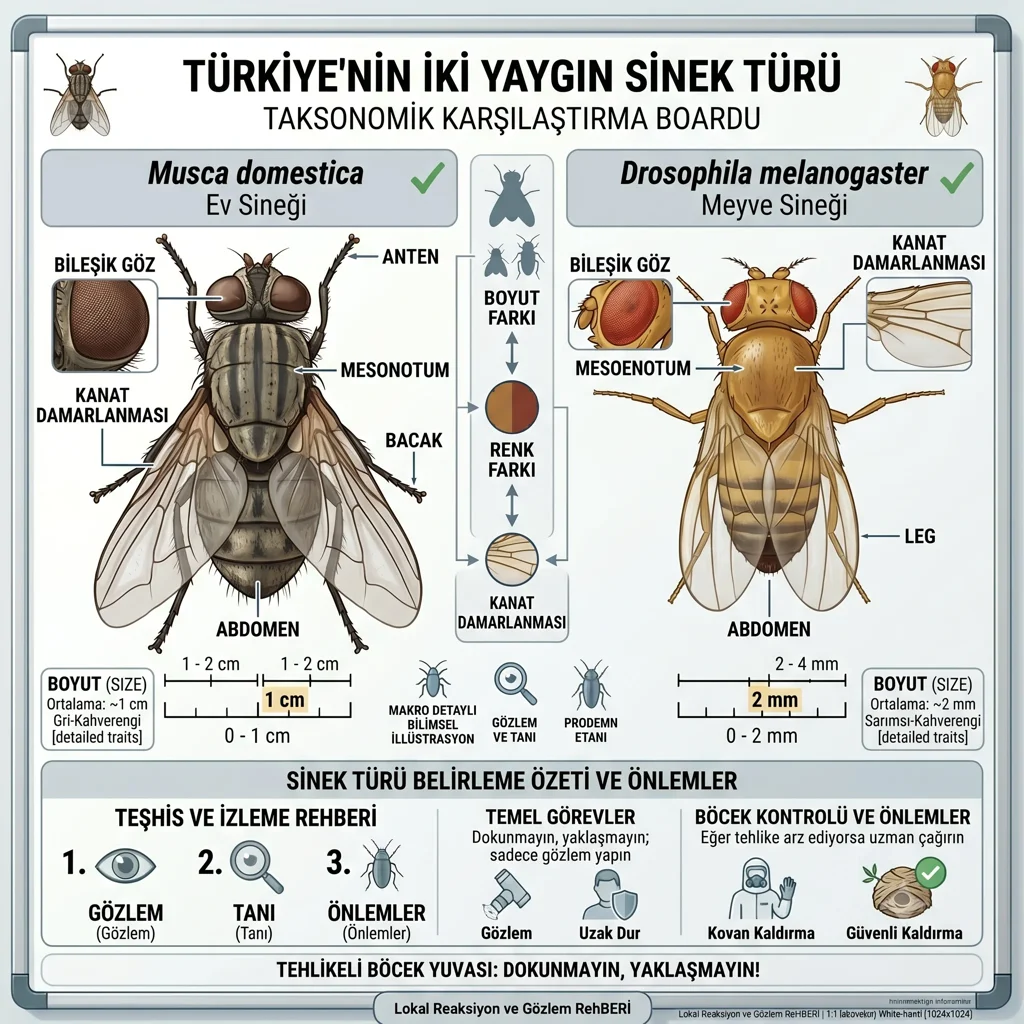
The house fly is 6-7 mm long. Drosophila is around 2-3 mm; that is, roughly a third of the size. The house fly looks gray-black, more matte and coarser. Drosophila has a yellow-brown body and is smaller and lighter. The quickest sign is the red eyes. At a single glance, read the size, body color and eye color together.
Wing posture also helps. The house fly’s overall silhouette looks fuller, its legs stronger and its head-to-body proportion larger. Drosophila, on the other hand, is tiny, agile and most often noticed in groups around fruit. You don’t need a microscope for a first decision; good light and a patient look are enough.
The habitat difference
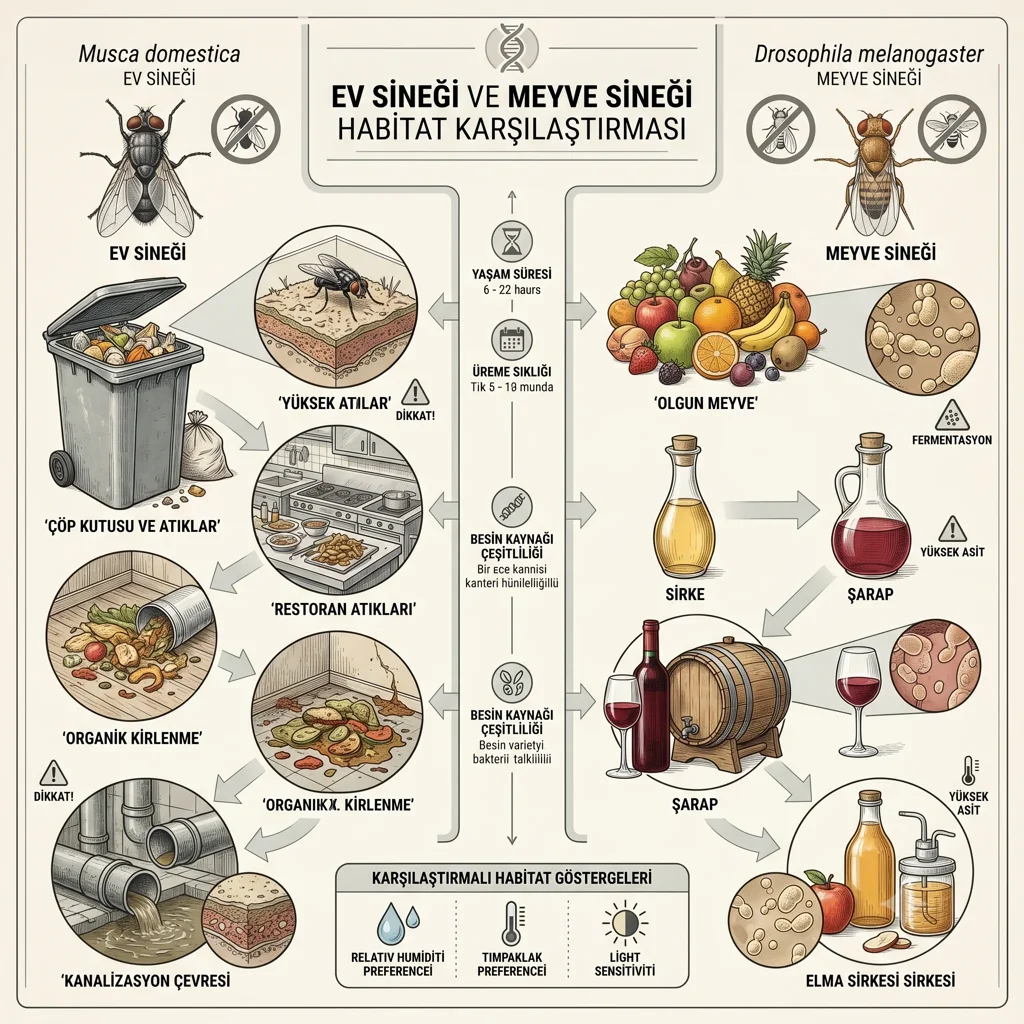
The house fly comes to trash, restaurant waste, organic debris left out in the open and the area around drains. This is because it lays its eggs on nutrient-rich, dirty and rotting organic material. Drosophila, by contrast, heads for ripe fruit, crushed grapes, wine, vinegar and apple cider vinegar. If there is a banana peel, an open fruit bowl or a fermented bottle at home, that is most often the source of the small flies. Habitat is half of the identification.
The hygiene and disease difference
The house fly does not work like an active biological vector; but it is a mechanical carrier. In other words, it does not produce the microbe, it carries it. Bacteria and dirt stuck to its feet and body can pass onto food. Salmonella, E. coli and Shigella are the important names here. That is why the house fly is taken seriously in food hygiene.
For Drosophila the picture is lighter. It is a nuisance at home and spoils fruit, but it is not considered a vector that carries human disease. The main harm is food waste and loss of stock. The same wings do not mean the same risk.
That’s why you shouldn’t lump together a few small flies that came in with a grocery bag and a house fly coming out of the mouth of a trash can. The first is most often a storage problem, the second a hygiene and waste problem. In the field, correct identification is half of the correct intervention.
The life cycle and the science side
For the house fly, the transition from egg to adult is in the 7-10 day band in most sources. For Drosophila this period is around 8-14 days. Both are fast; so if the source remains, the numbers increase in a short time. The house fly explodes in large organic waste, Drosophila multiplies in a small corner of fruit.
Drosophila’s place in science is special. Thomas Hunt Morgan’s 1933 Nobel Prize rests on work showing that genes are arranged on chromosomes and that inheritance can be mapped. When gene mapping is mentioned, it is one of the first species that comes to mind. So passing it off as a “small fly” is wrong; this species is one of the cornerstones of modern genetics.
This is also why the same species is so valuable in the laboratory: short generation time, mutations that can be followed by eye and ease of controlled mating. For a biologist, Drosophila is not just an insect wandering around the house; it is a standard model for heredity, development and gene expression.
An ecosystem note
Through a biologist’s eyes, neither of them is merely “harmful”. In nature they process decaying organic matter, serve as food for other creatures and take part in the decomposition cycle. The problem is not their role in nature; it is their entering the kitchen, trash and food line in the wrong place. Their meaning for people starts here.
That’s why apartment building management, market leftovers and kitchen order are not to be underestimated. Reading the species correctly narrows the intervention: you don’t pay for the wrong product, you don’t spray pesticide in the wrong area, and you close off the source faster.
What to do?
For the house fly the main line is clear: cover the trash, don’t let organic waste sit, cut off the source around apartment buildings and restaurants, and if necessary apply professional pest control. For Drosophila the solution looks simpler: keep fruit covered, remove ripe-rotten produce, don’t leave vinegar and fermented liquids open, and if necessary set up a vinegar trap. With the house fly, the hygiene and waste line comes first; with Drosophila, the storage and fermented source line comes first.
If the lid isn’t closed, the job isn’t done. If the mouth of the trash can is open, the area around the sink is damp, the top of the fruit crate is open or vinegar is left at the bottom of a bottle, the flies come back. That’s why the solution is not a single product but a chain of small disciplines that cut off the source.
A source left open in the kitchen even for one day can come back the next day as small flies.
In the field, this distinction cuts out the wrong choice of pesticide and unnecessary expense. You don’t carry out treatments for nothing. That is the clear result.
A biologist’s note
When identifying, use the specimen plate logic: have the dorsal view, the scale and the eye color in the same frame. A single angle deceives. In particular, if red eyes, small size and the fruit line are seen together, the likelihood of Drosophila rises. A gray-black, larger specimen roaming the waste line, on the other hand, is a house fly.
FAQ
Is the small fly called a “stain fly” in Turkish the same thing as the vinegar fly?
In most household contexts, yes. These names are used together for Drosophila melanogaster; it is also called the fruit fly.
Why is the house fly considered riskier?
Because it lands on food and carries microbes mechanically. The risk lies in the hygiene line.
Are red eyes alone enough?
Not on their own, but they are a very strong clue. They need to be read together with size and habitat.
What is the first step with a small fly that gets into the house?
Find the source. The problem won’t end until fruit, trash, vinegar and damp organic debris are checked.
Sources
- Penn State Extension — House Flies
- UC IPM — Flies
- Britannica — Fruit Fly
- Nobel Prize — Thomas Hunt Morgan, Facts
- Cornell University — Search: house fly
- NIH — Search: Drosophila Image Library
- Ministry of Health of Türkiye, HSGM — Zoonotic/Vector-Borne Diseases (in Turkish)