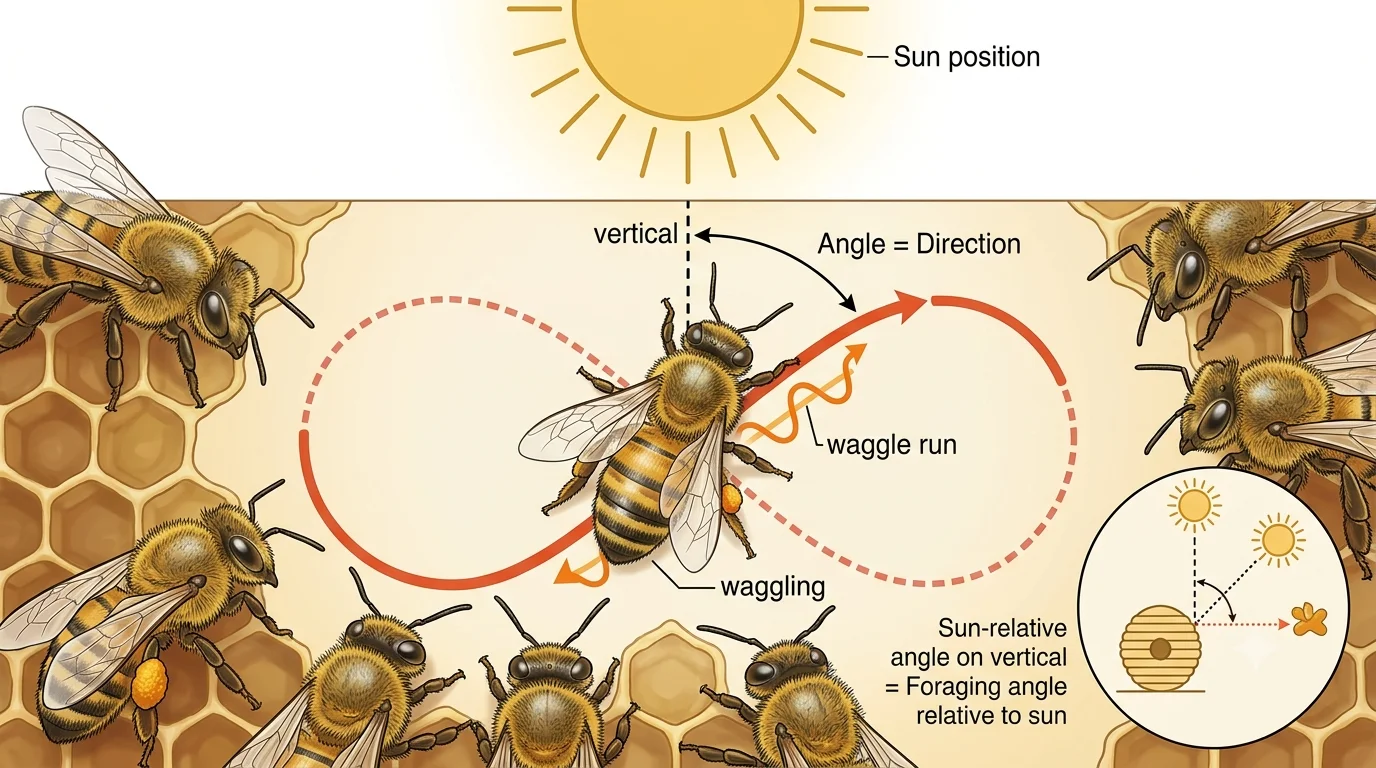
The honey bee dance language is a bee giving the colony location and quality information about a source it has found. Its best-known form is the waggle dance, that is, the figure-8 dance. Here the bee doesn’t just waggle; it encodes direction, distance and the strength of the source. This article should be thought of as a subtopic connected to section 5 of our main Honey Bee article. The short answer is this: the honey bee turns the information of the individual that found food into collective intelligence. This behavior is one of the most advanced examples of symbolic communication in the insect world. For the colony behavior section of the Honey Bee article, this topic is a key piece in understanding colony logic.
What does the honey bee dance language tell?
The honey bee dance language is a map of resources. When a worker bee returns from a flowering area, it moves back and forth on the comb in a particular pattern. The axis and duration of this movement tell the other workers what they should look for. In other words, the message doesn’t stay at the level of “there’s food here”; it opens up as “in this direction, at this distance, this good”.
The logic of this system is simple, but its effect is large. Instead of individuals in the colony trying things one by one, they copy the source found by an expert. This saves energy. In honey bee society, information works not like a word coming from a single mouth but like data carried by movement. That’s why the dance language is read like a communication protocol that can be observed in the field.
How was Karl von Frisch’s honey bee discovery made?
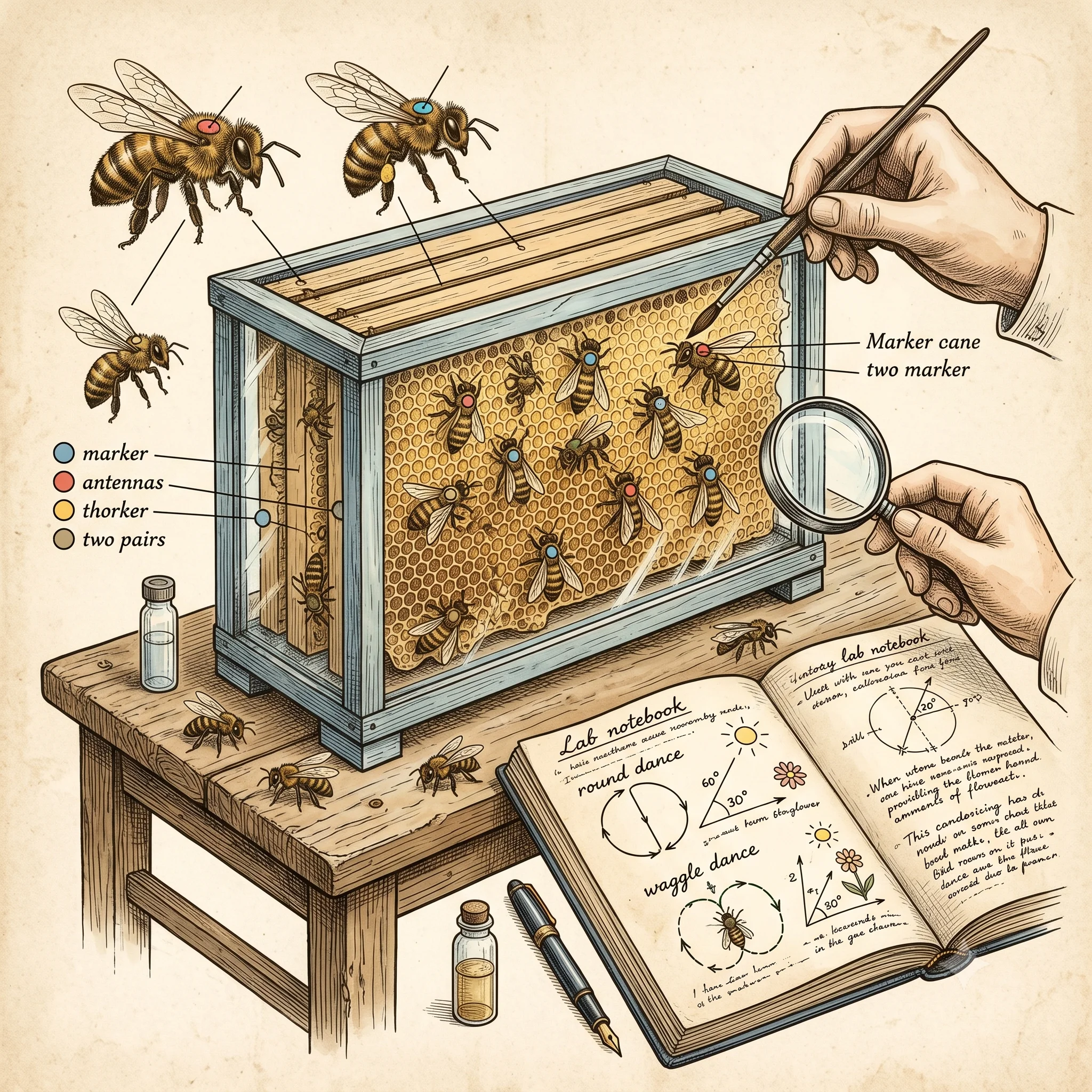
Karl von Frisch systematically studied the movements of honey bees in the first half of the 20th century — especially from the late 1920s onward. He followed marked bees returning to the hive, changed the location of the source and showed that the dance pattern changed accordingly. This line pointed not to a random vibration but to an orderly code. The result later entered classic science history; von Frisch shared the 1973 Nobel Prize in Physiology or Medicine with Konrad Lorenz and Nikolaas (Niko) Tinbergen.
The important point here: the discovery did not come from a single observation. Repeated experiments, controlled changes of the source and the response of other bees were read together. In other words, the honey bee dance language emerged through patient observation in the field. The general colony behavior section in Honey Bee: pollination and behavior explains in a broader context why this discovery is so critical.
How is the honey bee figure-8 dance decoded?
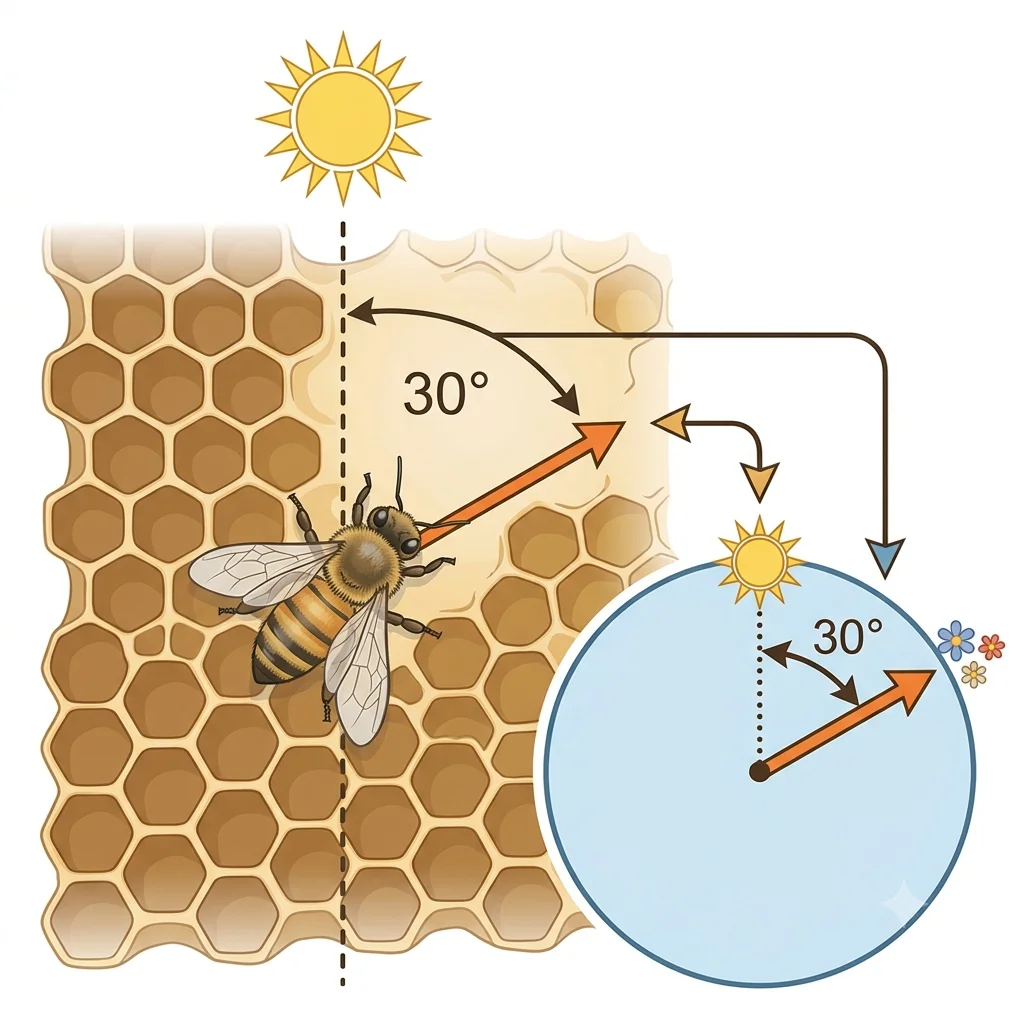
The heart of the honey bee dance is the waggle run. As the bee moves along a line on the comb, it vibrates its abdomen. The angle of this line relative to the vertical describes the relationship of the food source outside to the sun. Here is an example: on the vertical comb, the upward direction is the direction of the sun. If the bee turns the waggle line slightly to the right of up, the source lies in the direction to the right of the sun.
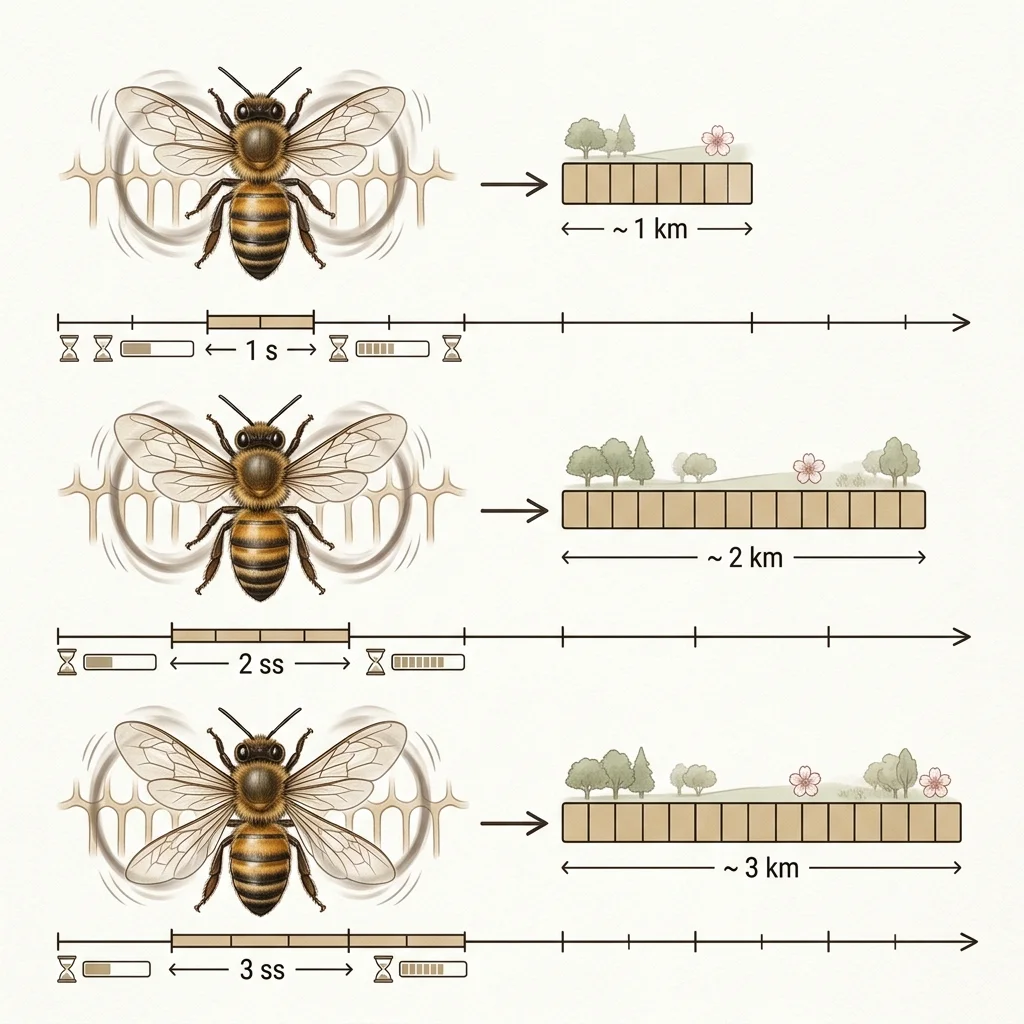
Distance information, meanwhile, lies in the waggle duration. The longer the waggle, the farther away the source is taken to be. The definitions can vary with laboratory and field conditions, but the main idea is fixed: a longer waggle means a more distant source. Quality information is also felt in the number of repetitions of the dance, its eager character and sometimes in the intensity of the stimulus. If there is plenty of nectar or good pollen, the dance can be more lively.
This decoding works like mathematics, but it is not as free as human language. It is a kind of geometry, a kind of speed, a kind of behavior reading. The bee doesn’t just show the colony a direction; it influences the decision for collective movement. That’s why the figure-8 dance breaks the cliché that “insects don’t talk”. In the main Honey Bee article, this section describes the mental work beyond pollination.
What is the practical test of the honey bee dance and its margin of error?
On the science side, the strongest test is whether the bees watching the dance actually fly in that direction. Experiments showed that the watching workers headed to the new source, and sometimes even responded to information given by robot bees. This supports the idea that the dance is not decoration but a signal that directs behavior. But the system is not flawless. Wind, terrain, the sun’s angle, in-hive conditions and the distribution of sources create a margin of error.
The previous section described the direction and distance code of the dance clearly; however, in the field this system doesn’t give absolute precision. In the field this margin of error matters. The bee leads roughly in the right direction; it doesn’t work like a GPS with micron precision. That’s why the waggle dance is not an absolute coordinate but a good-enough guide. From the colony’s point of view this is enough; because the aim is to direct not a single individual but hundreds of them to a productive area. There is a balance in communication here: little data, but high benefit. This logic can also be compared with the logic of the chemical trail in the How Do Ant Trails Form (The Pheromone Language) article.
What are the limits of the honey bee language, the FAQ and related links?
The honey bee dance language is impressive but not limitless. The most important limit is that this communication depends on the physical context. The comb surface, the sun’s position and the perception channels inside the colony are part of this system. Also, not every bee species speaks the same language. That’s why it is wrong to think of the honey bee as if it had a human language; more accurately, this is a natural encoding system.
On the FAQ side the short answers are clear: the dance language in its most classic form is seen in Apis mellifera. In a dark hive the information is read through vibration and touch. Female workers carry the foraging and dance role; males are not active in this regard. Robot bees and artificial dance experiments show that the system is based on order.
In external sources the basic references are clear too: the Nobel Prize page summarizes Karl von Frisch’s discovery; FAO pollinator resources explain the place of bees in agriculture; Britannica, meanwhile, gives a well-organized introduction to Apis mellifera and general bee biology. At first glance it looks like a simple dance; inside it there is colony decision-making, energy optimization and collective wayfinding. The honey bee here is more than an insect, it is a distributed information system.
Sources:
- https://www.nobelprize.org/prizes/medicine/1973/frisch/facts/
- https://www.fao.org/pollination/en/
- https://www.britannica.com/animal/bee-insect
the honey bee dance language is one of the strongest natural examples of an individual bee in the hive passing information to collective intelligence. If you read this article together with the colony, pollination and behavior sections in Honey Bee: Society, Communication and Ecological Importance, the picture is complete.