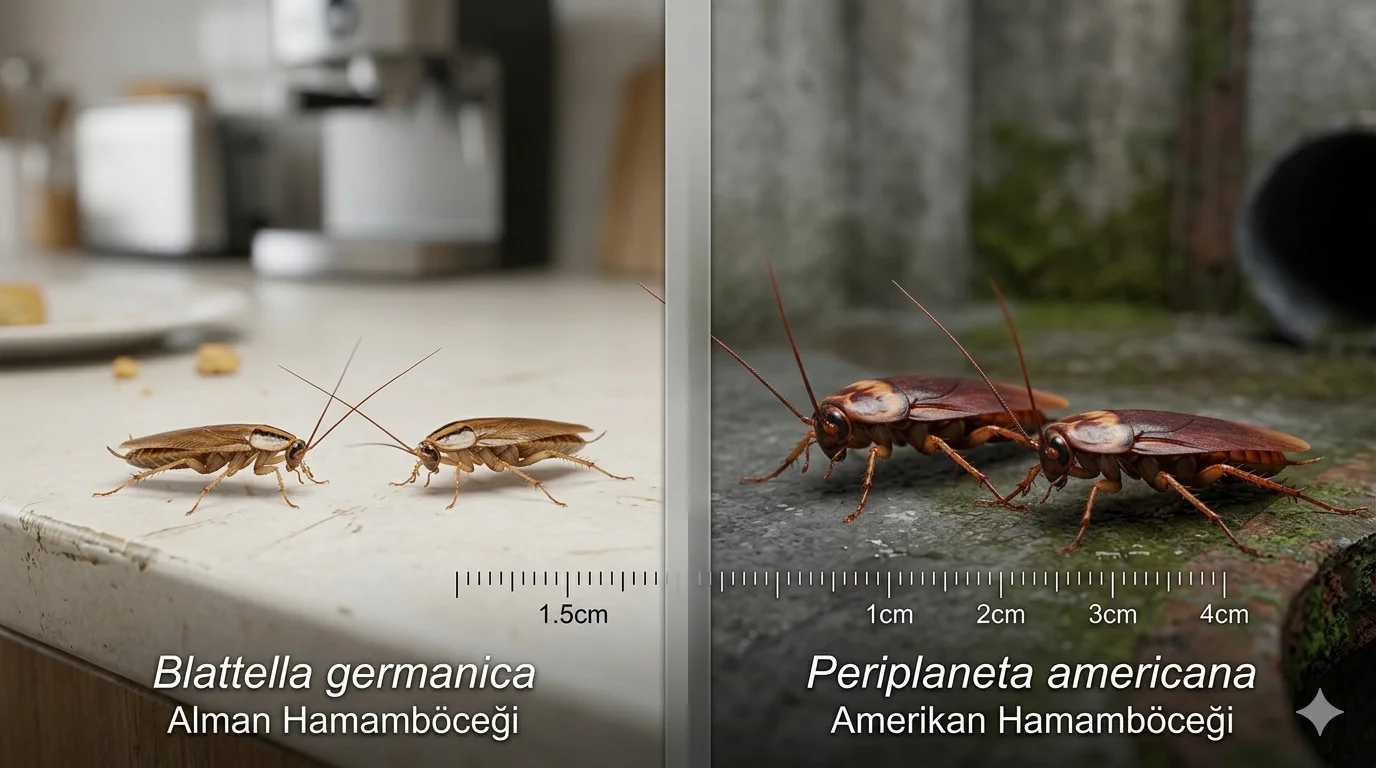
The difference between the German and the American cockroach is not just a difference in size. These two species belong to the same order but do not use the same niche. The main cockroach guide covers general biology; this article makes the species distinction clear. If you also want to see how they get into the house, the article why do cockroaches come indoors? describes the entry points. The right decision in the field starts with seeing the right species.
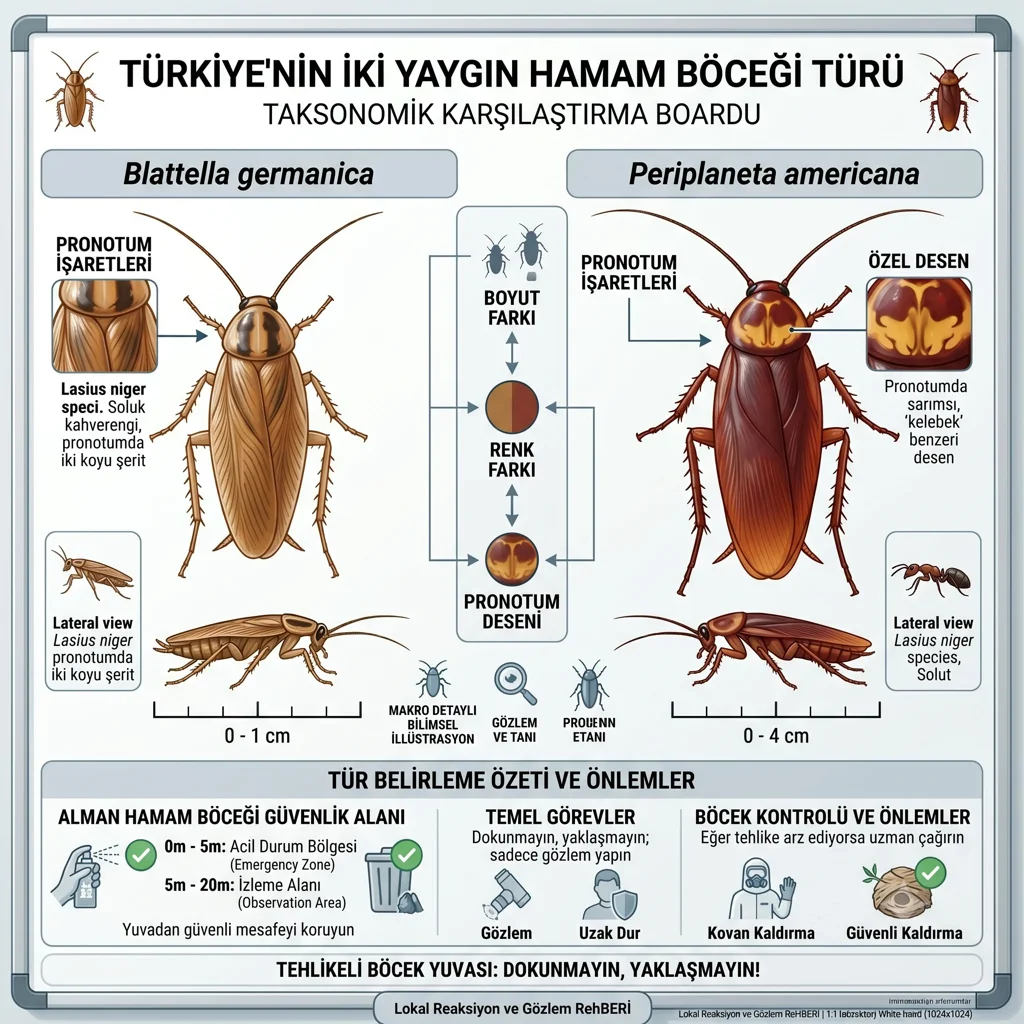
Quick summary: two species, two different problems
For a biologist this distinction is not cosmetic; it is a difference in behavior. Blattella germanica is a smaller species that reproduces faster and is tightly bound to indoor life. Periplaneta americana is larger, longer-winged and usually tied to building infrastructure and outside sources. The first sets up a kitchen colony; the second usually uses drains, basements and warm, damp transit lines. That’s why you need to read not the individual insect but the way of life behind the species.
German cockroach: small but fast
Blattella germanica is 12-15 mm long. Its body leans toward light brown-yellow; two parallel dark stripes on the pronotum are the most classic distinguishing mark. Its antennae are long and its body is flat; it slips into narrow cracks and is not easy to spot. It has wings but is not considered a good flyer; it mostly moves by running, and when disturbed it may show a short hop or a controlled wing-opening behavior.
The real strength of this species is speed. In a suitable environment it goes from egg to adult in about 6-7 weeks. When the temperature rises and water and crumbs are available, the colony grows in a short time. That’s why the German cockroach is one of the most persistent species in indoor infestations. Through a biologist’s eyes, this is an opportunistic indoor compromise: if there is a tight space, warmth, grease and crumbs, and a drop of water, the species settles there.
American cockroach: large, hardy, infrastructure-focused
Periplaneta americana can grow up to 35-40 mm; in other words, it is one of the largest of the indoor species. It looks chestnut brown, has a more matte back, and the pale yellowish ring on the edge of the pronotum stands out. Its wings are long; gliding over short distances or wing-opening behavior can be seen. It does not truly fly like a bird, but its range of movement is wider than the German species'.
The American cockroach is mostly associated with places such as sewers, basements, warm plumbing voids, damp storage areas and tree hollows. Its development is slower; a 6-12 month range is often given. This does not mean it is weak. On the contrary, it is a species that can rely on outside sources, roam large volumes and enter the building through the infrastructure. Seeing it at home usually points to an “outside line” problem.
Habitat: not the same insect, not the same niche either
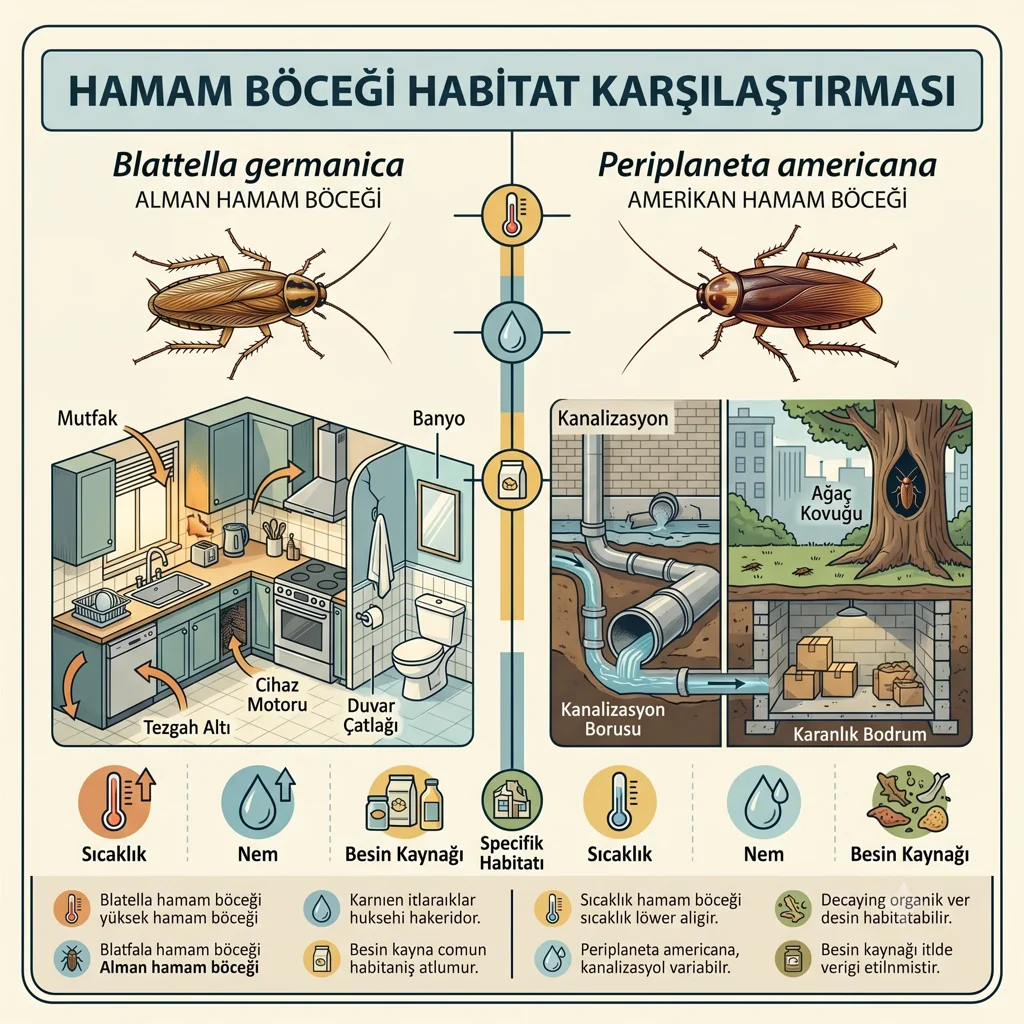
The table below is useful for making decisions in the field. The numbers vary with the environment; these are typical ranges.
| Feature | German cockroach | American cockroach |
|---|---|---|
| Size | 12-15 mm | 35-40 mm |
| Color | Light brown, two dark stripes | Chestnut brown, matte back, yellowish ring |
| Temperature preference | Around 24-30°C | Around 26-33°C |
| Humidity need | Medium-high, kitchen humidity is enough | High, wet rooms and infrastructure suit it better |
| Food | Crumbs, grease film, starch, open pet food | Organic waste, rotting material, around refuse |
| Typical location | Kitchen, bathroom, appliance void | Sewer, basement, drainage line, tree hollow |
This table says one thing: the German species stays indoors; the American species usually uses an outside line to get in. So both species can be in the same apartment building, but their stories are different.
Prevalence in Türkiye: the coast and port effect, the urban effect
In Türkiye the German cockroach is the more widespread and more “common” species. It is seen a lot in big cities, in apartment buildings, in kitchens and in service voids. The American cockroach, on the other hand, becomes more visible in warm regions, along the coastline, in port-linked areas, in large hotels, and in basements and infrastructure lines. The Mediterranean, Aegean and Marmara coasts and the big transit points are a warmer field; in the inland regions, building infrastructure and warm spaces keep it going.
The important point here is this: geography alone is not decisive. The urban heat island effect, the sewer layout, the age of the building and humidity also change species distribution. In other words, when the map is drawn, not only the city but also the building is read.
Treatment difference: the same insecticide does not mean the same result
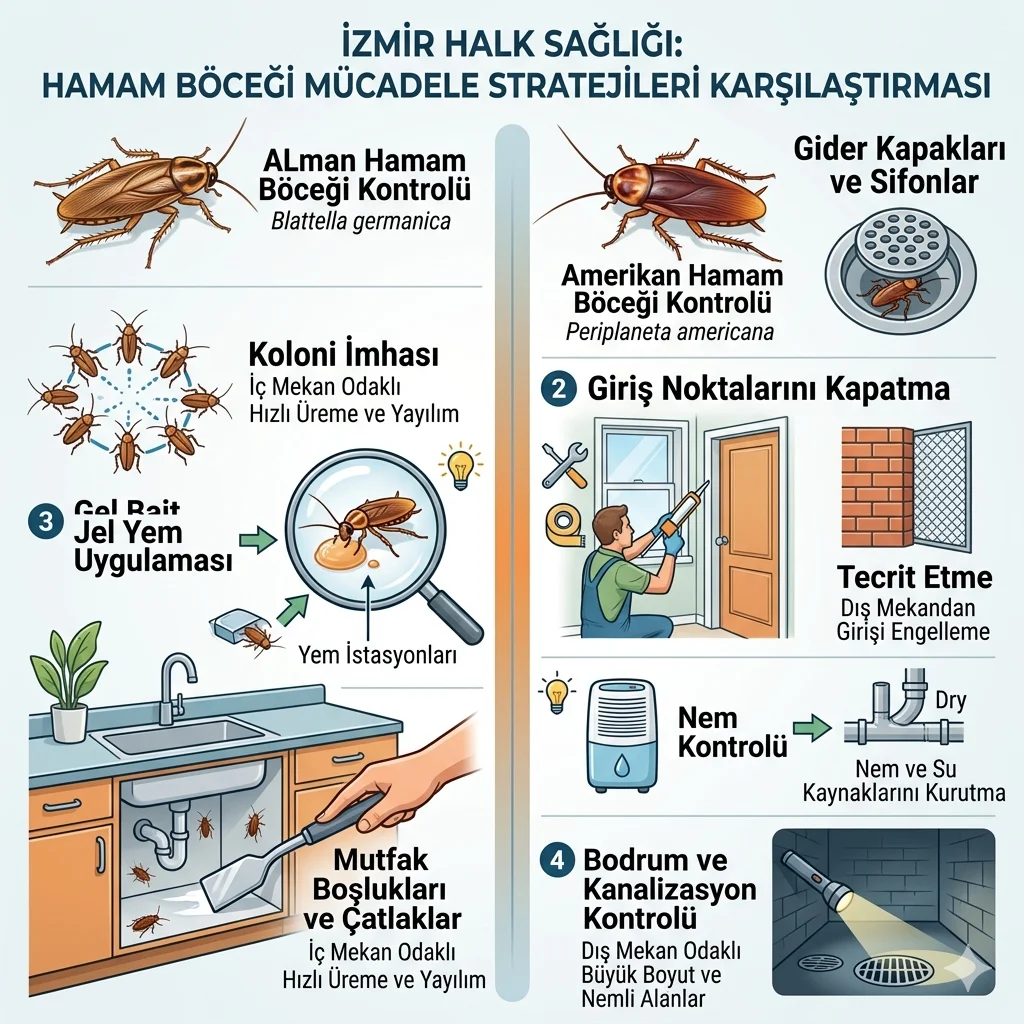
In the German cockroach the main strategy is bait. Because this species is a colony; the workers take the bait, carry it to the nest and colony pressure drops. The goal here is not to kill insects one by one but to break the colony chain. Spraying is usually not the solution; it can even scatter the colony.
In the American cockroach, the first job is to cut off outside sources. Checks of the sewer cover, the area around pipes, shaft voids, floor drains and under the doors are needed. Unless the moisture source is cut off, the entry is narrowed and the outside line is isolated, the individuals inside will come back. In this species exclusion, that is, keeping them out, is the basic step. Don’t think of it like a bed; you can’t fight mosquitoes without closing the door, and the logic here is the same.
Ecosystem and the biologist’s perspective
In nature, cockroaches are not just “household pests”. They process decaying organic matter and are food for some small invertebrates and vertebrates. In other words, they are part of the decomposition cycle in the ecosystem. The problem starts when they enter the wrong niche in a human-made environment. For a biologist, the real question becomes: why is the species here? The answer is usually temperature, humidity, hiding places and food scraps.
So don’t make the comparison by appearance alone. Understanding the species means understanding the habitat. The kitchen species and the infrastructure species appear under the same heading, but the control method is different.
A decision sentence for the first look in the field
One that is small, reproduces fast, has two stripes and is mostly in the kitchen is most likely the German species. One that is large, linked to the sewer/basement and long-winged is most likely the American species. If there is doubt about the identification, the dorsal view, the pronotum and the scale are looked at together in the specimen plate approach; a single frame is not enough.
When is professional help needed?
If you see active individuals during the day, if you have found an ootheca, if there is activity recurring within a few weeks and if there is a suspicion of spread within the building, you don’t read the job as a single apartment. Checks of the building’s lines, shafts and shared plumbing are needed. A bait plan in the German species, and cutting off outside sources plus exclusion in the American species, are carried out together.
FAQ
Which is more dangerous, the German or the American?
Both carry allergen and hygiene risks from a health perspective. Because the German species colonizes faster indoors, in practice it causes problems more often; the American species draws more attention because it is larger.
Which one flies more?
The American cockroach can use its wings over short distances. The German species, on the other hand, mostly runs; its flight behavior is very weak.
Why do they show up in a clean house?
Because the problem is not just dirt. Moisture, cracks, a neighboring source, the drain line and boxes that are carried in also play a role.
Can I apply a single insecticide to both?
No. In the German species bait comes first; in the American species cutting off entry and moisture control come first. The same product does not give the same result.
Sources
- Penn State Extension — German Cockroaches
- Penn State Extension — American Cockroaches
- Penn State Extension — Got Roaches? Eliminate Roaches With IPM
- UF/IFAS Ask IFAS — Cockroach search portal
- Republic of Türkiye Ministry of Health, HSGM — West Nile Virus Infection (in Turkish)