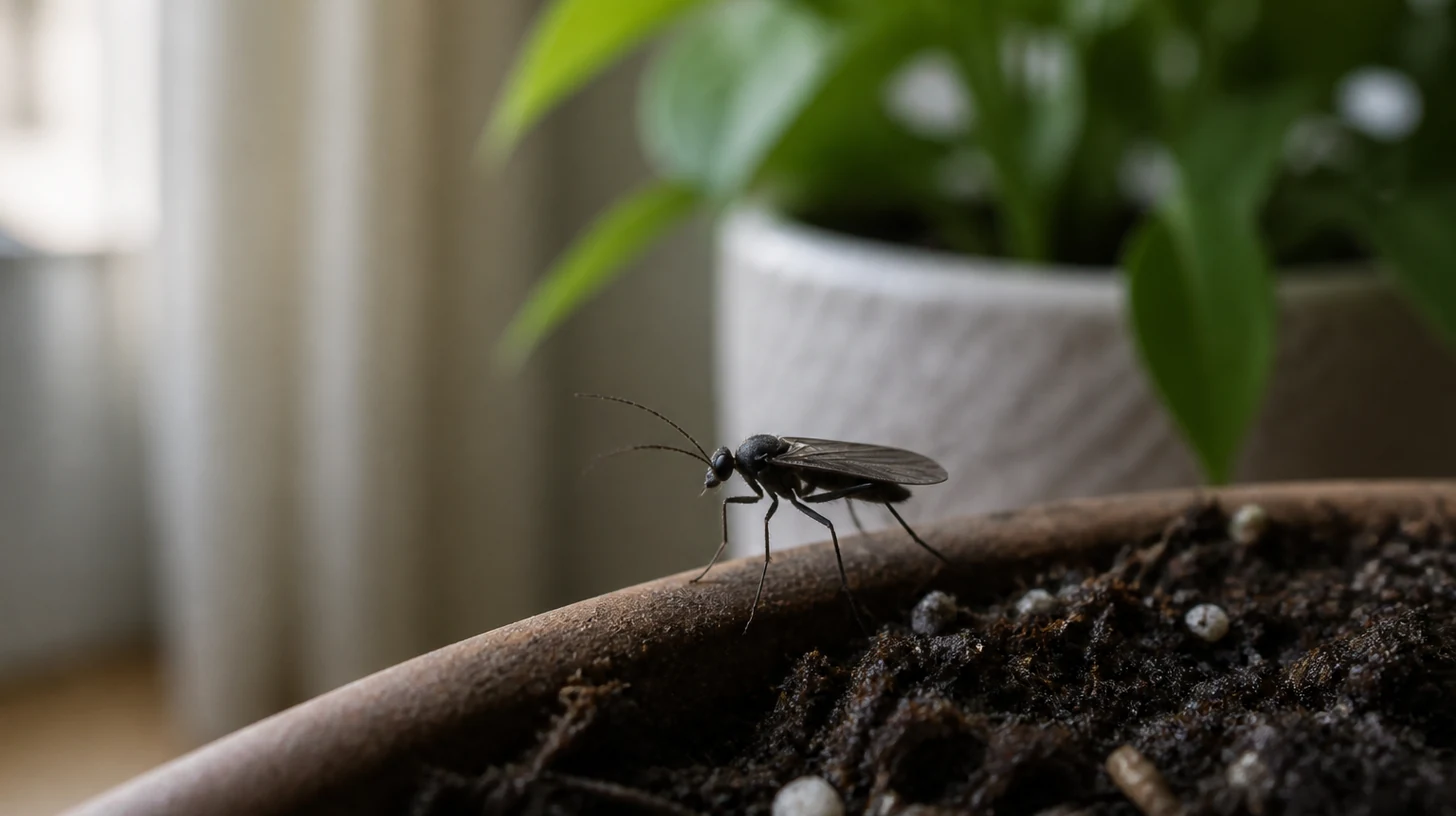
If you are seeing fungus gnats in the house, the first place to look is not the fruit bowl but the potting soil. These small, dark-colored flies mostly hang around damp growing mix. For lasting control, as with an ant problem in the house, catching only the flying adults is not enough; you also need to reduce the breeding conditions. Adjust watering to the plant’s needs, don’t leave water in the pot saucer and watch new plants for a while.
What is a fungus gnat?
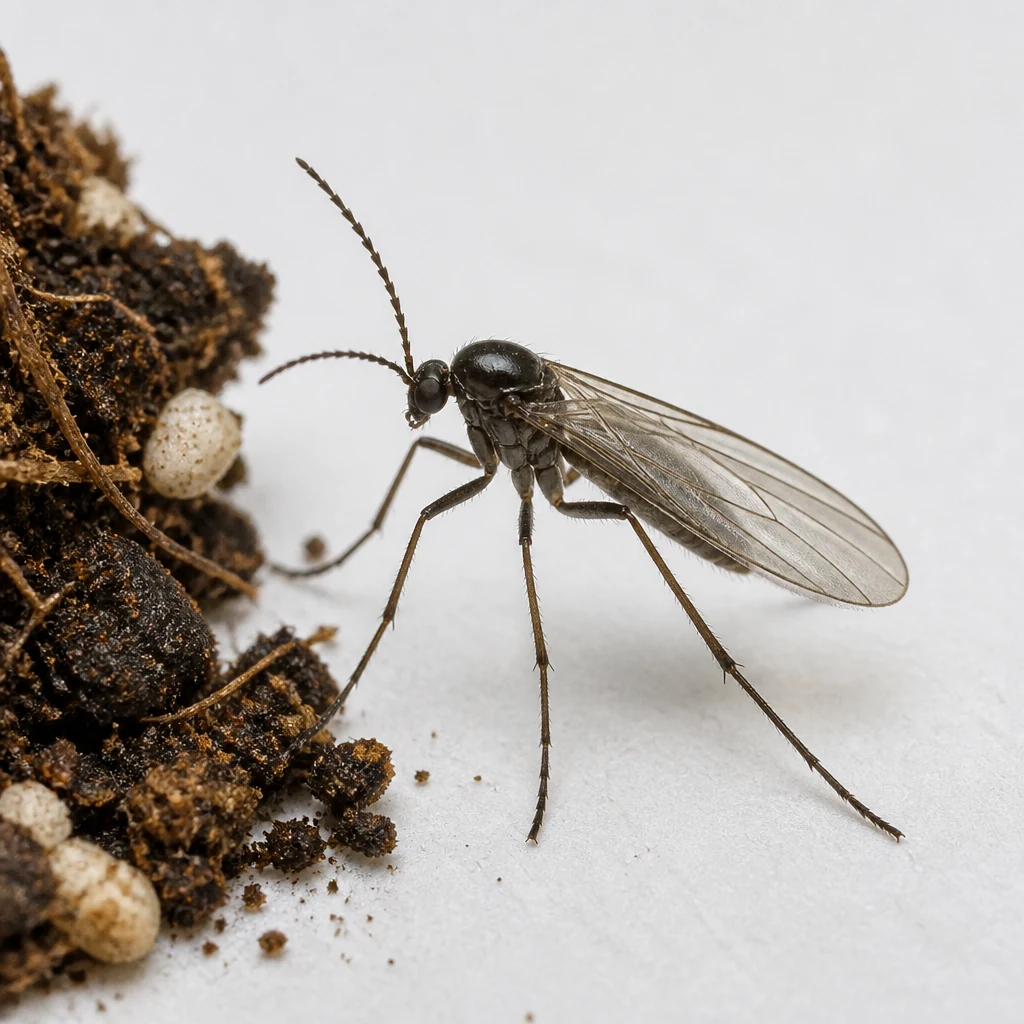
“Fungus gnat” or “dark-winged fungus gnat” is one of the common names used for the small flies in the family Sciaridae. This family belongs to the order Diptera, that is, the true flies (two-winged insects); you can find the basic framework for telling insect classes apart in the what is an insect guide. It would not be right to pin down the species of every small fly seen on houseplants just by looking from a distance; however, a slender dark body, long legs and the habit of wandering around the potting soil give clues for identification.
The adults often fly on the soil surface, at the edge of the plant pot or near the window. The larvae, on the other hand, live inside the mix; they can look small, slender and light-colored with a dark head capsule. Because appearance can vary with species and developmental conditions, this description on its own is not a laboratory-level identification.
Why are there fungus gnats in the house?
The main factor is usually a growing medium that stays damp for a long time. Organic matter in the potting mix and fungal growth can create a feeding area for the larvae. Watering the plant more often than it needs, using a pot with poor drainage or leaving water standing in the pot saucer keeps the soil constantly wet.
The problem may not be just a watering habit. A newly bought plant, mix brought in from outside or shared potting equipment can also help the flies get into the house. That is why it is not right to explain every fly problem by how clean the house is. First find which pot the insects are concentrated around.
It is easy to confuse fungus gnats with fruit flies and drain flies. Fruit flies are seen around ripe fruit, fruit juice and fermented food; drain flies around the organic layer inside drains. Potting soil flies, however, mostly wander on top of the soil. If there is a concentration in the drain or on the kitchen counter, use the observation approach in the guide to telling flying insects in the house apart; don’t put a single name on it without seeing the source. To assess larger flies seen in the kitchen, you can also look at the house fly guide.
Life cycle and effect on the plant
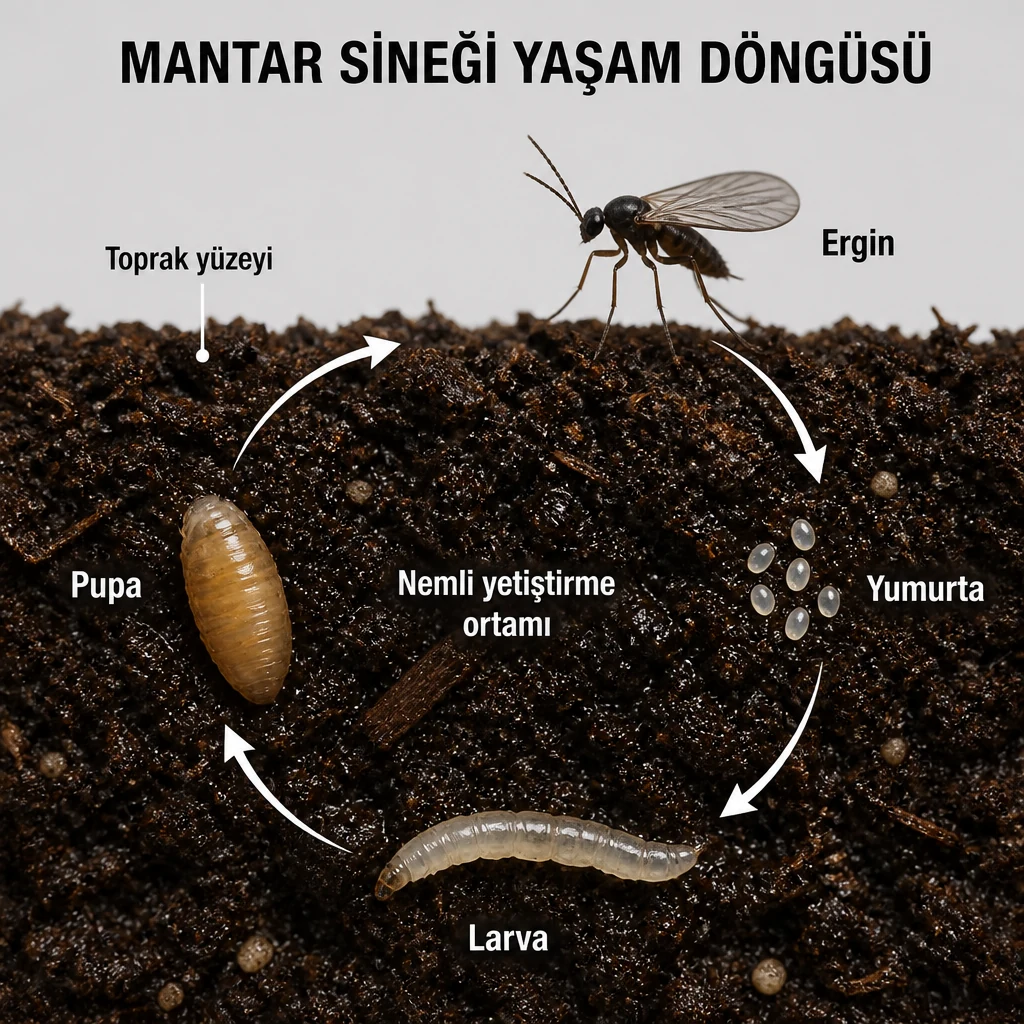
Female flies can lay eggs in a suitable damp growing medium. The larvae that hatch from the eggs feed on organic material and fungi in the mix; under some conditions, fine roots can also be damaged. When the larva completes its development, it passes through the pupal stage and a new adult emerges. For this reason, catching the flying flies can reduce visible activity, but it does not on its own deal with the developmental stages inside the soil.
The level of impact depends on the plant’s age, root health, the structure of the mix and the density of larvae. In a healthy houseplant with an established root system, a small number of larvae may not cause noticeable damage. Newly germinated seedlings, plants with weakened roots or pots with heavy larval numbers may be more sensitive. If the plant shows yellowing or stunted growth, don’t automatically blame fungus gnats; watering mistakes, root rot, light and nutrient conditions should also be checked.
Health perspective
Risk
Fungus gnats associated with houseplants are not pests that bite people or suck blood. Their flying around indoors can be annoying; the main problem is the damage that the larvae developing in the plant’s root zone can cause in sensitive plants. If bite-like marks are seen on the skin, don’t attribute them to fungus gnats; there may be a different insect or another cause.
I could not find a reliable, topic-specific rate for the prevalence of fungus gnats on houseplants in Türkiye or their effect on human health. For this reason, I am not carrying over the statistics of other pests here. The Wisconsin Extension and Colorado State University Extension sources cover habitat, identification and control principles in the context of greenhouse and potted plants; one should not assume that greenhouse recommendations will fit every condition for houseplants unchanged. The common foundation is managing a constantly wet growing medium and monitoring the adults.
Prevention and control
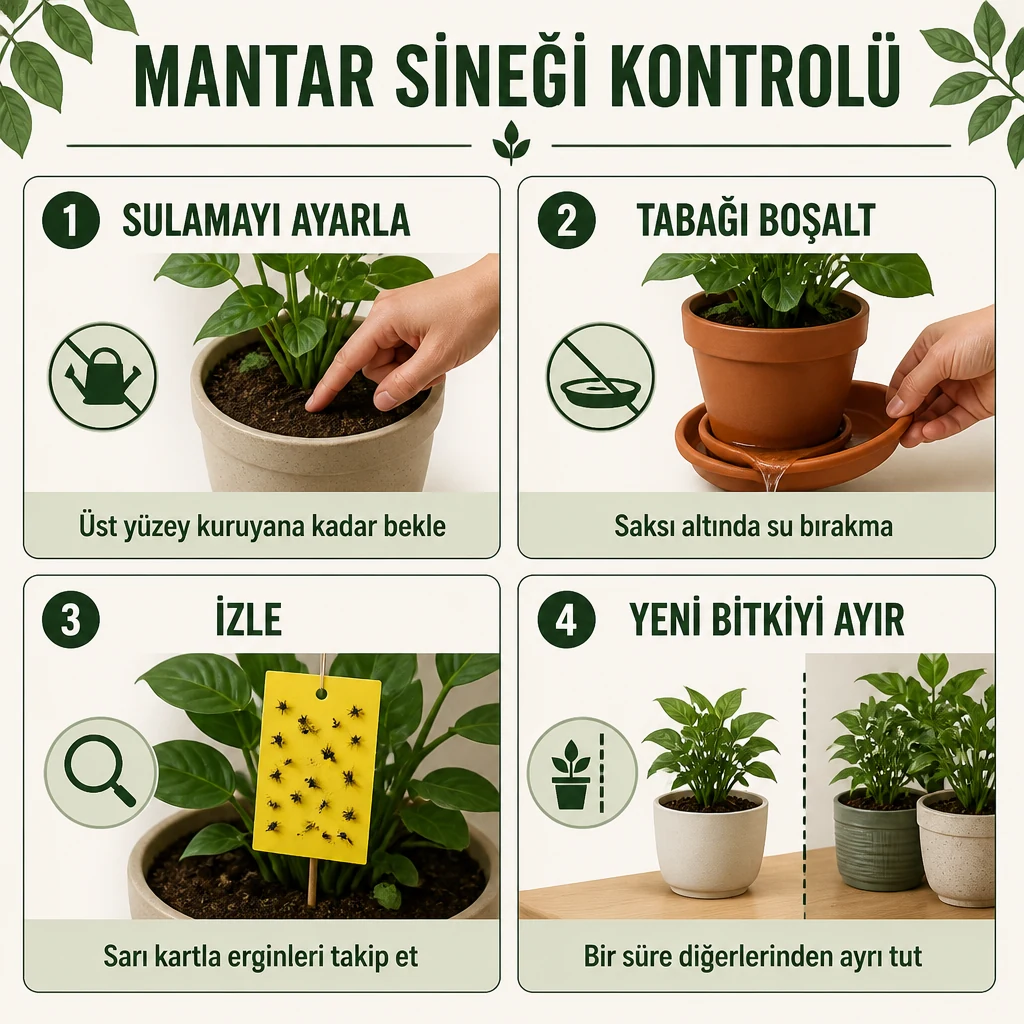
First, inspect the pots one by one. If you see flies on the soil surface or at the edge of a pot, separate that pot from the others and check its watering routine and drainage. Allow the top surface to dry partially between waterings; but take the plant species’ drought tolerance into account. For moisture-loving plants, drying the soil out completely is not a correct general rule.
You can track the flying adults by placing yellow sticky cards close to the soil. Note whether the number on the card is rising and whether there is a concentration around a particular pot. The cards catch adults; they are not a measure of the larvae in the soil and do not on their own eliminate the breeding area. Don’t leave water that drains into the saucer standing, don’t block the pots’ drainage holes and don’t leave plant debris on top of the mix.
When you bring new plants home, instead of mixing them into the collection right away, keep them separate for a while and watch them. If there is a heavy and recurring problem, assess the state of the plant’s roots and mix; if necessary, consider repotting with a clean growing mix suited to the plant’s needs and a clean pot. Don’t apply the same mix or watering interval to every plant. As with flea control in the house, choose steps suited to the target instead of treating at random without correctly identifying the source.
Pesticide use is not the first move. Don’t pour a product whose suitability for houseplants is not clearly stated on the label into the soil, and don’t spray at random indoors. If a product is needed, the target pest, the application area, ventilation, child and pet safety and the label instructions should be assessed together. Pouring homemade detergent, bleach or strong chemical mixtures into the soil can damage plant roots; I do not recommend such mixtures.
Control sequence to apply at home
- Identify the pot where the flies gather; don’t treat all the surrounding plants at the same time.
- Readjust the watering frequency according to the plant species and how fast the soil dries.
- Empty the water that collects in the pot saucer after watering.
- Fix pots whose drainage holes are blocked and whose mix stays muddy all the time.
- Track adult activity with a yellow sticky card for a few weeks; keep the card where children and pets cannot reach it.
- Watch new plants separately; if heavy infestation is suspected, don’t place them near the existing plants.
- If the plant is weakening or the flies persist, inspect the roots and mix; if necessary, get support from a plant specialist or a qualified professional.
When is professional support needed?
Seeing a single fly is not an emergency. But if there is a steady increase in different pots, marked weakening in young plants or numbers that persist despite a suitable watering routine, examine the source more thoroughly. If there are many pots, a winter garden or shared plant care in the common areas of an apartment building, the problem may not be limited to a single pot.
| Situation | What does it suggest? | Appropriate next step |
|---|---|---|
| A few adults in one pot | The source may be in that mix | Check watering and drainage, monitor with a card |
| The number on the cards keeps rising | The breeding medium may be continuing | Re-examine the mix moisture and the surrounding pots |
| Stunted growth in a young plant | There may be a root, water, light or larval effect | Assess roots and care conditions together |
| Flies are seen in more than one room | More than one pot or a new plant may be the source | Watch the plants one at a time, isolate incoming new plants |
| A product is being considered while there are children or pets | There is a risk of product exposure | Don’t apply at random; follow the label and professional guidance |
Frequently asked questions
Do fungus gnats bite?
Sciaridae fungus gnats seen on houseplants are not known as pests that bite people or suck blood. Don’t assume every small fly in the house belongs to this family either; behavior and location are assessed together.
Is a yellow sticky card enough?
No. The card catches the flying adults and lets you monitor activity. It does not fix the soil where the larvae and eggs are. It should be used together with a watering and drainage routine.
Should I cover the top of the soil with sand?
The same top layer is not suitable for every plant and pot. A thick or poorly chosen top layer can change how the soil dries and breathes. First fix the watering routine and drainage; if you are going to use a top layer, assess whether it suits the plant’s care.
Does the potting soil need to be replaced completely?
Not in every case. If the problem is in a single pot and the plant is healthy, it is reasonable to first adjust watering and drainage and monitor. If heavy larval numbers are suspected, the plant is getting worse or the problem continues, repotting can be considered depending on the condition of the roots.
Are fungus gnats the same as fruit flies?
No. Fungus gnats are mostly seen around potting mix and damp plants; fruit flies around ripe or fermented fruit. Small hairy flies that concentrate around drains may belong to another group.