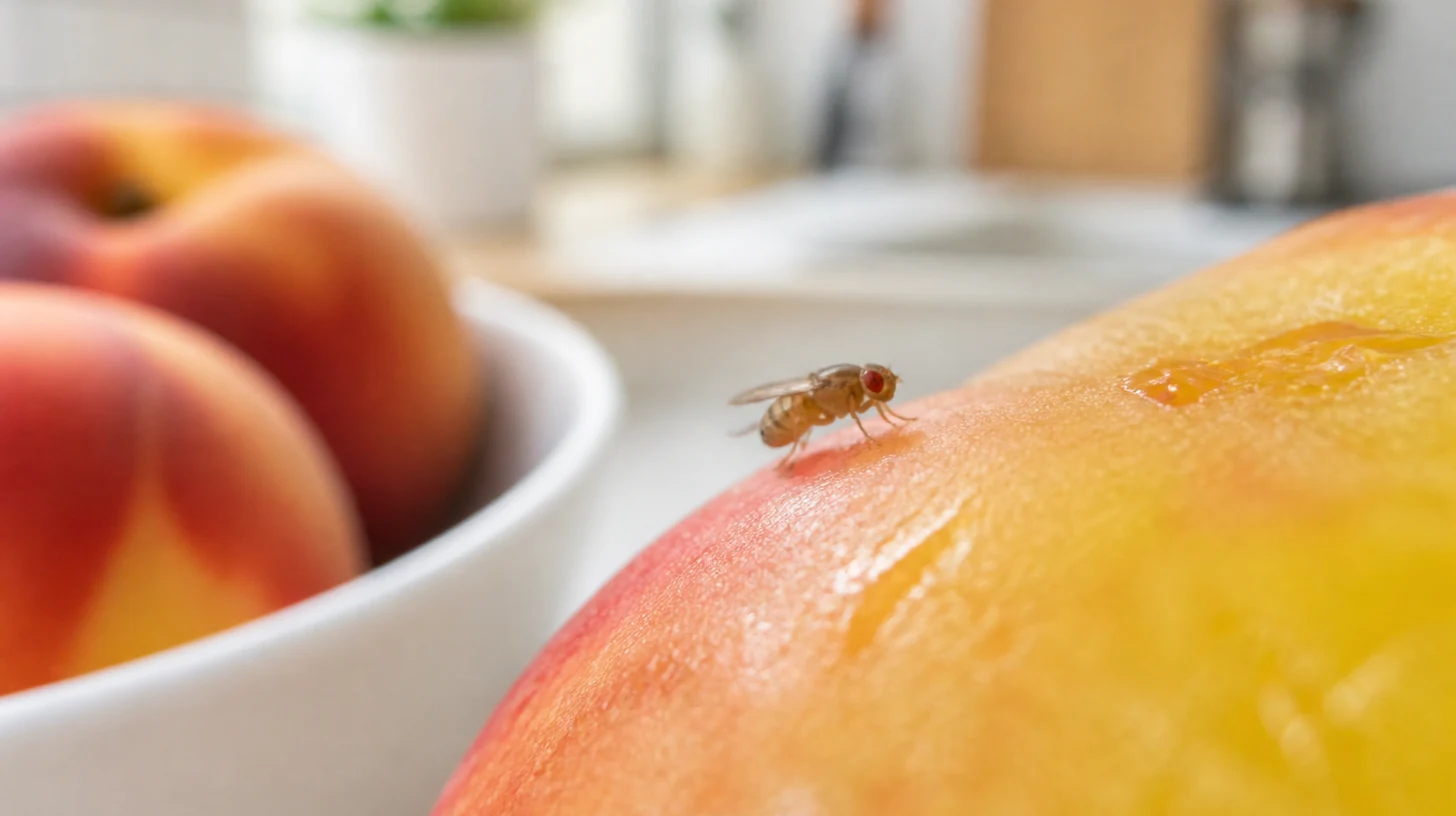
The small, red-eyed flies wandering around your kitchen may often be fruit flies, that is, Drosophila melanogaster. The adults are a few millimetres long; they are seen around ripe fruit, drops of fruit juice and organic residues that are starting to ferment. If a few flies keep reappearing, you need to find not just the flying adults but also the source that feeds them and lets them multiply. Knowing the difference between the house fly and the fruit fly helps you avoid misclassifying similar small flies.
How do you recognize a fruit fly?
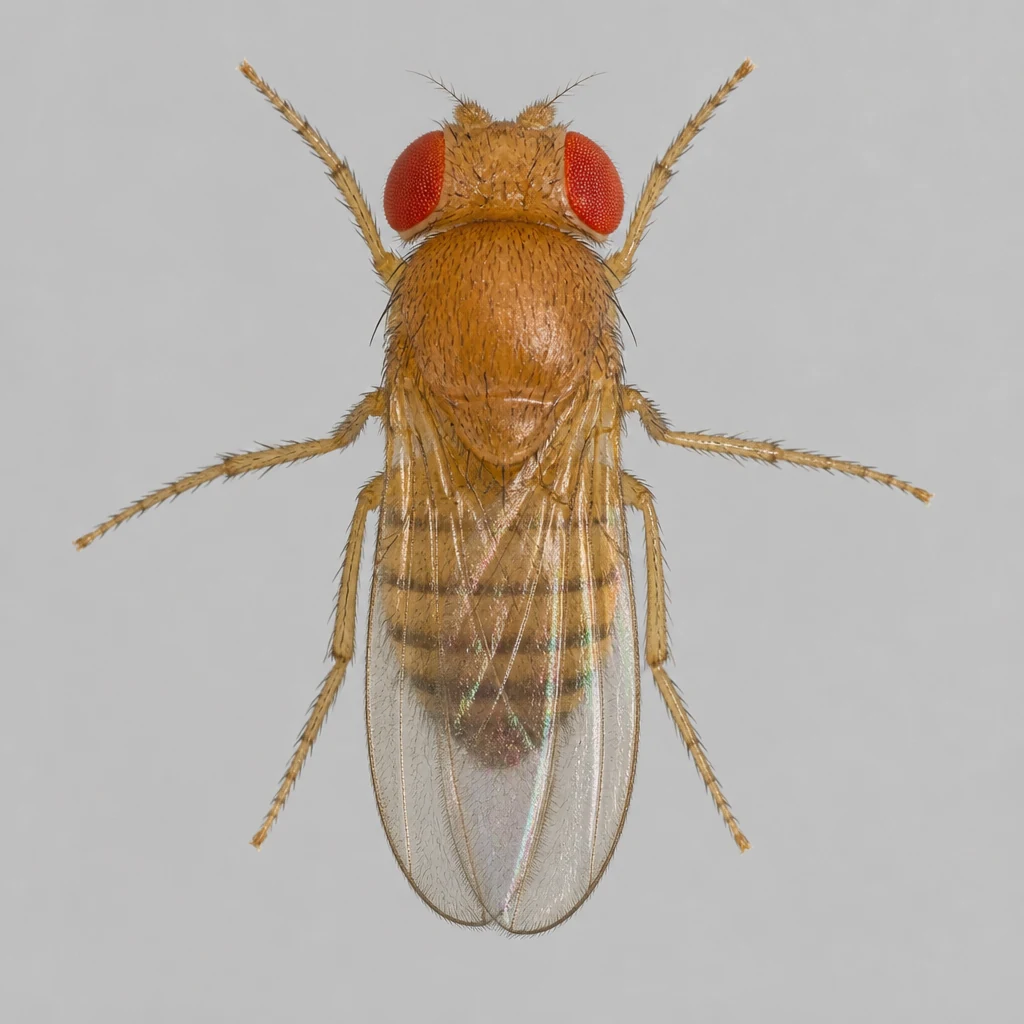
In everyday language the name fruit fly can be used for different small flies. This article deals specifically with the species whose scientific name is Drosophila melanogaster. This species, in the family Drosophilidae and the order Diptera, is generally recognized by its yellow-brown body, its prominent red compound eyes and its small size. As with insects, it has six legs and a single pair of functional wings. Without a close look it can be hard to make out the colour and size details; for this reason, a “small fly” appearance alone does not count as a definitive identification.
The adults mostly fly around the fruit bowl, the compost container, drink leftovers or organic waste. Smell and fermenting matter attract them. Fruit flies do not bite people and do not suck blood. The main issue in the home is that they land on food and keep reappearing if the source persists. For a broader way of telling flies apart in relation to the fruit fly, you can also look at the house fly guide.
Why is the life cycle noticed so quickly?
Drosophila undergoes complete metamorphosis: it has egg, larva, pupa and adult stages. The female can lay eggs on surfaces where suitable food is available. The larvae that hatch from the eggs feed not on the fruit itself but mostly on the microorganisms of fermenting and rotting organic matter. Development time depends on conditions such as temperature, food and humidity; that’s why giving a fixed “it multiplies in this many days” figure for every season and every setting in the home would be misleading. Laboratory protocols also evaluate lifespan and development under controlled conditions; the results cannot be applied directly to every kitchen.
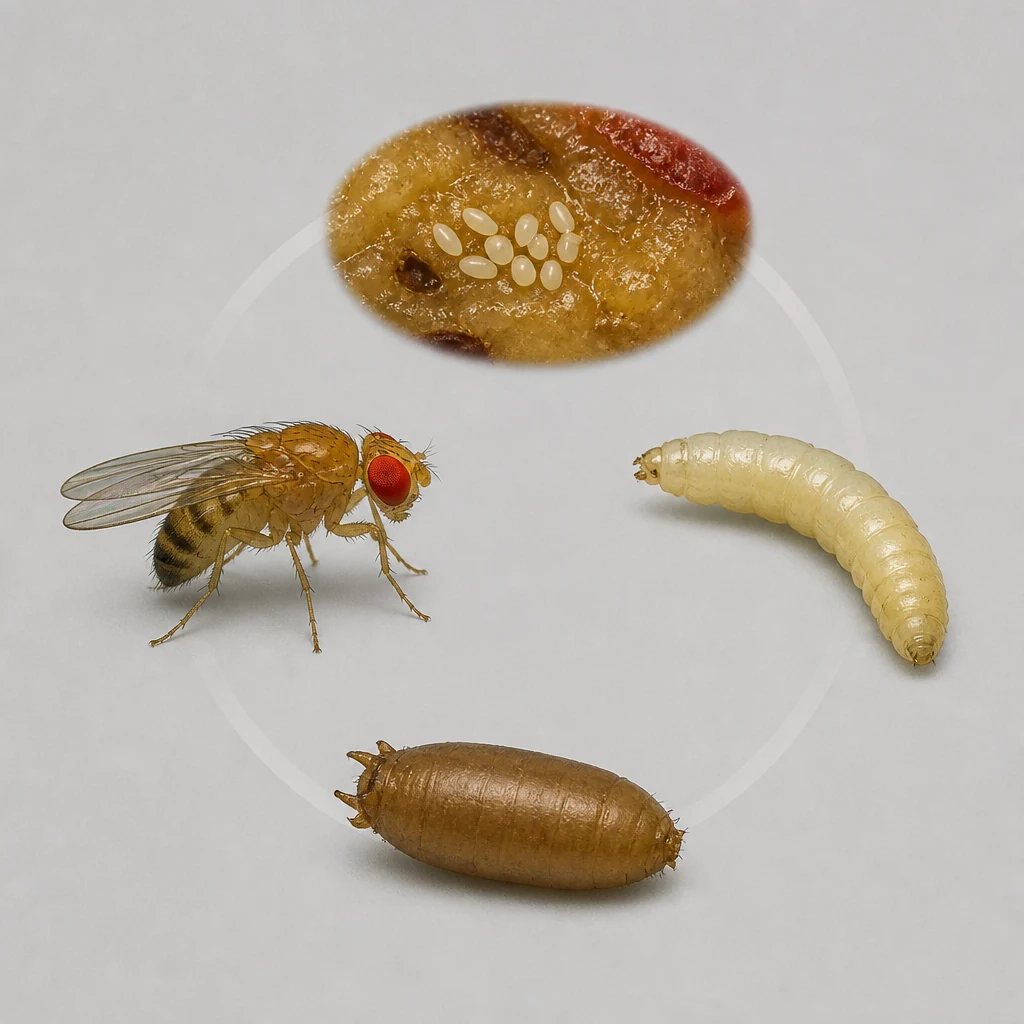
This cycle explains why catching only the adults doesn’t give a lasting result. You can get rid of one fly at the fruit bowl; but if a suitable source remains in the bin, the recycling container or a sticky fruit juice residue on the counter, new adults can emerge. First find the source, then keep up the cleaning and storage routine for a few days.
Where can it breed in the home?
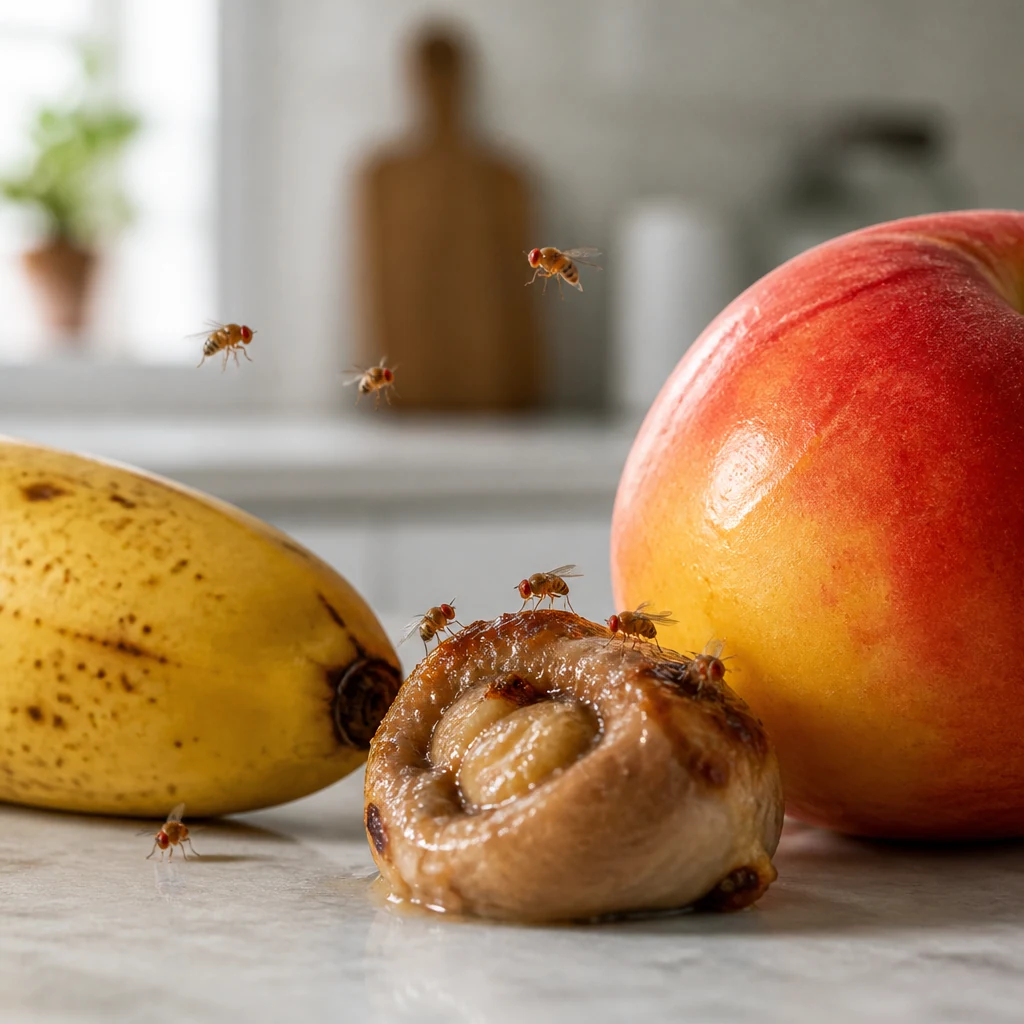
The best-known source is ripe fruit left at room temperature for a long time. But don’t limit your search to the fruit bowl. Crushed fruit, an open bottle of fruit juice or wine, empty drink cans, the lid of the organic waste bin and residues in the recycling container can also create a fermenting smell. Also check overlooked areas such as under the counter, inside cupboards and around the pet food bowl.
Flies concentrating around a drain does not on its own prove that they are fruit flies. The drain fly and the fungus gnat that develops in potting soil can also look small; their biology and sources are different. If the flies are rising especially from the drain opening or flying up from the potting soil, examine the source separately. The guide to fungus gnats in the home can help with this distinction.
What can you do to reduce breeding?
The goal of the measures is not to suppress the fly with smells but to remove its food and breeding area:
- Eat ripe fruit soon; if you’re going to keep it, store it in a closed container or in the fridge.
- Throw away crushed or rotten pieces without leaving them on the counter.
- Keep the organic waste bin closed and empty it regularly.
- Rinse bottles, cans and jars before putting them in the recycling.
- Clean up spills of fruit juice, vinegar, wine and the like immediately.
- Wash the bin lid, its inner surface and the floor around it; don’t leave sticky residue.
- Check window and door openings, especially in areas where there is fruit.
- For a few days, keep the kitchen counter and the organic waste area dry and clean.
Sticky traps can catch the flying adults; but they don’t remove the source where the eggs and larvae are. If you use a trap, think of it as an addition to cleaning and food storage measures. Don’t apply sprays or other pesticides carelessly near food, preparation surfaces or areas that children and pets can reach. Label instructions and safe-use conditions matter; in most indoor situations, removing the source first is the more direct step.
Health and household risk
Drosophila melanogaster is not a species that bites, stings or takes blood from people. For this reason it should not be placed in the same risk group as the mosquito or some other flies. That said, flies wandering around the food preparation area and landing on food is undesirable from a hygiene point of view. Protect food left out; apply the usual food safety rules for perishable foods the flies may have touched.
Nor should you assume that every small fly seen in the home is Drosophila melanogaster. If you can’t identify the source, if the flies persist despite cleaning and food storage measures, or if they appear in many different rooms, get an assessment from a pest control specialist. The breeding source may be the drain line, potting soil or an inaccessible organic waste area; a correct identification helps prevent unnecessary chemical use.
When is professional help needed?
| Observation | Recurrence | Risky household or situation | When should you call a specialist? |
|---|---|---|---|
| A few flies around the fruit bowl | If they decrease noticeably after the source is removed | Hygiene matters in every home where food is prepared | Clean up the source; if they are still seen regularly after a few days, get an assessment |
| Flies coming out of the drain, the waste area or inside a cupboard | If they keep reappearing after cleaning | In a household with a baby, an elderly person or someone with a suppressed immune system, pay particular attention to food hygiene | If you can’t find or reach the source, ask for a specialist inspection |
| Small flies dense in potting soil or other areas | If they don’t decrease or are spreading within a few days | Where there are pets and children, don’t use pesticides carelessly | Get professional help to distinguish the species and identify the source |
Frequently asked questions
Where do fruit flies come from in the home?
Fruit and organic waste that are ripe or starting to ferment can attract the fly. Eggs can be carried into the home with fruit, or adults can come in through openings.
Does the fruit fly live inside the fruit?
The larvae can develop on or in suitable, fermenting organic matter. This doesn’t mean there are larvae in every fruit or with every fly.
Does the fruit fly bite people?
No; Drosophila melanogaster is not a fly that sucks blood or stings. The main problem in the home is that they land on food and cause a nuisance.
How do you tell a fruit fly from a drain fly?
Fruit flies fly around fruit and fermented food; drain flies are generally hairy, look like small moths and are seen around drains. Where they are seen gives a clue, but on its own it doesn’t provide a definitive identification.
Is setting a trap enough?
A trap can reduce the adults, but it doesn’t remove the source where the larvae and eggs are. Cleaning up fruit, waste and surface residues is the basic step.
Sources
- Erzincan Binali Yıldırım University AVESİS, Evaluation of the Lifespan of Fruit Fly Drosophila melanogaster Exposed to Dioxins: https://avesis.ebyu.edu.tr/yayin/e1cffeb9-cd11-4286-bbee-e18e6cb15d2b/evaluation-of-the-lifespan-of-fruit-fly-drosophila-melanogaster-exposed-to-dioxins
- Bilkent University, “Modeling Intellectual Disability in Flies” seminar announcement: https://w3.bilkent.edu.tr/www/mbg-semineri-modeling-intellectual-disability-in-flies-prof-dr-arzu-celik-fuss-1530-15-aralik-en/
- Süleyman Demirel University Journal of Natural and Applied Sciences, Drosophila melanogaster as an emerging model host for entomopathogenic fungi: https://dergipark.org.tr/tr/pub/sdufenbed/issue/91374/1581318
- JoVE, Lifespan Protocol for Drosophila melanogaster (in Turkish): https://www.jove.com/t/20104/lifespan-protocol-for-drosophila-melanogaster-generating-survival?language=Turkish
- Bocek.net, The difference between the house fly and the fruit fly