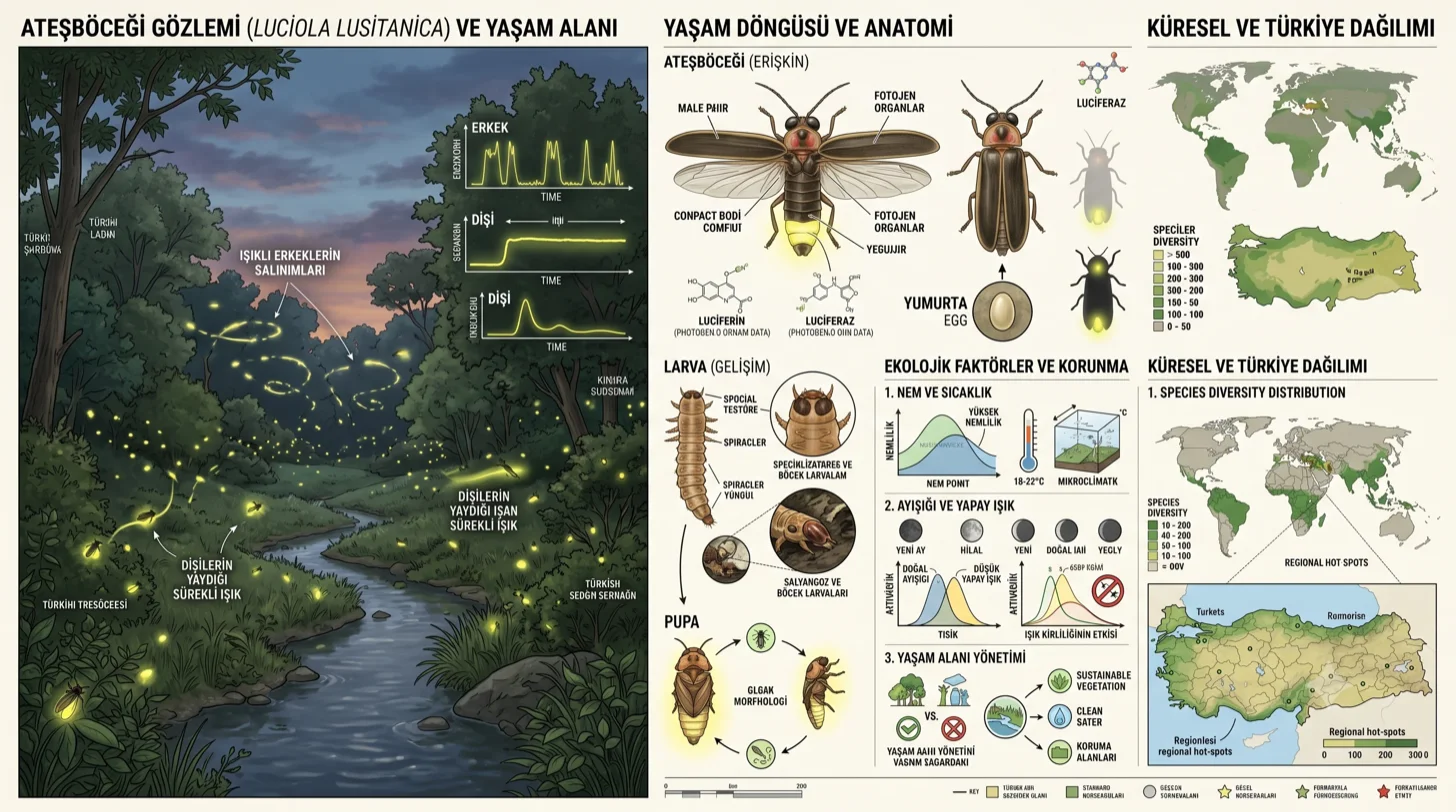
The short answer is clear: if you know the species backbone in the article Firefly: Bioluminescence and Ecology, the answer to the question of where fireflies can be seen opens up too. When looking for this creature in Türkiye, the target is not a single spot but the edge lines where humid forest, stream bank and meadow touch one another. The best chance is on nights when the darkness is strong, the moonlight is weak and the ground stays alive.
Know which species you’re looking for
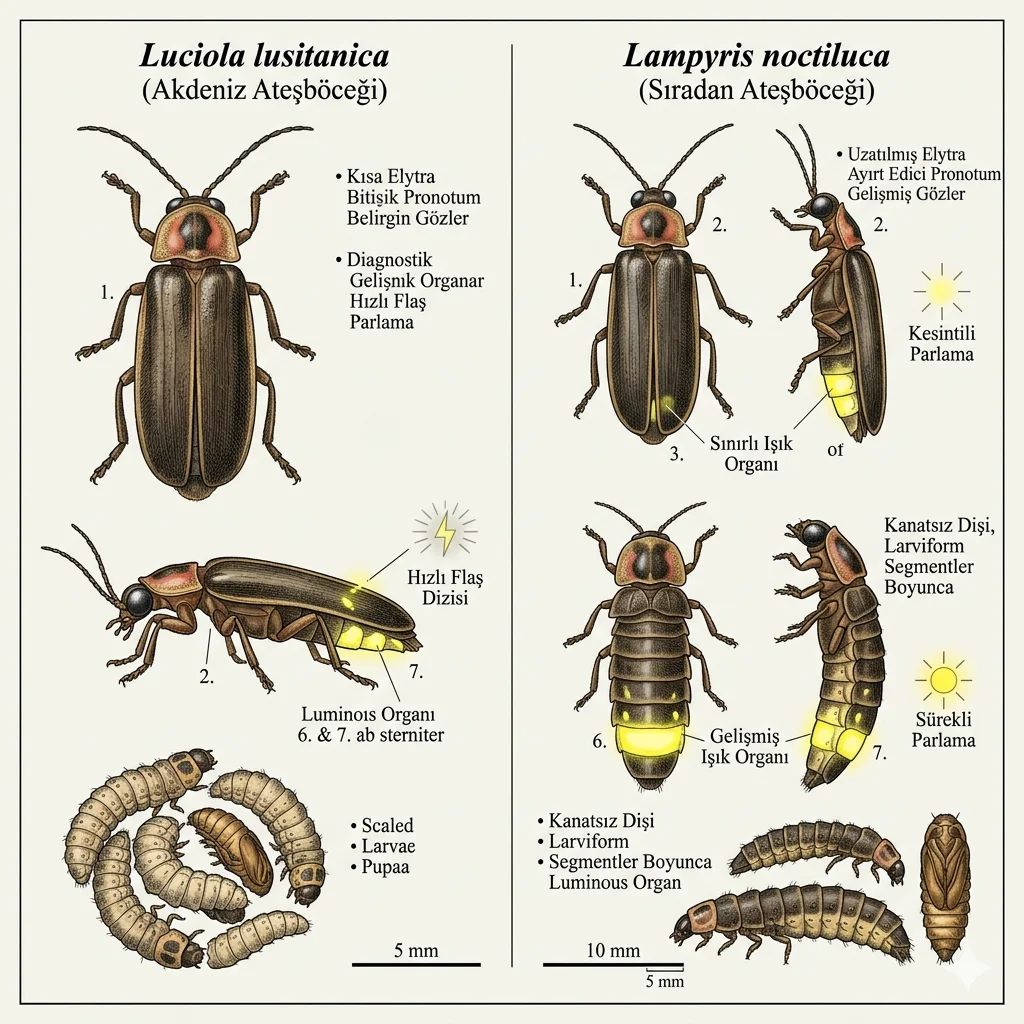
The names you encounter most in the field in Türkiye are the two species that also appear in Firefly: Bioluminescence and Ecology: Luciola lusitanica and Lampyris noctiluca. Luciola lusitanica is the type that moves more and stands out with short flash sequences. Individuals that fly are easier to pick out in the evening dark. Lampyris noctiluca, on the other hand, is mentioned in the northern belt and along cooler, humid lines; its low glow on the ground and its position close to the plant layer set it apart.
Through a biologist’s eyes, the critical point here is this: behavior matters as much as the species name. You can’t consider the job done just because you saw a firefly. The height of the light, its duration, its rhythm and whether the animal is on the ground or in the air are read together. That’s why writing “it glowed” in your observation notes is not enough; you also need to write whether it was a short flash or continuous light, whether it was on the ground or on top of a bush.
Where are they seen in Türkiye?
When chasing a map, don’t look for an exact spot. Fireflies are distributed across micro-areas with good habitat quality. In other words, while they are seen in one valley within the same province, they may not appear at all a few kilometers away. Still, the regions that stand out in a field search are clear:
- Marmara: around Lake Sapanca, the Bolu mountains
- Aegean transition: Mount Sakar, the Manyas area
- Black Sea: the Yenice forests, the Çamlıhemşin highlands
- Northern Central Anatolia: Karadağ in Eskişehir
What these areas have in common is that stone, soil and water work together. The humid forest floor, stream banks, clearings where meadow and forest meet, shady pockets where leaf litter remains and edge lines far from human light are the most valuable. Not wide, dry and bright clearings; the in-between zone is what matters. Fireflies are often seen where the inside of the forest intersects with open ground.
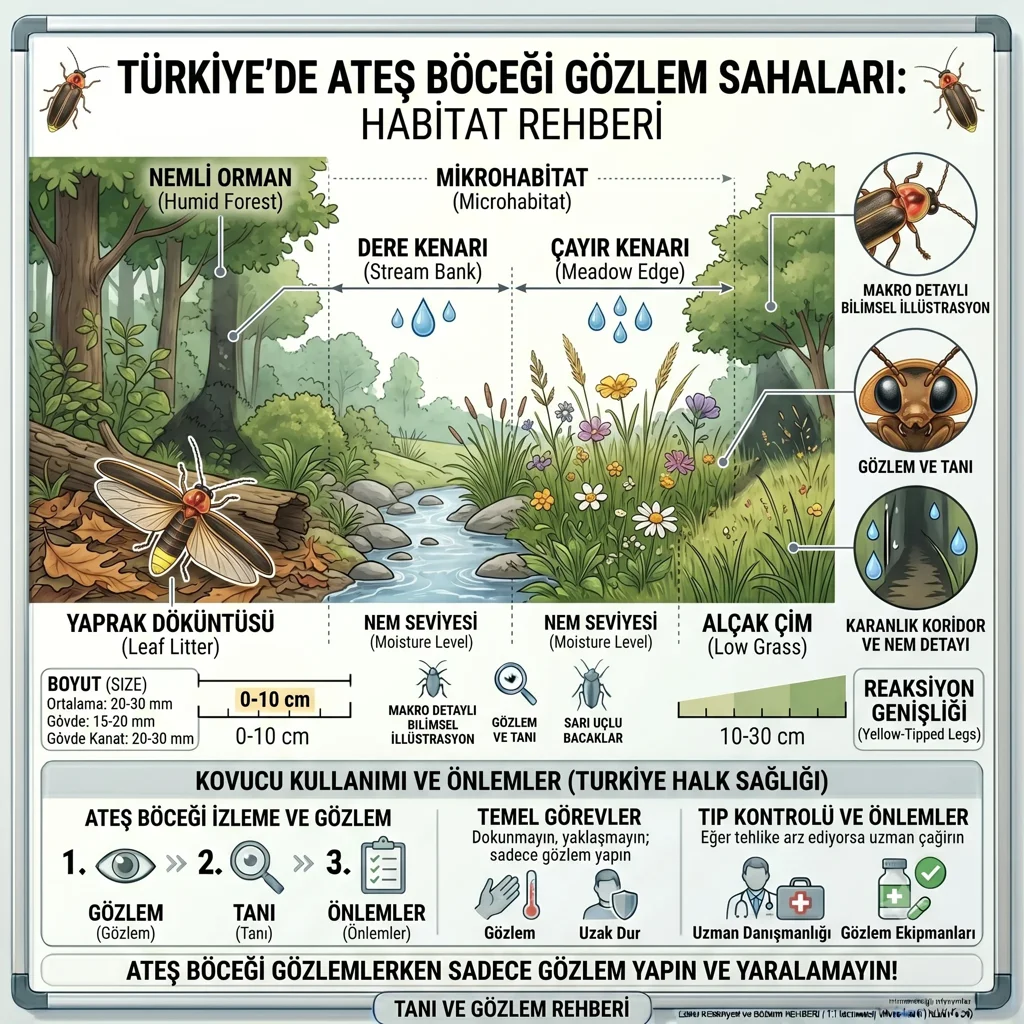
Another practical tip is wind and surface texture. On a calm evening, if there is little leaf movement, flashes are easier to pick out; in places with fine grasses, the bases of bushes and damp soil close to water, the eye gets less tired. Don’t get stuck on a single path while searching. Read the shoreline, the forest clearing and the meadow transition as three separate layers. Coming back empty-handed from one does not mean you have no chance in another.
When do they come out?
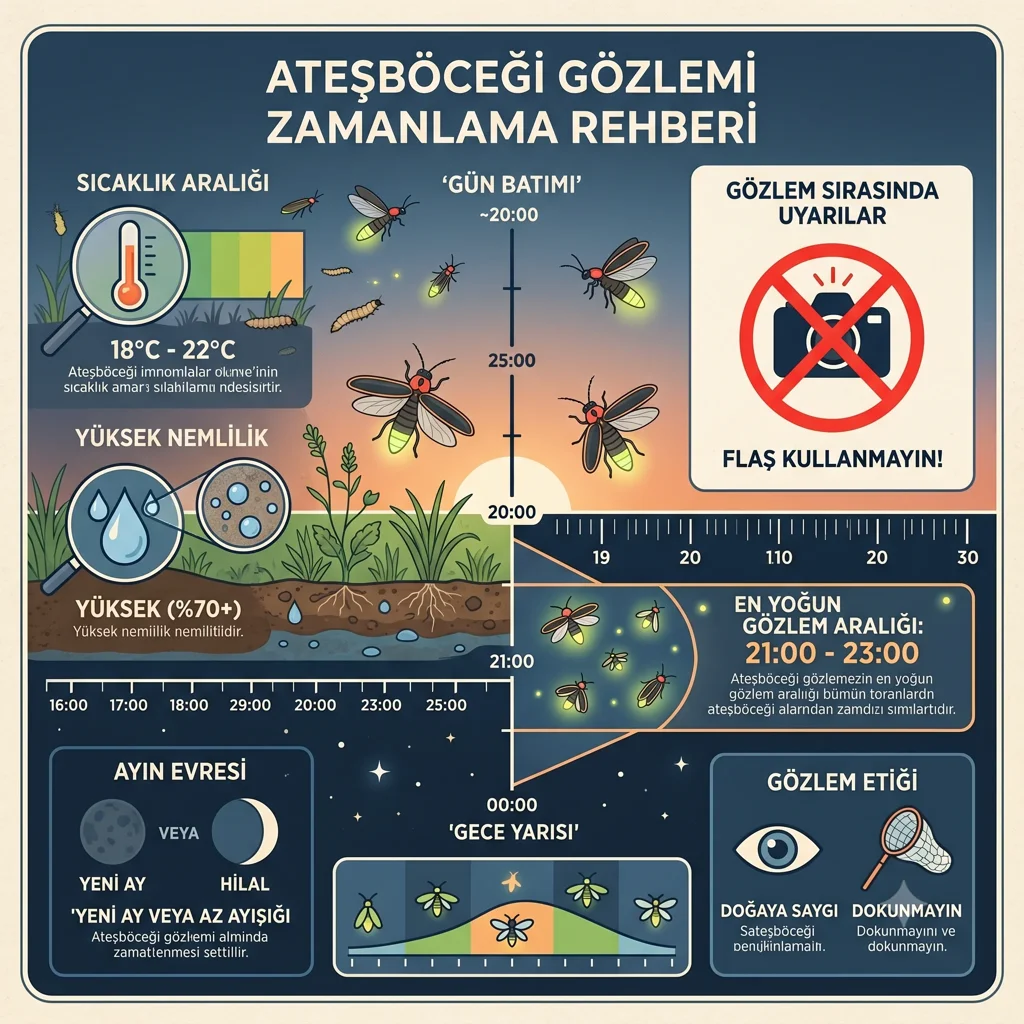
If you don’t read the timing right, the terrain looks empty. In most places in Türkiye the observation period is squeezed between late May and early July; the peak is most likely mid-June. As the evening coolness settles in, the light signal also becomes easier to read. That’s why the first 1-2 hours after sunset are the most productive window. In the summer pattern, this often falls in the 21:00-23:00 band.
The weather matters too. An 18-22 degree band and high humidity make your job in the field easier. The new moon period, nights when the moonlight is weak and humid evenings after rain work well. A full moon, a bright city edge or a dry, windy night, on the other hand, spoils the game. For fireflies, the issue is not just “night”; darkness and moisture must go together.
How should you behave in the field?
There is no compromise here. Don’t turn on a light. Phone light included. Flash included. Fireflies talk with light; your white light drowns out that conversation. If you are going to take photos, use a long exposure, not a flash. Set up a tripod. Around ISO 6400 does the job, and the exposure time can be extended up to 30 seconds. But the goal should not be to chase the creature, but to capture it calmly.
Watch where you step. Larvae live in the leaf litter and damp soil. In some night observations, low points of light on the ground show larvae in particular or females staying close to the ground. So don’t place your footsteps carelessly. Don’t press down on the grass, don’t crush sunken ground, don’t scatter the base of the bushes. It is easy to leave an empty area emptier; it is hard to protect a living edge line.
Catching by hand is forbidden. Don’t put them in a jar, don’t put them in your pockets, don’t try to carry them around out of childish enthusiasm. A short observation is fine; no holding on for long. Squeezing an individual both disrupts its behavior and frightens the other creatures in the field. The right thing to do is to look, take notes and let go.
How do you observe with a child?
If you’re going out with a child, explain first. Show them how to stay quiet, not to get in front of one another and how to step on the ground. Saying “don’t run” is not enough; also explain why they shouldn’t run. Because fireflies show up in calm more than in fast movement. A child’s eyes light up quickly, but respect for the surroundings should be taught just as fast.
Also keep the noise under control. No shouting, no whistling, no turning on device sounds. Stopping for two minutes before the observation to get used to the night is often the best start. For a child this is not just a nature lesson; it is also about learning to look without interfering with the surroundings.
Why is it valuable through a biologist’s eyes?
The firefly is a good indicator of environmental quality. It needs moisture, leaf litter, darkness, proximity to water and low pesticide pressure. If these conditions break down, the species also retreats. In other words, if you see fireflies, the microhabitat there is still working. If you don’t see them, it would not be right to immediately say they are absent; but light pollution, habitat fragmentation and chemical pressure are the first suspects.
The larval stage is even more important. The bright image of the adult is not the whole story on its own; the real effort is built through the long larval period spent on the ground. In most species, larvae feed on small snails and other soft-bodied invertebrates. In other words, the firefly is not just a stage creature that produces light, but also a small predator. It stands at a delicate point of balance within the ecosystem.
Think specimen plate when taking notes in the field
A good record in the field starts with a good image. That’s why you should use a specimen plate approach. Let the dorsal view, the lateral view, a scale bar and a short behavior note sit in the same frame. If possible, write down the distinction between Luciola lusitanica and Lampyris noctiluca on a single plate. This way the observation stops being a single photo and becomes a scientific record.
If you want to read the bioluminescence side of this observation line more deeply, move on to the article Why Do Fireflies Glow? The Secret of Bioluminescence. There you’ll find the chemistry of the light; here you have where, when and with what behavior the light appears. Read together, the picture is complete.
Source backbone
- Doğa Derneği search page: firefly (in Turkish)
- Sara M. Lewis lab page, Tufts University fireflies
- Lewis et al. 2021, Firefly tourism: Advancing a global phenomenon toward a brighter future
- Faust, Lynn Frierson. 2017. Fireflies, Glow-worms, and Lightning Bugs
This source backbone does not leave the field observation on its own. It reads the Türkiye line through Doğa Derneği, the biology and conservation side through the Lewis line of work, and the popular but solid background through Faust’s 2017 review. The conclusion arrives at the same place: fireflies appear where there is darkness. Silence is the best field tool.