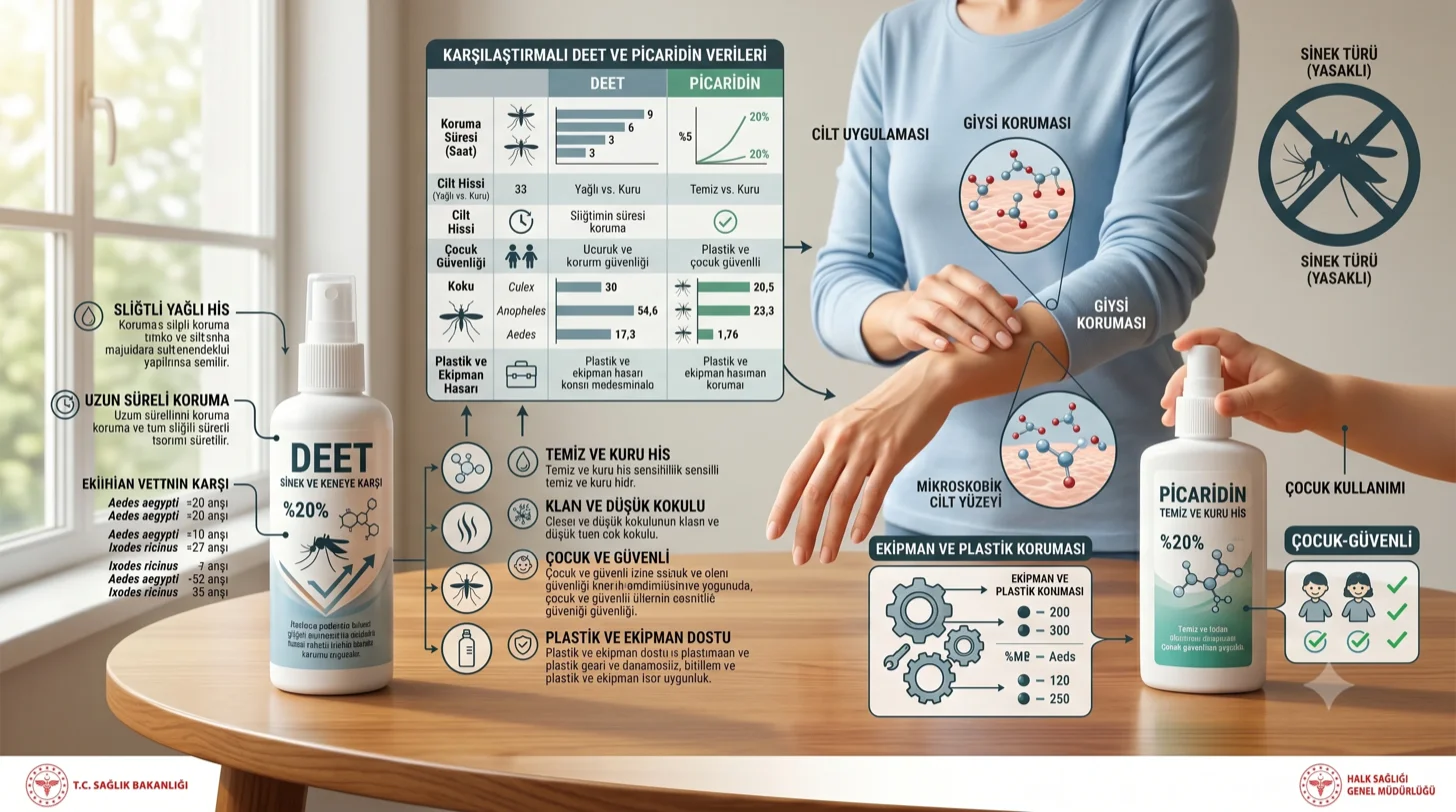
This article builds on Mosquito: Biology, Species and Health Information and Why Do Mosquitoes Bite Some People More? The ETM Complex. The question here is clear: which repellent goes on the skin, which one goes on clothing, and which one makes more sense for a baby.
Quick decision
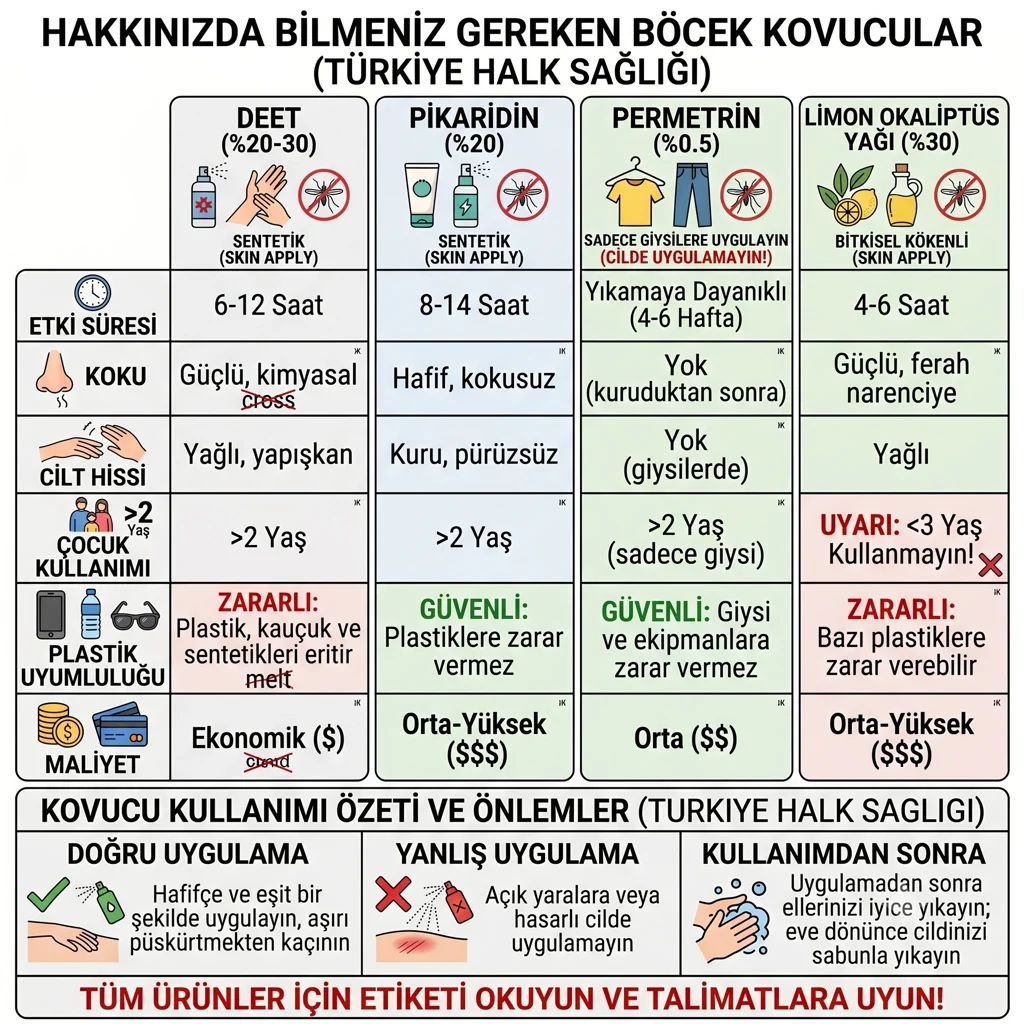
DEET and picaridin don’t belong in the same basket. DEET is the older option and is considered stronger; picaridin is an option with less smell, a less oily feel and better compatibility with plastic. Permethrin is a separate class: it goes not on the skin but on clothing. Oil of Lemon Eucalyptus is a natural alternative, but it is not the first choice for every household.
In the field the issue is not “which is better” but “which is more appropriate in which situation”. EPA’s DEET page and CDC’s guide to preventing mosquito bites state this approach clearly: use an EPA-registered product, in line with the label.
Short comparison table
| Product | Duration | Smell | Skin feel | Use in children | Plastic compatibility | Cost |
|---|---|---|---|---|---|---|
| DEET | 4-6 hours in most field conditions at 20-30% | Noticeable | Can feel oily/heavy | Can be used over 2 months of age if the label allows | Poor; needs care on some plastic and synthetic surfaces | Generally lower |
| Picaridin | Up to 8 hours in most field conditions at around 20% | Little or none | Cleaner, dry feel | Can be the first choice for most families over 2 months of age | Good; safer on watches, glasses and some surfaces | Medium |
| Permethrin | On clothing, until washing; not on skin | Little | Not applied to skin | Can be used on children’s clothing; not applied to the skin | No problem on clothing; read the label depending on the surface | Medium |
| OLE / PMD | 3-4 hours in most field conditions with a 30% formula | Herbal/sharp | Light-medium | Not given to children under 3 years of age | Generally good | Medium-high |
DEET: old but not for nothing
DEET is known by its full name, N,N-diethyl-meta-toluamide. It was developed in 1946 and came into general use in 1957. So it is not a new trend; it is an active ingredient that has been in the field for a long time. The way it works is not by killing, but by making it harder for the mosquito to find us by smell.
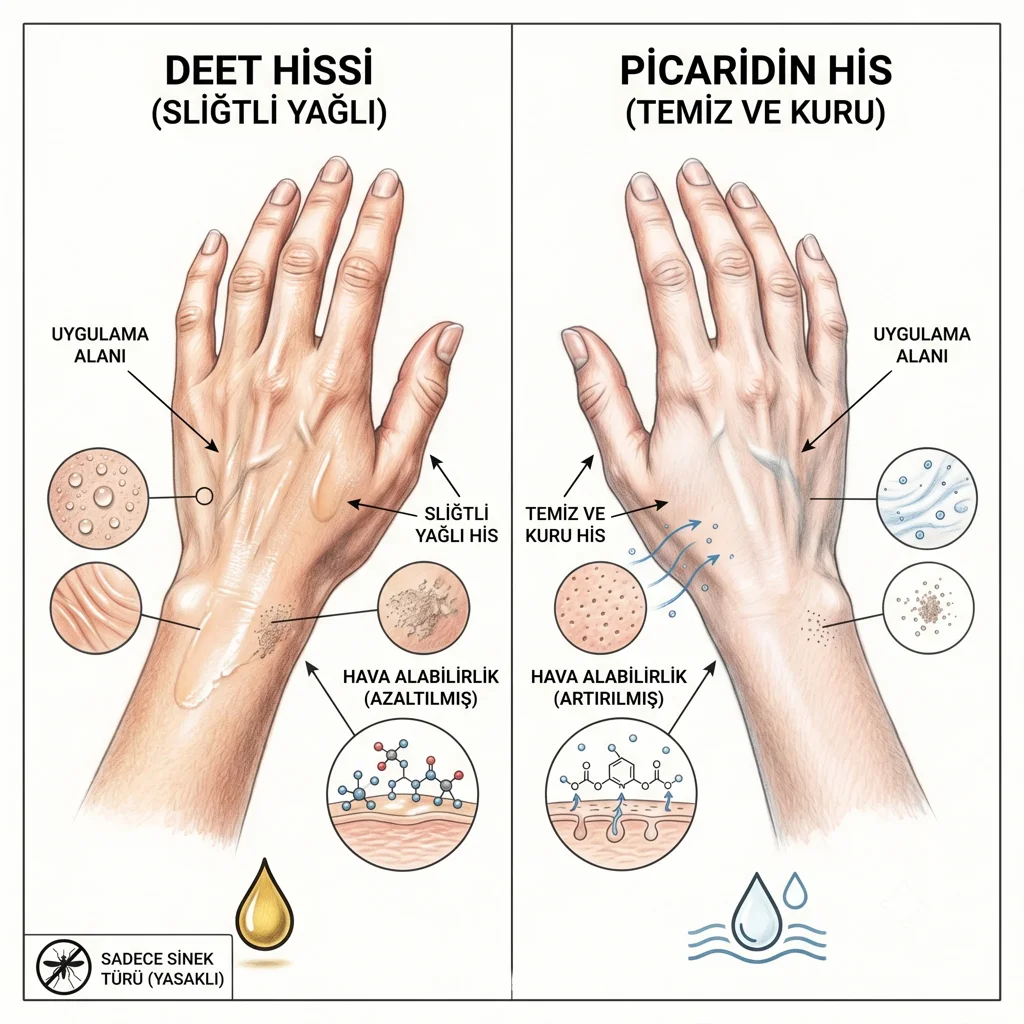
In practice, DEET’s strength shows in its wide range of use and long protection. The 20-30% range is enough for most outdoor work; in field terms it gives a window of 4-6 hours. But you pay for it in skin feel. There is an oily feel, a strong smell and a risk of leaving marks on some plastic/synthetic surfaces. Care is needed with watch straps, eyeglass frames, PVC surfaces and some synthetic fabrics.
Picaridin: a cleaner feel, more comfortable use
Picaridin is also known as icaridin. Its main difference is this: it feels cleaner to use. The smell is weaker, the feeling of an oily layer is weaker and in daily use it is perceived as more “normal”. That’s why most users try it before DEET. It is especially practical in hot weather, on long walks, in the city and in scenarios involving family use.
Protection time varies with the product formula; formulas of around 20% often open a long window. On top of that, its compatibility with plastic and gear is generally better. It doesn’t cause as many problems as DEET with glasses, watches, phone cases and camping gear. So for a user who says “I’m going out with my child, I don’t want it to smell much or leave an oily feel on my hands”, the first candidate will most likely be picaridin.
When CDC and EPA recommend EPA-registered active ingredients, they list picaridin along with DEET. At this point the decision depends as much on tolerance as on effectiveness. A good product is one the user doesn’t avoid.
Permethrin: not on the skin, on clothing
Permethrin is in a separate lane. Although this substance is talked about like a mosquito repellent, it is actually used for treating clothing and gear. CDC’s permethrin-treated clothing page also says this clearly: don’t apply it to the skin, apply it to clothing.
Clothing treated with a 0.5% spray gives a serious advantage outdoors. It is useful on trousers, socks, shirts, hats and camping gear. In many applications the effect lasts until one wash. This is especially important in brushy areas, on rural trips and in situations where it is used alongside tick risk. For mosquitoes, too, it strengthens the clothing line.
OLE: a natural alternative, but not unlimited
Oil of Lemon Eucalyptus is marketed as a natural option; but being natural does not automatically mean being better. In the EPA and CDC line, OLE/PMD is an alternative that works for some users. However, its protection time is not as long as DEET or picaridin. Formulas of around 30% often give 3-4 hours of protection.
The age limit is also important here. CDC says OLE/PMD products should not be used in children under 3 years of age. So saying “it’s herbal, so it’s safe for a baby too” would be wrong. The rule is clear: read the label and respect the age limit.
How do you draw the line for babies and children?
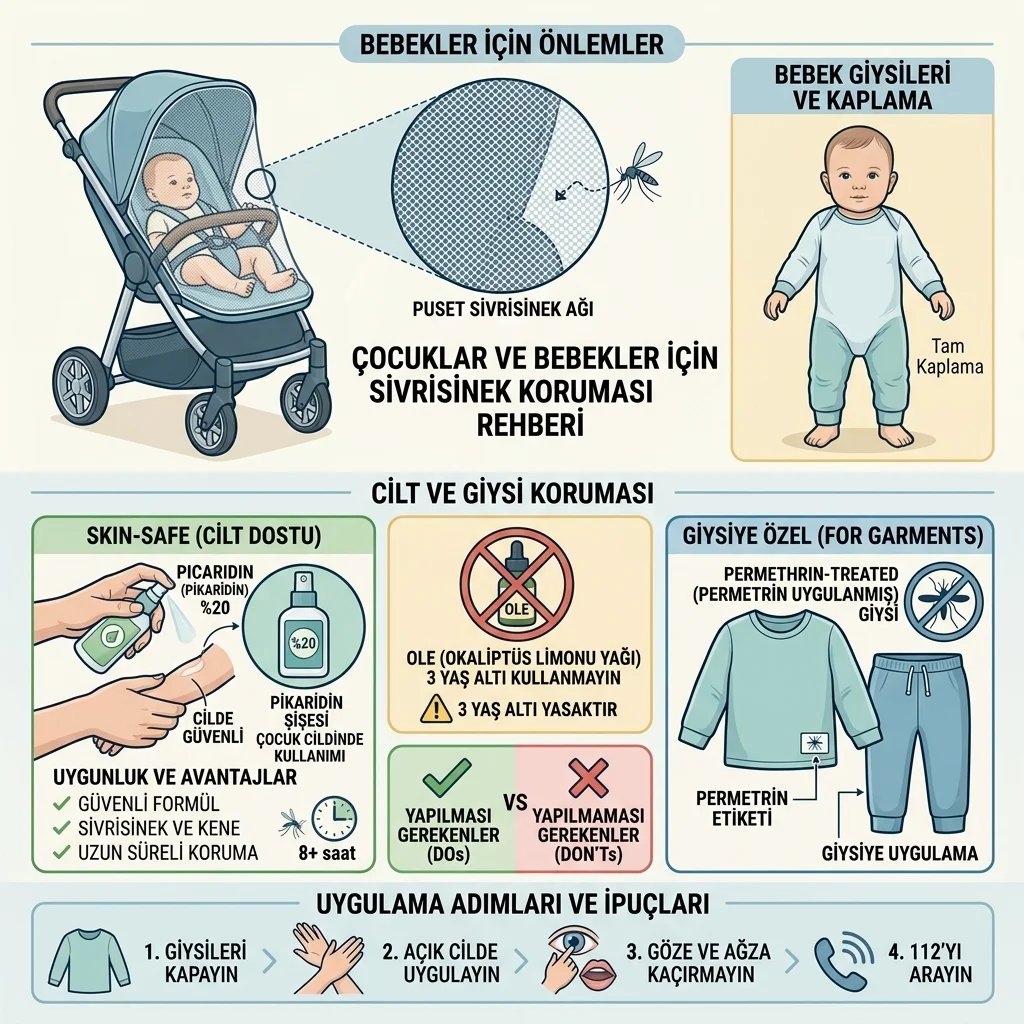
For a baby over two months old, if the product label allows, picaridin is the option most families consider first. DEET can also be an option; but because of its heavier feel and smell, it is less preferred at home. At this point the AAP’s repellent guide for children is useful: the product is chosen according to age, the label instructions and the method of application.
The important line is this: spray the repellent onto your hand, then apply it to the face. Don’t apply the product to the eyes, the mouth, irritated skin or cuts. In a stroller, clarity is needed: product on the skin, thin clothing on top and a mosquito net work together. Protecting a child is not a one-product job.
Which product makes sense when?
If there is a short camping trip, heavy mosquito pressure and a long stay outdoors, DEET is a strong candidate. If it is for use in the city, family use and a lighter feel is wanted, picaridin comes to the fore. If you’re working with clothing, permethrin is added. If you’re looking for a natural option, OLE is considered; but the age limit for young children is not forgotten.
For Türkiye, the general risk reading needs to be done together with the vector-borne disease pages of HSGM (in Turkish). Because choosing a repellent is not enough on its own; standing water, open windows and protection at night are also part of the job.
Short practical conclusion
DEET = strong, oilier, smellier, for long outings. Picaridin = cleaner, more comfortable, more pleasant for most families. Permethrin = clothing, not skin. OLE = short-acting natural alternative, needs care with young children.
The final decision sentence in the field is this: picaridin or DEET on the skin, permethrin on clothing, water control in the surroundings. Once this trio is in place, mosquito repellent is not left to chance.
Sources
- CDC — Preventing Mosquito Bites
- CDC — About Permethrin-Treated Clothing and Gear
- EPA — DEET
- EPA — Skin-Applied Repellent Ingredients
- EPA — Find the Repellent that is Right for You
- AAP — How to Choose an Insect Repellent for Your Child
- WHO — West Nile virus fact sheet