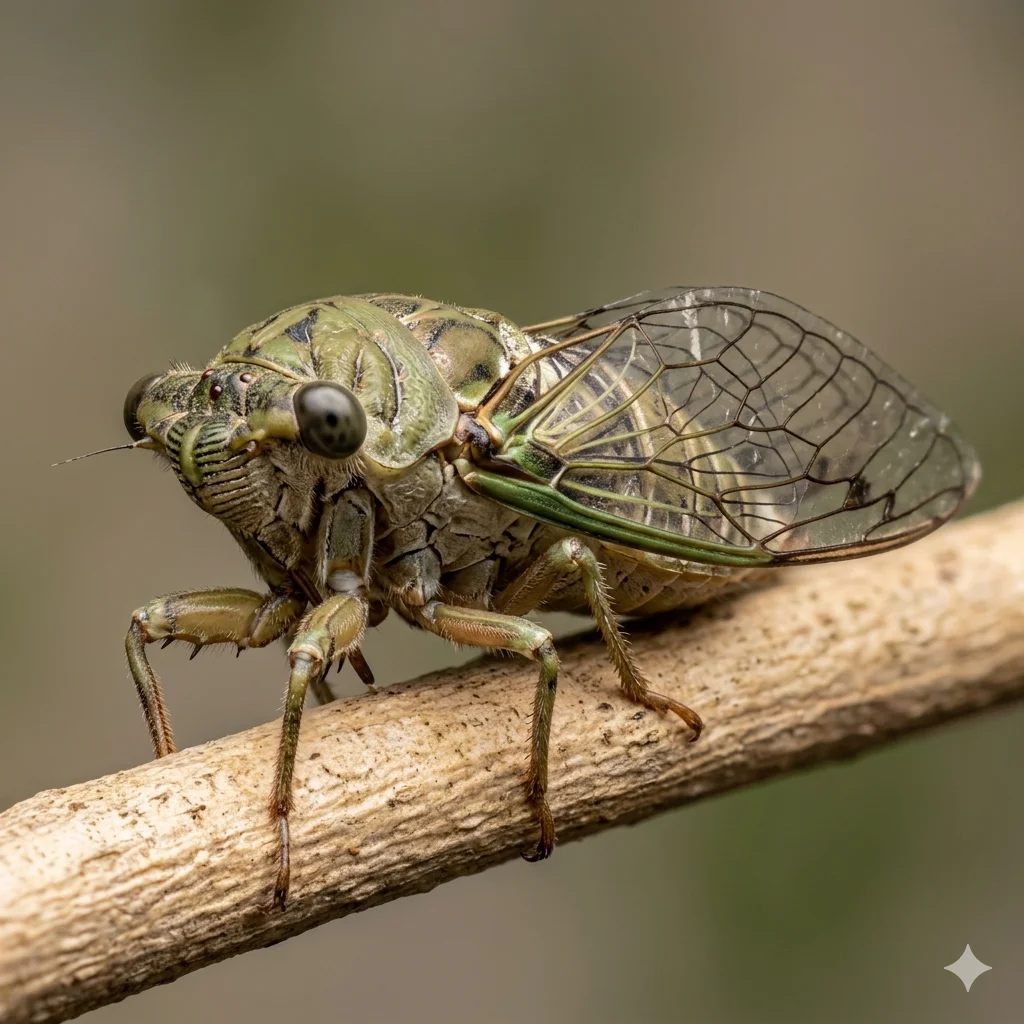
The short answer: the cicada is an old and populous insect group of the family Cicadidae within the order Hemiptera, noticed in the summer heat by its sound. We are talking not about a single species but about a large family with more than 3000 species. Its origin is not new either; its evolutionary traces go back roughly 200 million years. Everyday language claims it as just a “bug”, but what it does is not ordinary: it produces one of the strongest insect sounds in nature, comes onto the stage with daylight and hot weather, and calls a mate with its sound. This article is a general guide; for the detail asked about most often in daily life, you can look at our article Why Do Cicadas Sing Constantly? The Sound Mechanism.
This article is a basic guide to the cicada. It gathers into a clean framework which species are mentioned in Türkiye, how it produces its sound, why it is heard more in summer and why its relationship with people is so pronounced. When the cicada is the subject, excessive emphasis on health is unnecessary; the main matter is natural sound, the life cycle and summer culture. You can also go from here to the article Cicada sound mechanism subtopic.
What is a cicada?
The cicada is a thick-bodied, broad-winged, large-eyed insect that lives with a focus on sound. People know it as a creature that shouts in the trees in summer; science places it in the family Cicadidae. This family is in the order Hemiptera; that is, its mouth structure is of the sucking type and adapted to feeding on plant sap. So the cicada is neither a fly nor a bee. It is a distinctive, old and specialized insect group.
One of the things that makes the cicada interesting is that its sound is not an accident. This group uses its attractive sound not as decoration but as a communication tool. Male individuals make their presence known with sound; although females don’t produce sound directly, they perceive these calls. That is why in the insect world the cicada stands out not for its visual but for its acoustic identity.
The main cicada species in Türkiye
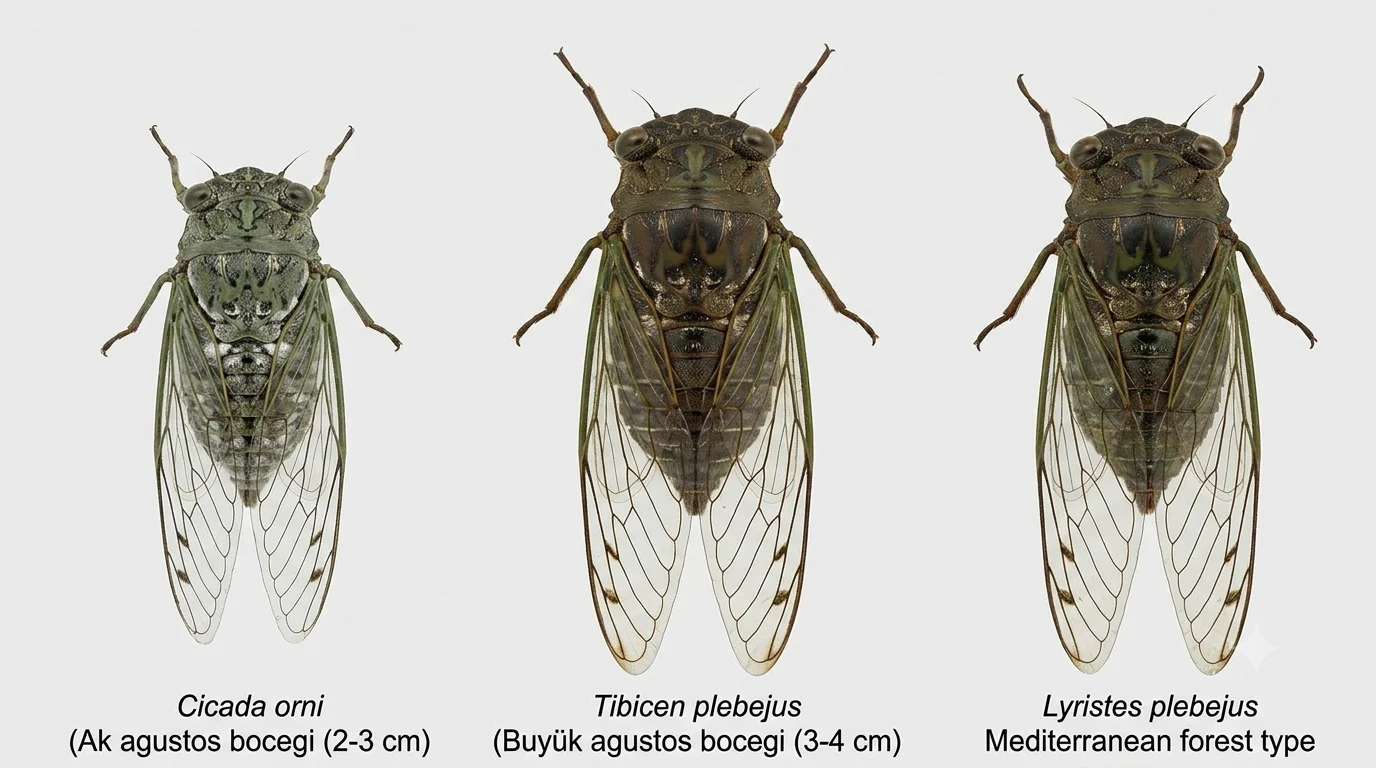
When cicadas come up in Türkiye, among the names mentioned most in the field are Cicada orni, Tibicen plebejus and Lyristes plebejus. A note on names is needed here: in the literature taxonomic names can change over time, and sometimes old and new names are used together. That is why when reading a species you need to look not just at the label but also at the morphology and the habitat it comes from.
Cicada orni
Cicada orni is one of the species widely mentioned in the hot parts of the Mediterranean and Anatolia. It is known for its gray-green striped appearance and its sound, which is more pronounced on hot days. In midsummer, especially in a scorching and dry grove, the presence of this species is felt immediately. The sound can sometimes consist of a thinner buzz, sometimes of a rhythmic call.
Tibicen plebejus
Tibicen plebejus is a species mentioned as having a larger body and dark brown tones. Although its name appears in different forms in some sources, the description in the field generally points to a large-built and loud cicada. In species of this type, in addition to the sound, body size and the sense of “territory” they claim stand out.
Lyristes plebejus
Lyristes plebejus is another species name mentioned especially in connection with Mediterranean forest character. Here again there may be a difference in names; but what the reader should keep in mind is this: the cicada in Türkiye is not of a single type. Within the same summer it can appear before us with different sizes, different tones and different habitat preferences.
The cicada sound production mechanism
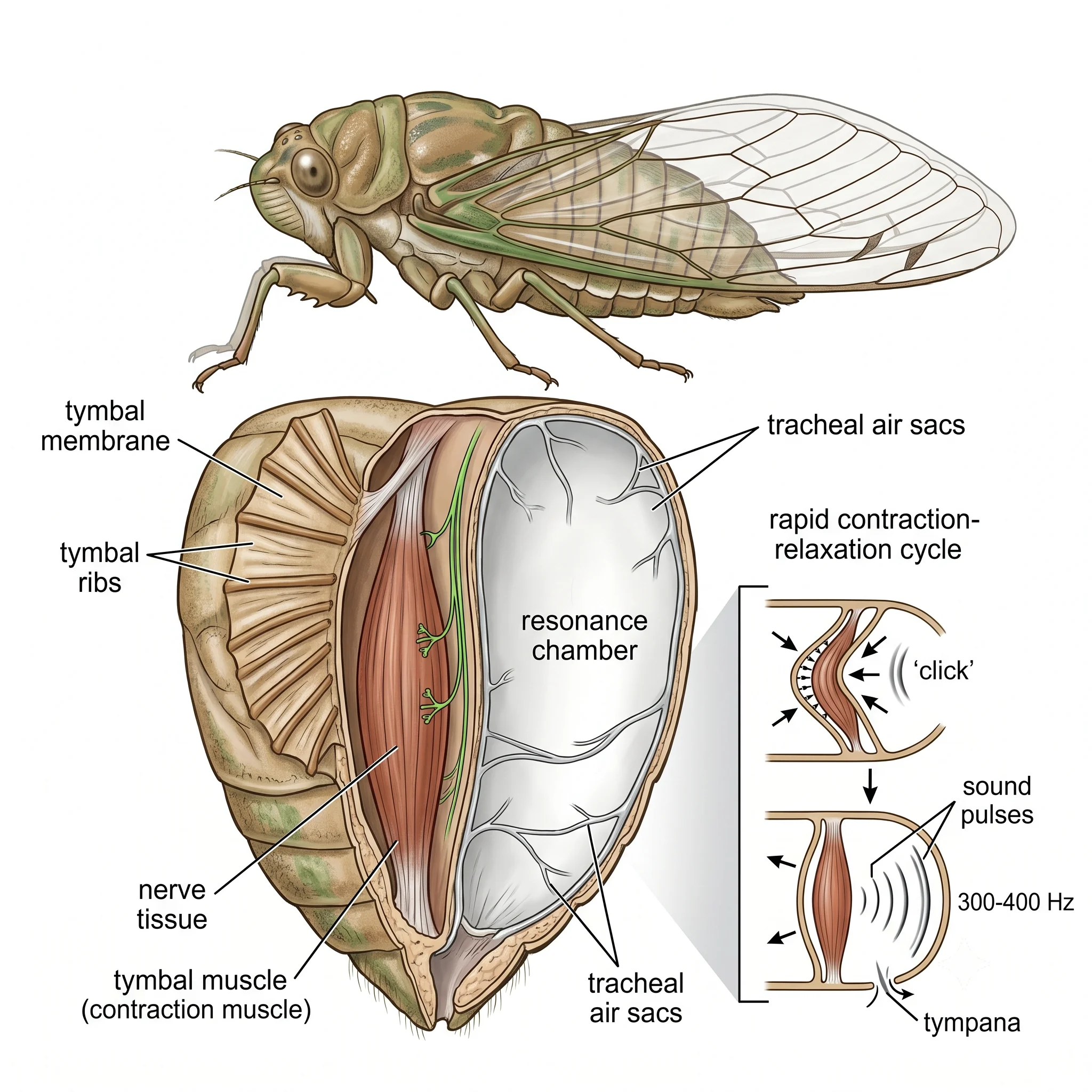
The cicada’s sound comes about thanks to the tymbal organ. The tymbal is a thin but durable membrane structure located on the sides of the abdomen. The male individual vibrates this structure with rapid contract-relax movements. This cycle can be repeated roughly 300-400 times per second; and what comes out is a very powerful call that starts as click-click and then turns into a sharp buzzing drone. This sound is not a single beat but the sum of pulses coming one after another.
In amplifying the sound, the abdominal cavity, that is, the resonance chamber, plays a critical role. Because the tymbal does not want to shout on its own but to amplify the sound. The inside of the abdomen works like a box, strengthens the vibration and carries the sound far. That is why the cicada often sounds to the human ear as if it is “shouting nearby”, but in fact it may be quite high up in the tree. Values above 100 dB are mentioned in the literature for this group; so the sound is serious.
The main point here is this: this is not a show but a call to find a mate. Only the male sings. The female is silent or doesn’t produce sound; in return, she perceives the call of the right species and responds. So cicada sound is not random noise of the summer air but a biological signal.
The cicada life cycle and the 17-year story
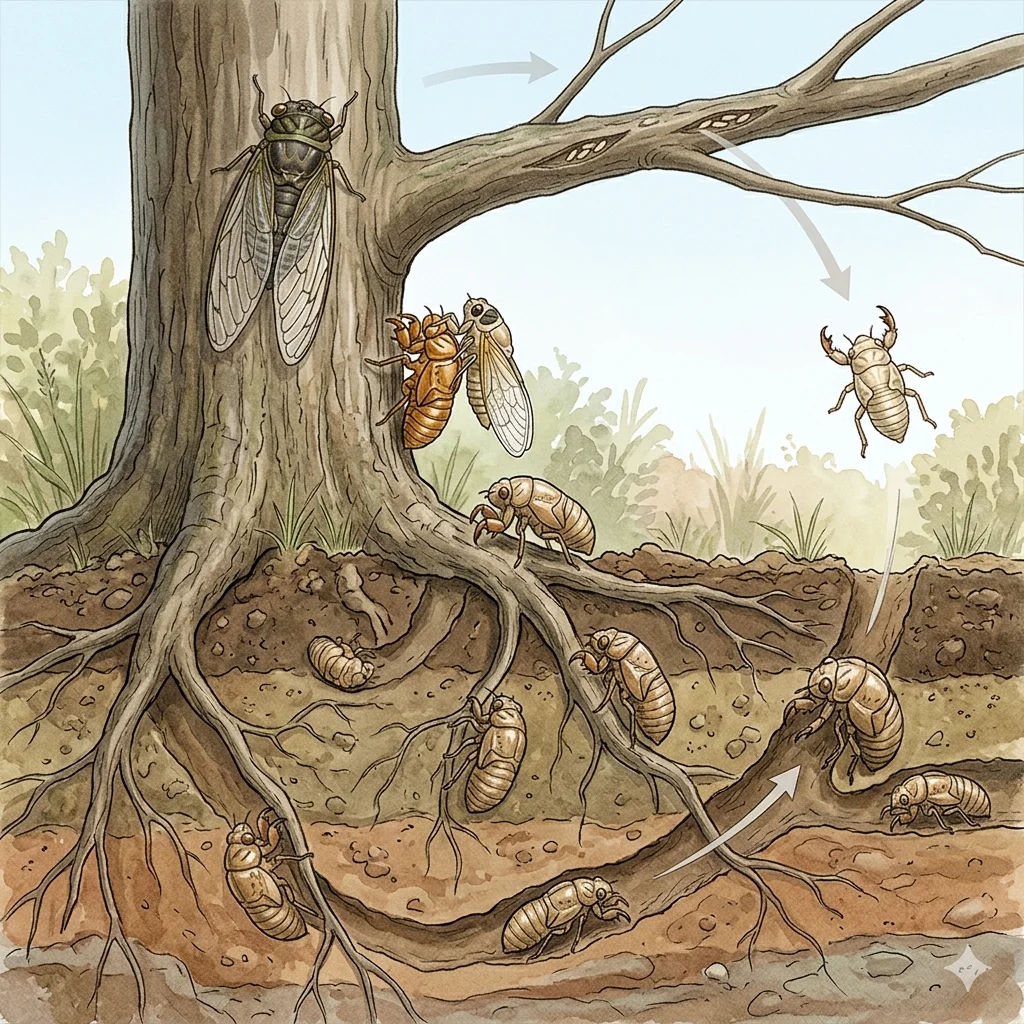
The cicada does not undergo complete metamorphosis; its story progresses along the axis of egg, nymph and adult. The female lays her eggs inside a tree branch or thin plant tissue. The nymph that hatches from the egg drops to the ground and goes under the soil. The real long part starts here. The nymph can stay underground for years; it lives by sucking sap from plant roots. Depending on the species, this period can vary between 2 and 17 years.
Among the best-known periodical cicadas worldwide there are 13- and 17-year cycles. This is a truly remarkable rhythm for the insect world. Many cicadas in Türkiye, however, are not periodical over such a long span; most species follow a cycle in the 2-5 year range. So the expression “17 years” does not apply to every cicada, but it is the family’s most striking example.
The adult stage is short: generally 2-4 weeks. Within this short time the main goal is not feeding but producing sound, finding a mate and laying eggs. Nature’s balance here is clear: the nymph that waits silently for years comes onto the stage in a short summer window. This is also interesting proportionally among insects; a long underground life and a short adult period exist together.
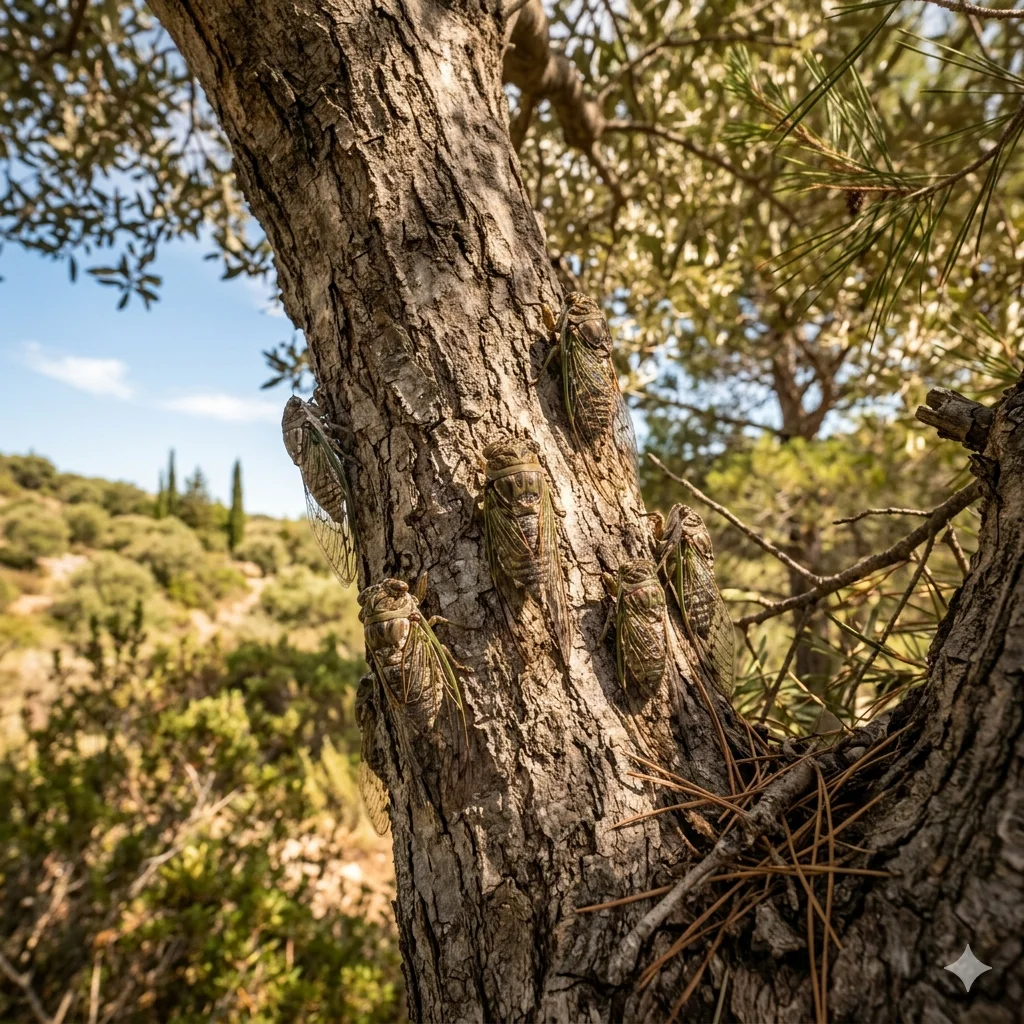
Cicada behavior and the summer chorus
To understand cicada behavior, looking at the hours is not enough; you need to look at the temperature and the sun. Male individuals become more active in the hottest hours of the day. Because the sound call requires energy and hot weather makes this mechanism easier. That is why the cicada is more pronounced not in the cool of the morning but in the afternoon and toward the summer evening.
In some areas more than one male gathers on the same tree and forms a collective summer chorus. At first glance this looks like chaos, but in fact the whole system is built between competition among individuals and within-species mating. Females respond silently. In some species wing movements or body posture can also be part of the signal. So the request is not just sound but position and timing.
This behavior also gives the cicada a place in human memory. The rhythmic sound coming in the background on a summer evening is not a momentary thing but like a seasonal signature. The Summer Insect Concert article can describe this sound geography more broadly. There is also a topic to be developed, such as Periodical Cicada 17 Years; there, why periodical species emerge to the surface in synchrony can be explained in detail.
The cicada and its relationship with people
In human culture the cicada is tied to the feeling of summer more than to fear. In Anatolia it is called by its name, whose Turkish form means “August insect”, because it is heard most in the month of August. In different cultures from Ancient Greece to Japan, it has also been thought of together with summer, light and sound. The cultural image of “semi” in Japan, summer festivals and the way of remembering the sound that passed in summer show this group’s emotional power.
In modern life, on the other hand, the cicada is seen less in the city, but in the countryside it still sets the sound of summer. Part of this sound is aesthetic, and part of it is an ecological indicator. Because if there is a cicada, there are suitable trees, suitable temperature and enough natural area. The sound here is not just music but a signal of the habitat.
Compared with the firefly, the difference is seen more clearly: the firefly speaks with light at night, the cicada speaks with sound during the day or in the hot hours. One gives its message with light, the other with vibration. Both groups leave a trace in human memory in summer, but the channel they use is different. For the cicada, sound is its lasting identity.
The cicada from a health perspective
The cicada is generally harmless. Biting, stinging, venomous defense or aggressive attack is not to be expected. For people the main issue is not biological harm but the occasional disturbance of loud sound. Exposure to intense sound for a long time and very close up can create unease in some people. At this point, rather than giving medical advice, it is right to keep it simple: if the sound seems loud to you, increase the distance or consider ear protection.
Another point is curiosity about eating and contact. Although the cicada is mentioned among edible insects in some Asian cultures, this subject varies from culture to culture. The main focus here is not food but natural behavior. In addition, handling the insect, shutting it in a jar or keeping it under stress for a long time is not right. If there is observation, it should be short and gentle; afterwards it should be released.
The short summary is this: the cicada is not a creature to be feared but a summer insect to be understood correctly. You listen to its sound, but you don’t disturb its natural order.
Cicada FAQ
Why does the cicada sing only in summer?
It is temperature-dependent. In conditions above 25 C activity increases. That is why it is heard more in midsummer, especially in hot and dry hours.
Does the female cicada sing?
No. Basically it is the male individuals that sing. The sound is used as a mating call.
Why is the cicada so loud?
The tymbal organ vibrates rapidly, and the abdominal cavity strengthens the sound. This pair produces a call heard even from far away.
How many years does the cicada live?
The adult stage is short, the larval stage long. Depending on the species there can be a nymph period of 2-17 years; adulthood, on the other hand, is usually around 2-4 weeks.
Aglaboz vs cicada: what’s the difference?
There is so little difference that you could say there is none; aglaboz is one of the names in everyday Turkish. Cicada is closer to scientific and international usage.
Topics and sources related to the cicada
This main page serves as a pillar for the cicada. Readers looking for detail can head in these directions:
- detailed article on sound production — subtopic #18
The following pages can be read as external sources:
- Britannica - Cicada - species-based basic page
- Cicada Mania - species and notes from the field
- TÜBİTAK Science and Technology (in Turkish) - for local science reading
If the subject is to be read in more depth, the Encyclopedia of Life and species-based academic records also help. But the main message for this article is clear: the cicada is an insect group of ancient origin, biologically specialized, known in summer for its sound. If you listen in the right place, you can also read the map of summer.
Related Topics
If you want to read this topic in a wider context, look at the cluster articles: Firefly: Bioluminescence and Ecology.