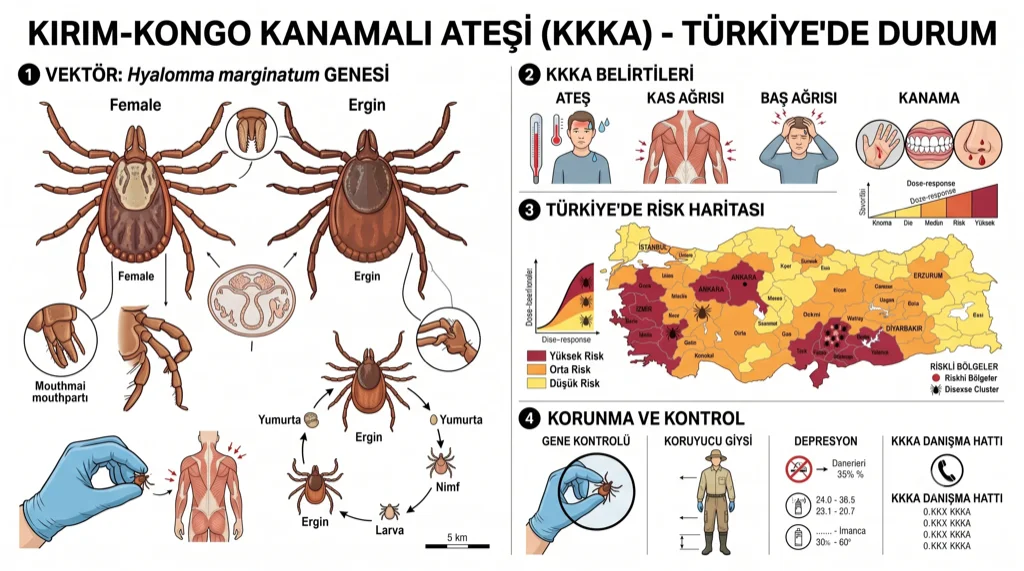
When it comes to CCHF Crimean-Congo symptoms, the game turns into one about delay. In the Tick: Biology, Life Cycle and Health Perspective article we covered the vector side; in What to Do After a Tick Bite? An Evidence-Based Guide we covered first response. This page has a single job: to make clear the stages of the disease, the risk areas in Türkiye and the threshold for calling your country’s emergency number.
This article is for information. If there is fever, bleeding or rapid deterioration, don’t delay calling your country’s emergency number.
What is CCHF?
CCHF, or Crimean-Congo hemorrhagic fever, is a severe viral disease transmitted by ticks. In Türkiye it is one of the most talked-about pathogens because its course can be fast and lost time in treatment causes problems. Sources give the disease’s fatality rate as roughly within the 5-30% band; with delayed presentation this risk rises. The main vector is usually Hyalomma marginatum. This tick stands out especially in the warm, dry and rural belt, in areas with animal contact.
When it comes to case hotspots in Türkiye, Central Anatolia and the Black Sea line are often mentioned; the Tokat-Sivas area is also among the regions named in public health records. This does not mean that all the risk lies only in these provinces. But the language of the field says this: if there is rural contact, the season is warm and there is a history of tick exposure, stay alert.
Symptoms are thought of in two phases
The first appearance of CCHF is often deceptive. People may wait because they think it’s the flu. Yet the picture can become severe in the first phase.
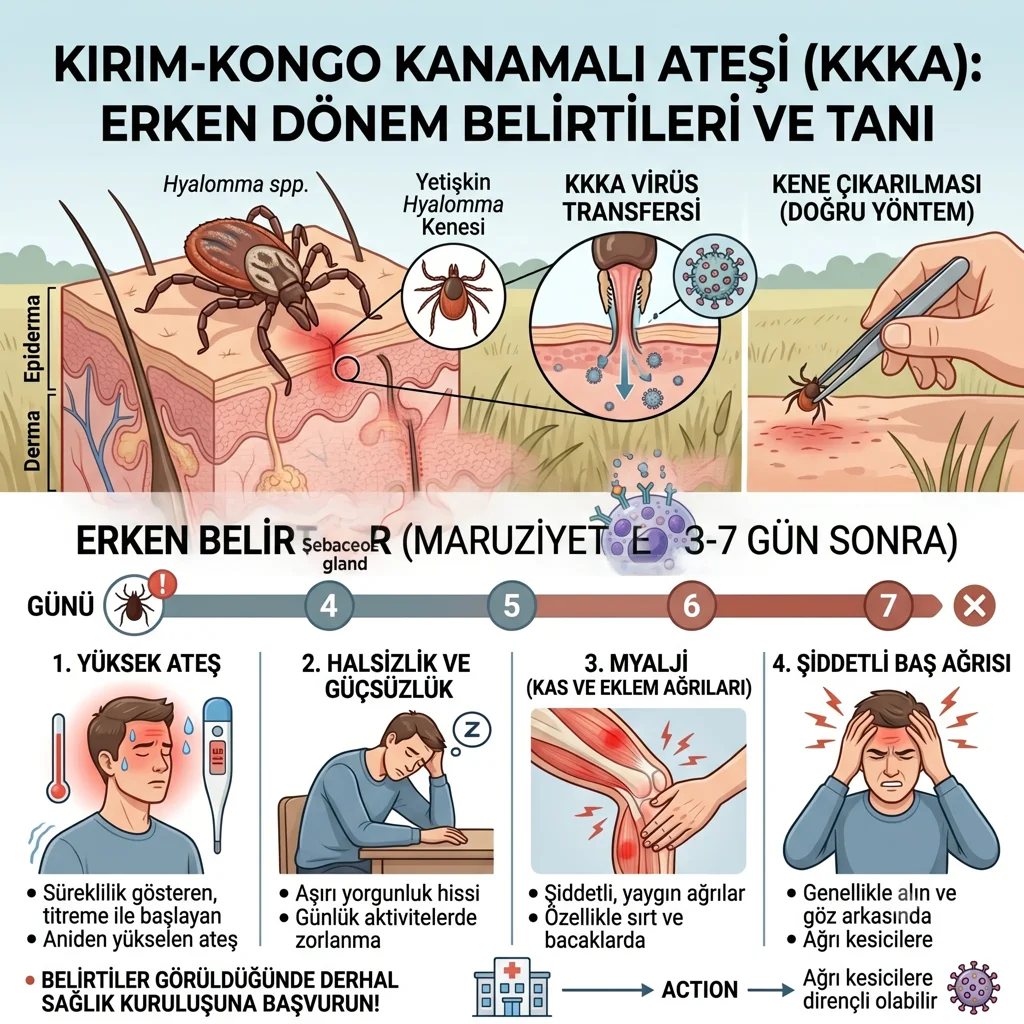
Phase 1: the picture that starts within 3-7 days
The most common first signs:
- fever
- weakness
- myalgia
- headache
- sometimes nausea, loss of appetite and muscle aches
At this stage the disease sometimes looks like an ordinary viral infection. But if there is a history of tick contact, it is not considered ordinary. The 3-7 day window in particular is the first alarm interval. The goal here is not panic but setting up the right filter.
Phase 2: the hemorrhagic period
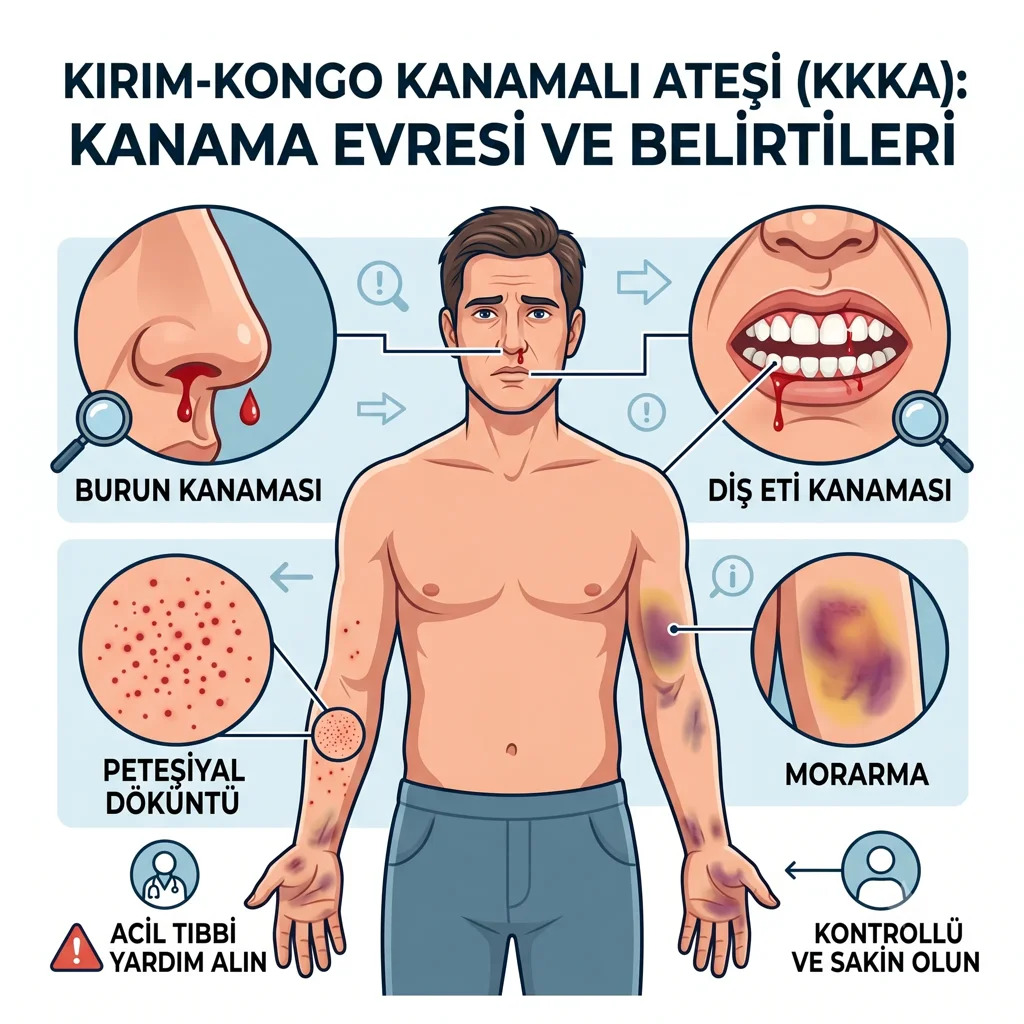
If the picture progresses, a bleeding phase may appear. Here the red line is clearer:
- nosebleed
- gum bleeding
- petechial rash
- bruising
- blood in the urine or stool
- blood in vomit
This phase does not run with the same severity in every patient. But once it starts, the urgency increases. Because bleeding can mean impaired clotting and damage inside the blood vessels. If you remember tick contact and these signs are added on top, the ground for monitoring at home narrows.
Why is delay dangerous?
The biggest mistake with CCHF is treating the first fever as mild. Because there can be a short window between the early phase and the bleeding phase. The earlier supportive treatment, monitoring and isolation begin, the more controlled the management is. Delayed presentation, especially as bleeding begins, increases the risk of death.
Reduce this to a single sentence in the field: tick contact + fever + weakness = don’t wait. If bleeding has been added, your right to wait shrinks even further.
How to read the risk in Türkiye
Reading risk is not just about memorizing region names. Rural work, animal contact, pasture, the area around barns, the summer season and checks after time outdoors are considered together. That is why case clusters in the Central Anatolia and Black Sea belt matter. The Tokat-Sivas line, in turn, is one of the classic hotspots on healthcare workers’ minds.
The important point here: don’t relax just because you’re outside a risk region. A tick is a piece of biology that travels. People, too, carry that biology on clothing, animals, pasture and gardens. That is why the contact history is always more valuable than the region label.
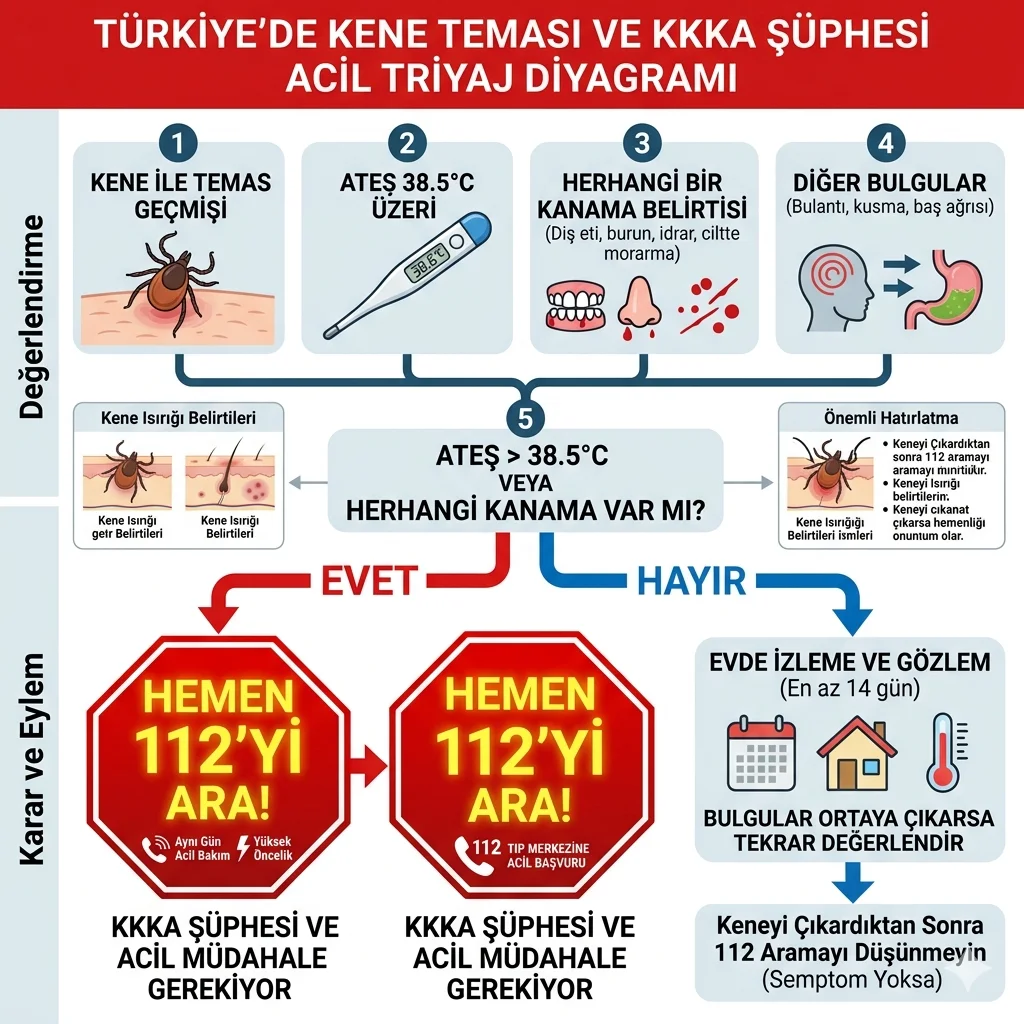
MANDATORY emergency-number triage table
Keeping the table below short is a deliberate choice. Let the rule be clear.
| Situation | What to do | Why |
|---|---|---|
| Tick contact + fever of 38.5 C or higher | Call your country’s emergency number, get same-day emergency assessment | Early alarm for CCHF |
| Tick contact + nose, gum, urine or stool bleeding | Call your country’s emergency number | Suspected hemorrhagic phase |
| Tick contact + petechial rash + weakness | Go to the emergency department | There may be impaired clotting |
| Tick contact + fainting, change in consciousness, shortness of breath | Call your country’s emergency number | Life-threatening risk increases |
This table is not decoration. In the field, this is the decision line. The sentence “it’ll pass soon” doesn’t work here.
Who should be more careful?
People working outdoors, those caring for animals, shepherds, farmers, campers and children should be especially careful. A tick often attaches unseen; areas such as the hairline, behind the ears, the groin and the back of the knees can be missed. When you get home, shaking out clothes, taking a shower and checking your body systematically is a simple but effective habit. Pets also carry risk; a tick on an animal can be brought into the home. That is why precautions are needed not only after a picnic but after every contact with the outdoors. Don’t neglect checks in the summer heat.
What to do, what not to do
If you’ve seen a tick or have just learned of tick contact, the same logic applies at the start and at the end:
- don’t crush the tick
- don’t apply oil, alcohol or petroleum jelly to it
- don’t try to burn it
- don’t try to break it apart on your own
- if possible, get guidance from a healthcare facility
In a suspicious situation, use the healthcare system instead of waiting. The answer to the question of what to do after a tick bite lands on the same ground here too: correct removal, correct monitoring, the correct threshold.
A look at the official sources
The CCHF page of the Turkish Ministry of Health’s General Directorate of Public Health (in Turkish) and WHO’s Crimean-Congo haemorrhagic fever fact sheet are required in-depth reading on this topic. The official framework is simple: a person with tick contact should not delay when there is fever, weakness, pain and especially signs of bleeding.
Frequently asked questions
How are CCHF symptoms distinguished from the flu? A history of tick contact, a fever that starts a few days later and then signs of bleeding make the distinction. The flu comparison alone can be misleading.
Does every tick carry CCHF? No. But species, region and season together create the risk. Hyalomma marginatum is the prominent vector.
Can I relax if there is no bleeding? No. Fever and weakness are important on their own too. The window before bleeding arrives must not be missed.
Short conclusion
CCHF is a tick-borne disease that must be taken seriously in Türkiye. Although the fever, weakness, myalgia and headache in the first phase may look mild, the picture can turn into bleeding. In the Central Anatolia and Black Sea belt, especially in people with a history of rural contact, vigilance should be raised. The rule is short: if there has been tick contact, call your country’s emergency number once fever or bleeding starts.
Sources
- Turkish Ministry of Health, HSGM — Crimean-Congo Hemorrhagic Fever (in Turkish)
- WHO — Crimean-Congo haemorrhagic fever
- Tick: Biology, Life Cycle and Health Perspective
- What to Do After a Tick Bite? An Evidence-Based Guide
This article is for information. If there is fever, bleeding, fainting or rapid deterioration, don’t delay calling your country’s emergency number; a physician’s assessment is needed.