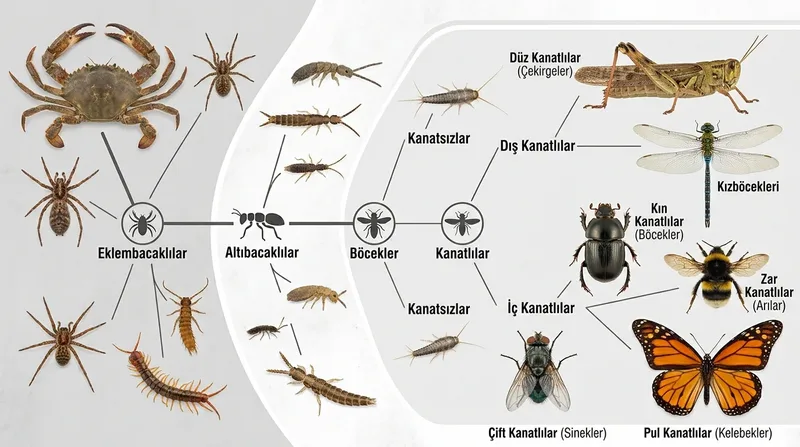
A taxonomic tree explaining what an insect is and a scientific montage of different insect groups

What Is an Insect? Insecta, Arthropods and Nature's Most Successful Animal Group

The short answer to the question of what an insect is: an insect is an animal belonging to the class Insecta within the arthropods, which in the adult stage has six legs, one pair of antennae and a body plan arranged as head, thorax and abdomen. This answer is narrower than the everyday meaning of “a small thing walking around the house”. In daily life it is correct to call the cockroach, the ant, the house fly and the mosquito insects; for spiders, ticks, millipedes, centipedes, woodlice, slugs and worms, the same word is not biologically correct. ...

Biological control and beneficial insects in the garden

Garden Biological Control Guide: Ladybugs, Dragonflies and Parasitoid Wasps

Biological control in the garden brings down to a single plane the network you have seen separately in the Ladybug, Ant and Honey Bee articles: it is not about poisoning the pest but about keeping the chain of predators, parasitoids and pollination standing. The short verdict is this: first protect the creatures that lower the pressure, then adjust the habitat. This article gathers the field practices for the focus keyword “biological pest control garden”. ...

Scientific cover image illustrating the green glow of GFP from the jellyfish Aequorea victoria

What Is GFP, the Green Fluorescent Protein?

The short verdict is this: if you know the luciferase logic in Firefly: Bioluminescence and Ecology, you will understand in one move why GFP is different; Pheromones, Dance and Light in Insect Communication, on the other hand, shows that in nature a signal is not carried in a single form. This article covers the laboratory side of that same family of signals. If you want to broaden the background, the chemical and behavioral side of signaling is also laid out in the Ant and Honey bee articles. ...

Comparison of the house fly compound eye and the human eye

Compound Eye vs Human Eye: How the House Fly Reads the World

The speed question on the House Fly page actually rests on the physics of the eye. The article on the house fly’s fast escape opens this up from the behavior side. The same optical question gives a different result for the honey bee. The firefly, on the other hand, carries a night signal. On the mosquito side, the balance of approach and avoidance rests on a different biology. In this article we reduce the compound eye vs human eye difference to a single sentence: one reads a wide field and motion, the other reads detail and depth. ...

Harmonia axyridis — the invasive ladybug with variable coloring

Harmonia axyridis as an Invasive Species: Why Is the Asian Lady Beetle a Problem?

This article takes the species distinction mentioned on the Ladybug main page one step further: Harmonia axyridis, i.e. the Asian/multicolored lady beetle, is one of the most debated invasive species within the same family. Reading the logic of invasive species through the framework we saw in the Ant and Mosquito articles is useful here too. The rule is simple: not every shiny insect is beneficial, and not every beneficial insect stays beneficial everywhere. ...

Ant pheromone, honey bee dance and firefly light in the same frame

Pheromones, Dance and Light in Insect Communication

Ant pheromones, the honey bee dance and the firefly flash give three separate answers to the same basic problem: transmitting information reliably. To read these three examples together, it is enough to consider first the pheromone logic of the ant trail, then the Honey bee dance language and Firefly light code pages. In each case it is communication; the carrier, the duration and the margin of error change. Chemical trails in the ant: low cost, high durability Ants build communication on a chemical map. Pheromones take on tasks such as trail marking, alarm, aggregation and colony identity. When a worker finds a resource it leaves a trail, the others read that trail with their antennae, and as the line strengthens the route turns into a real road. Alarm pheromone spreads danger quickly; an aggregation signal gathers individuals at the same spot. The strength of this system is that a single message grows as it is reused. Air currents, surface texture and rain change the quality of the trail; in other words, the error rate depends on the environment. ...

Firefly habitat squeezed between artificial city lights and the dark summer night

Light Pollution and Firefly Conservation: Giving Back the Flash Code

The short verdict is this: the species backbone in the Firefly: Bioluminescence and Ecology article is cut off by light pressure in this article; the flash language in Why Do Fireflies Glow? The Secret of Bioluminescence becomes unreadable under artificial light. To understand the field, the line of Where Can You See Fireflies? An Observation Guide for Türkiye together with Pheromones, Dance and Light in Insect Communication also needs to be put on the same table. This topic is not only about fireflies; it also shows how other creatures such as the Honey Bee, the Ant and the Ladybug live with night and environmental signals. ...

Mass emergence of Magicicada

17-Year Cicada: The Periodical 17-Year Cicada Phenomenon

The topic people search for as the 17-year cicada is actually a narrower biology story that starts with the main Cicada article and settles in through the sound mechanism and egg-laying behavior. The star here is the genus Magicicada, which lives only in North America. If you’d like to read the topic from the opposite side as well, the Why Do Fireflies Glow? article, which explains why the sound is so powerful, is a good neighbor too; one speaks with light, the other with sound. ...

Female cicada laying eggs with her ovipositor on a slender twig

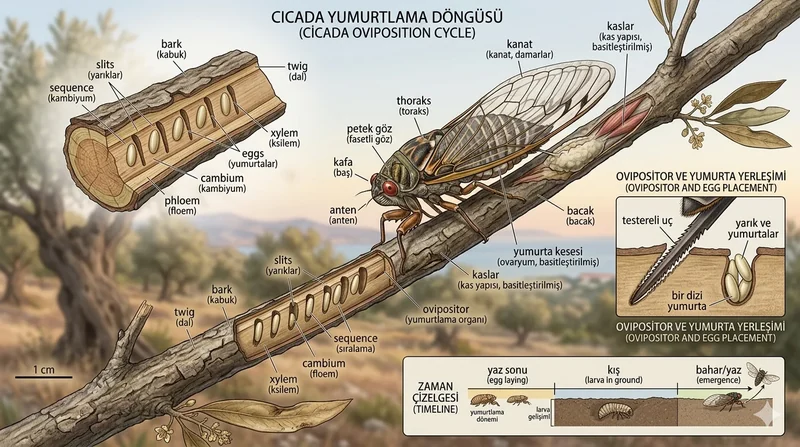
Cicada Egg-Laying Behavior

The short answer is clear: the Main Cicada article gives the general backbone of the life cycle; here, linking up with Why Do Cicadas Sing Constantly? The Sound Mechanism, we read cicada egg-laying behavior step by step. Because egg laying, the sound call, mating and underground development are parts of the same chain. Seen through the eyes of a field biologist, the matter is not a single moment but a cycle. In the classical sense, univoltine means single-generation; but for cicadas the more accurate framework is that the adult stage is short and the development period is long. In some species this wait is in the 1-4 year band; some periodical lineages in North America, on the other hand, wait 13 or 17 years. So the creature we call the cicada becomes visible in summer with a few weeks of sound, but spends the main part of its life hidden. ...

Pesticide risk between the honey bee and farmland

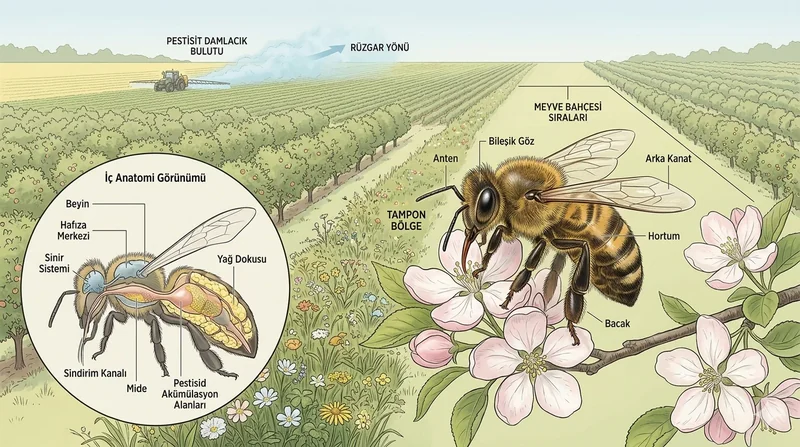
Honey Bee Protection: Pesticide Effects, Neonicotinoids and Colony Health

The short verdict is this: the honey bee protection pesticide issue can’t be explained with the name of a single product; it is read through the whole functioning of the Honey Bee colony and behavioral details such as the Honey Bee Dance Language. The problem is not only that the bee dies, but that it loses its way, can’t find food and that the colony weakens. That’s why the topic is both biology and agricultural management. ...

Fireflies glowing at night in an open area at the edge of a humid forest near a stream bank, with a dim summer sky in the background

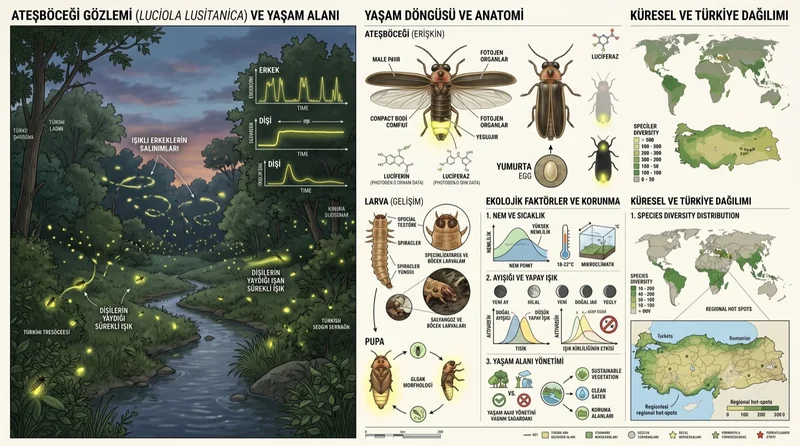
Where Can You See Fireflies? An Observation Guide for Türkiye

The short answer is clear: if you know the species backbone in the article Firefly: Bioluminescence and Ecology, the answer to the question of where fireflies can be seen opens up too. When looking for this creature in Türkiye, the target is not a single spot but the edge lines where humid forest, stream bank and meadow touch one another. The best chance is on nights when the darkness is strong, the moonlight is weak and the ground stays alive. ...

The difference between the house fly and the fruit fly; a side-by-side scientific comparison of the two species

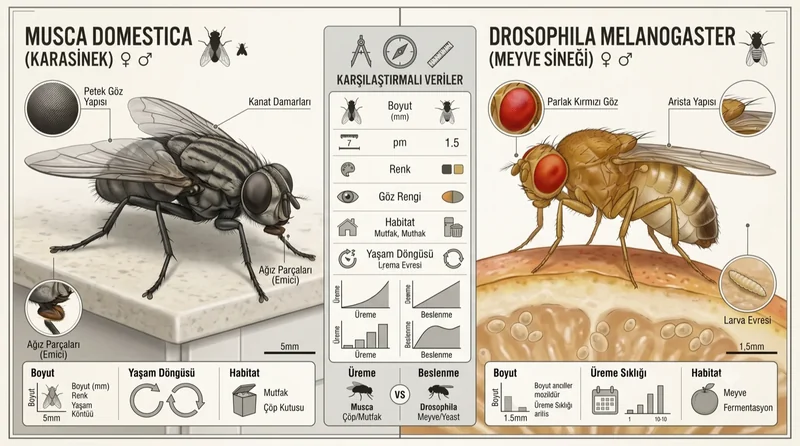
House Fly vs Fruit Fly: Musca domestica and Drosophila melanogaster

The difference between the house fly and the fruit fly falls fully into place when read together with the main house fly guide and the article explaining why the house fly escapes so fast. The issue here is not a single name; it is two separate biologies. On one side there is Musca domestica, on the other Drosophila melanogaster. One circles around trash and human living spaces; the other lives around ripe fruit, vinegar and fermentation. ...