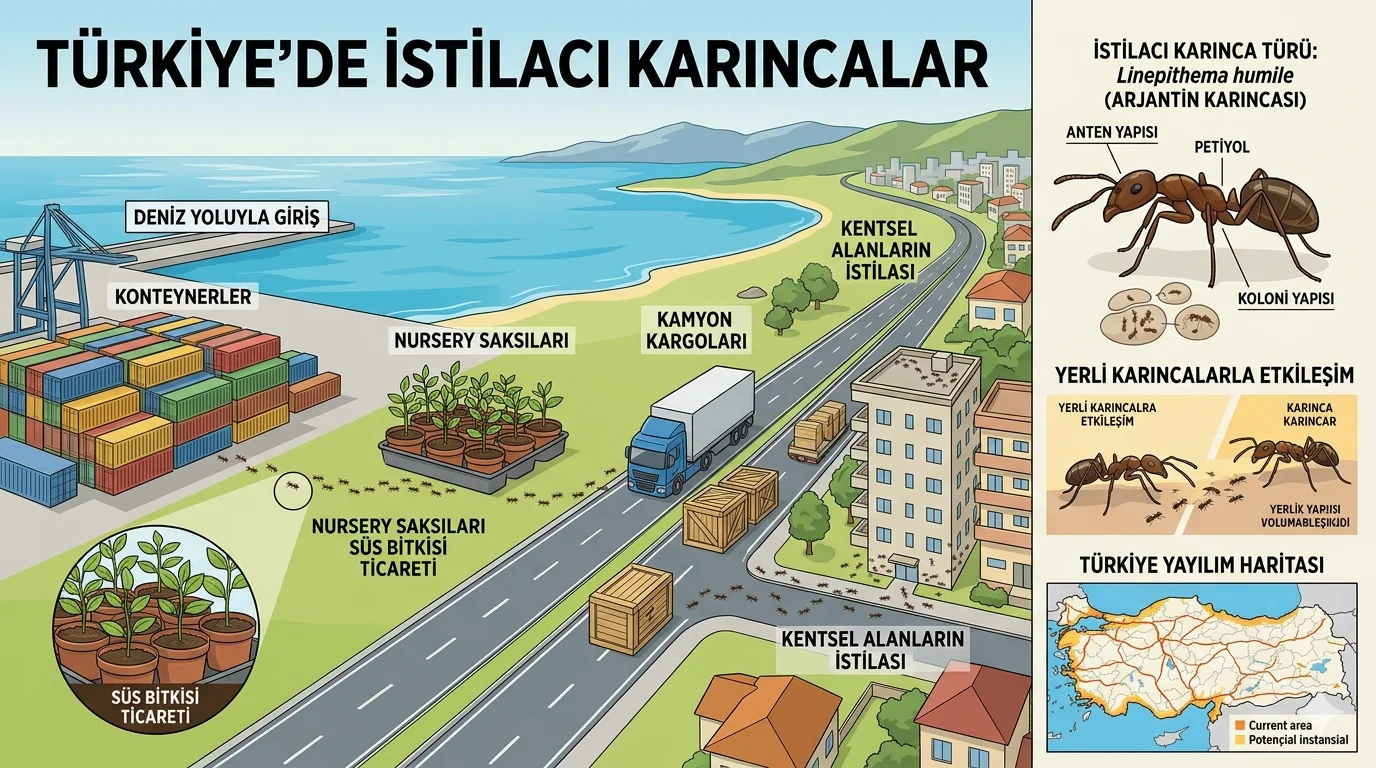
If you know the Ant backbone, the How Do Ant Trails Form? The Language of Pheromones article completes this piece. The species you see here is not an ordinary house ant; it is an invasive line spreading along the Mediterranean coast that works differently in both behavior and genetics. Its name is Linepithema humile; in the field, most people know it as the Argentine ant.
What is the Argentine ant?
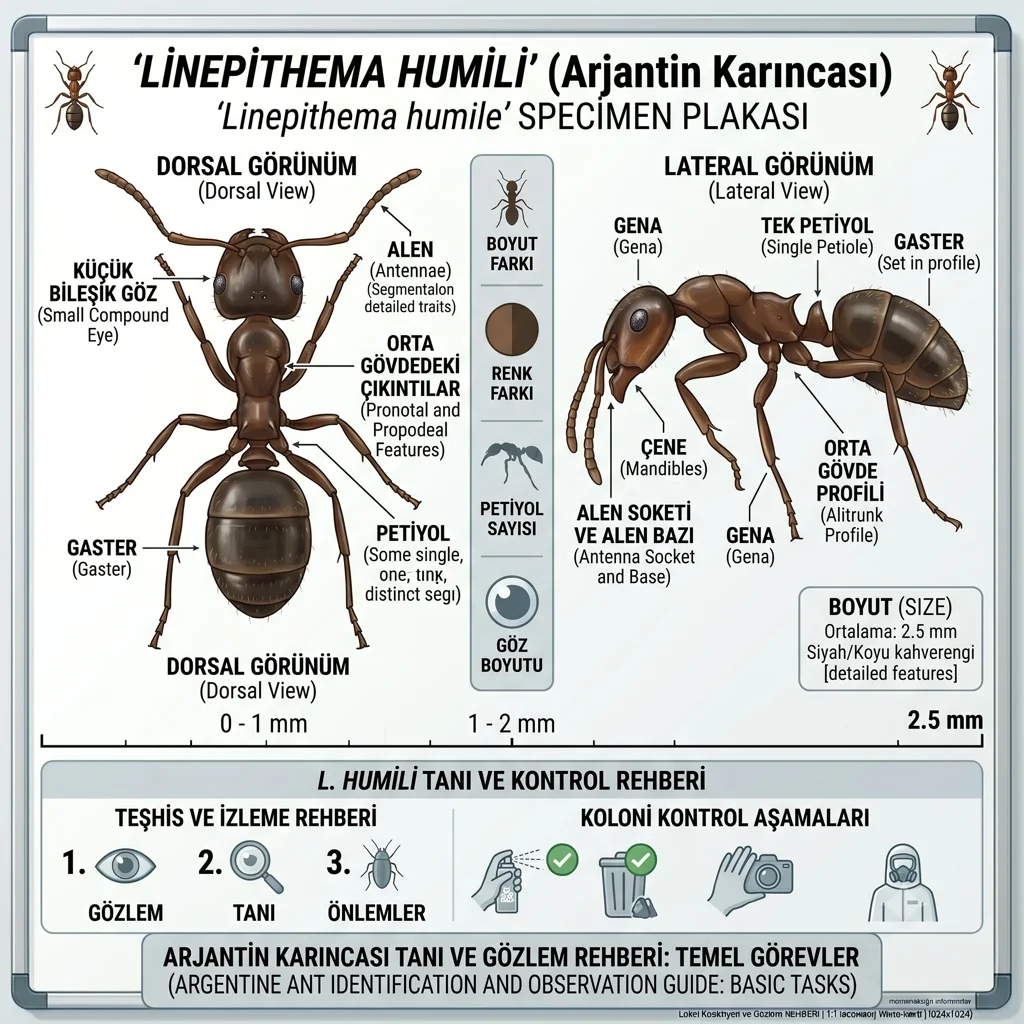
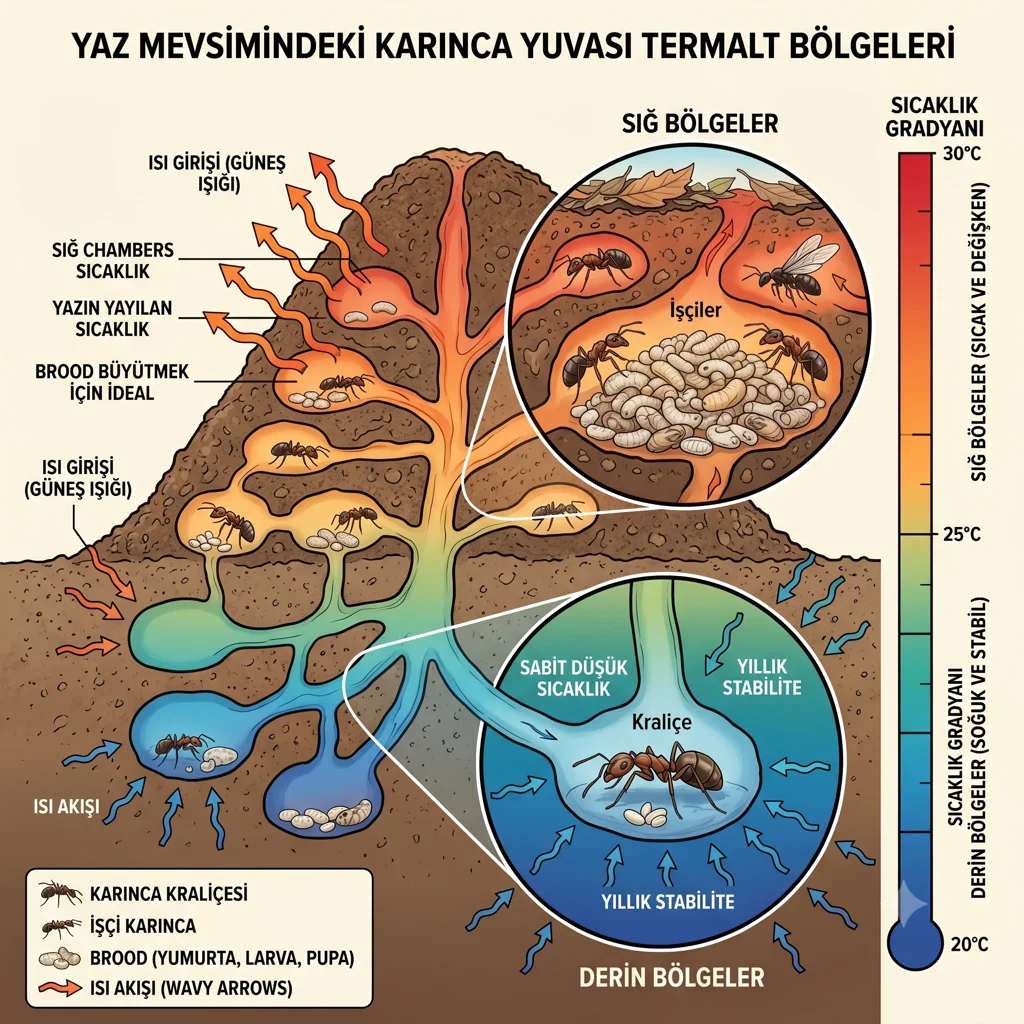
Linepithema humile is a small, dark brown species about 2.5 mm long. At first glance it doesn’t catch the eye. It has a single petiole, does not have large eyes and walks close to the ground. That’s why it hides easily under stones, in flowerpots, under pavements, at the base of walls and in pockets of loose soil. You won’t see the nest from above; you usually notice it when you lift a stone, open up the pot soil or see movement along the edge of a crack.
Identification calls for a biologist’s eye. Color alone isn’t enough. Size, the single petiole, the small body, rapid route changes and a preference for damp, sheltered nests are read together. That’s also why this article recommends a specimen plate: in the field, a single angle is often misleading. A dorsal and lateral view, a scale bar and a short morphological note should all be together.
Why is it drawing attention in Türkiye?
On the Türkiye side, the picture is becoming important especially in the Mediterranean coastal belt. Records from around Antalya and Mersin since 2010 show that the species has been able to gain a foothold along this line. The warm climate, port connections, the flow of nursery stock and heavy transport make this easier. Once it settles, it is not just a single-garden problem; pavements, shared walls, the surroundings of housing complexes and landscaping lines can all be affected at the same time.
The issue here is not “there are ants”. The issue is the displacement of native ant communities. While competing for resources, the invasive species narrows the food, nesting and passage space of native species. In the end, it isn’t just one species that increases; the surrounding network of small invertebrates also breaks down. This is the real harm to biodiversity.
Why does the supercolony change the game?
The most critical feature of the Argentine ant is its supercolony behavior. Billions of workers can operate like a single genetic network. Because local genetic differences are very small, neighboring colonies don’t attack each other; border fighting stays low. Normally, territorial warfare creates pressure in ant colonies. Here, that pressure is weak. That’s why the species spreads not from a single center but like a wide network.
This feature also makes control harder. You put bait down at one point, and part of it is affected. But the connected nests around it quickly fill the area. So the problem isn’t a single colony but a network of connected colonies. The individual approach in the How to Get Ants Out of the House? A Lasting Solution with Bait article isn’t enough here; block-level thinking is needed.
Where does the invasion route come from?
The transport route is usually opened by human hands. Cargo, nursery soil, potted plants, truck beds, pallets, and even ship and port logistics open the door for this species. A pot with soil is an invisible transport capsule. On top of that, if drainage is poor, irrigated areas become more attractive to the species. So the perception of a “clean place” doesn’t mean safe when it comes to an invasive ant.
Plant nurseries are a critical point in all this. Because if pot soil changes location without going through quarantine, it’s not a single individual but a piece of a colony that gets carried. That’s why in field practice the first question is: did this ant come here on its own, or was it carried? In most cases the second answer is closer to the truth.
What does it do to the ecosystem?
A species invasion doesn’t only bother people. When native ants are suppressed, seed dispersal, soil turnover, predation on small invertebrates and the balance of micro-nests change. Some plant species have their seeds carried by ants; if this network weakens, plant regeneration is also affected. A loss that looks small within the insect community grows larger along the food chain.
A biologist’s perspective matters here. It’s not just about counting; nest distribution, entry density, waste pockets, movement under plants and pressure from neighboring species are read together. The invader’s power lies not in individual workers but in its collective pressure that reshapes the environment.
Why does it crush native ants?
The Argentine ant doesn’t win only because it has “more individuals”. It shares resources quickly, fighting within the species is low, and it uses the area like a single network. Native species, on the other hand, usually form fragmented colonies. In such a picture, the invasive network is the side that reaches water and sugary resources first; the native species retreats. This retreat isn’t visible in a single day, but it accumulates over the season. That’s why it is a mistake to see a single spot and feel relieved; without reading the network behavior, the picture stays incomplete.
Another issue is the human-made environment. Pavements, irrigation, flowerpots, storerooms, shared walls and port lines provide the continuity this species loves. So when competition in nature combines with urban infrastructure, the pressure increases. That’s why a control plan is not just about killing individuals; it is about cutting off heat, moisture, passage and transport routes together.
Why is control hard, and what works?
Bait on its own is not wrong. But on its own it may not be enough, either. Bait targets a part of the colony; the supercolony structure, however, generates re-entry from the surrounding environment. That’s why the solution has three parts: coordinated treatment at block scale, drainage control and quarantine of pot soil.
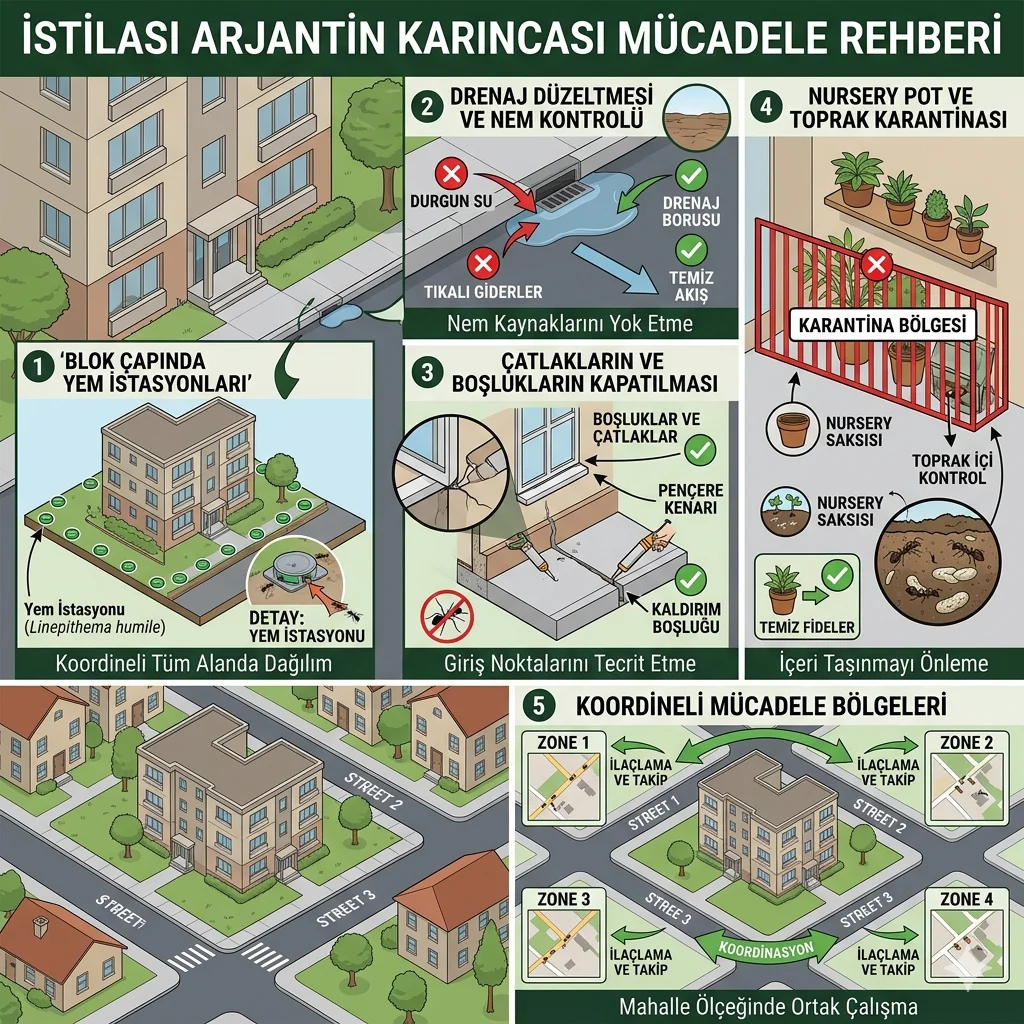
Coordinated treatment doesn’t mean spraying a single unit and leaving. The same building, the neighboring frontage, the pavement line and the shared shaft are dealt with together. If drainage isn’t corrected, the damp line stays open. If pot soil isn’t quarantined, the entry route comes back. In short, the source, the passage and the re-entry are cut off at the same time.
How do you read it in the field?
The first step is not to underestimate the species because of its looks. A big problem can come from a creature 2.5 mm long. The second step is to distinguish between a native ant and an invasive line. The third step is to give up single-point treatment. If it keeps appearing in the same block, the problem is not a single home’s problem. It is a problem of the surrounding line.
Here, the specimen plate approach and field notes work together. If one frame includes a dorsal view, a size scale, the nest location and the surrounding ground, the interpretation is more solid. With an untrained eye, you see “a few ants”. With the right eye, you see an invasive network being carried along.
Source backbone
- GISD — Linepithema humile species page
- CABI Compendium — Linepithema humile
- Suarez et al. — Relationships among native and introduced populations of the Argentine ant
- PNAS — Draft genome of the globally widespread and invasive Argentine ant
- Doğa Derneği — What remains from COP15 (Turkish)
- DergiPark — search of ant and entomology literature in Türkiye (Turkish)
Final word
In Türkiye, the Argentine ant shouldn’t be read as an ordinary garden ant. Its transport routes, supercolony structure and power to crush native species put it in a class of its own. The right reading is this: see the network, not the individual. See the block line, not the single spot. Because here the battle is not fought against a single ant, but against an interconnected colony system.