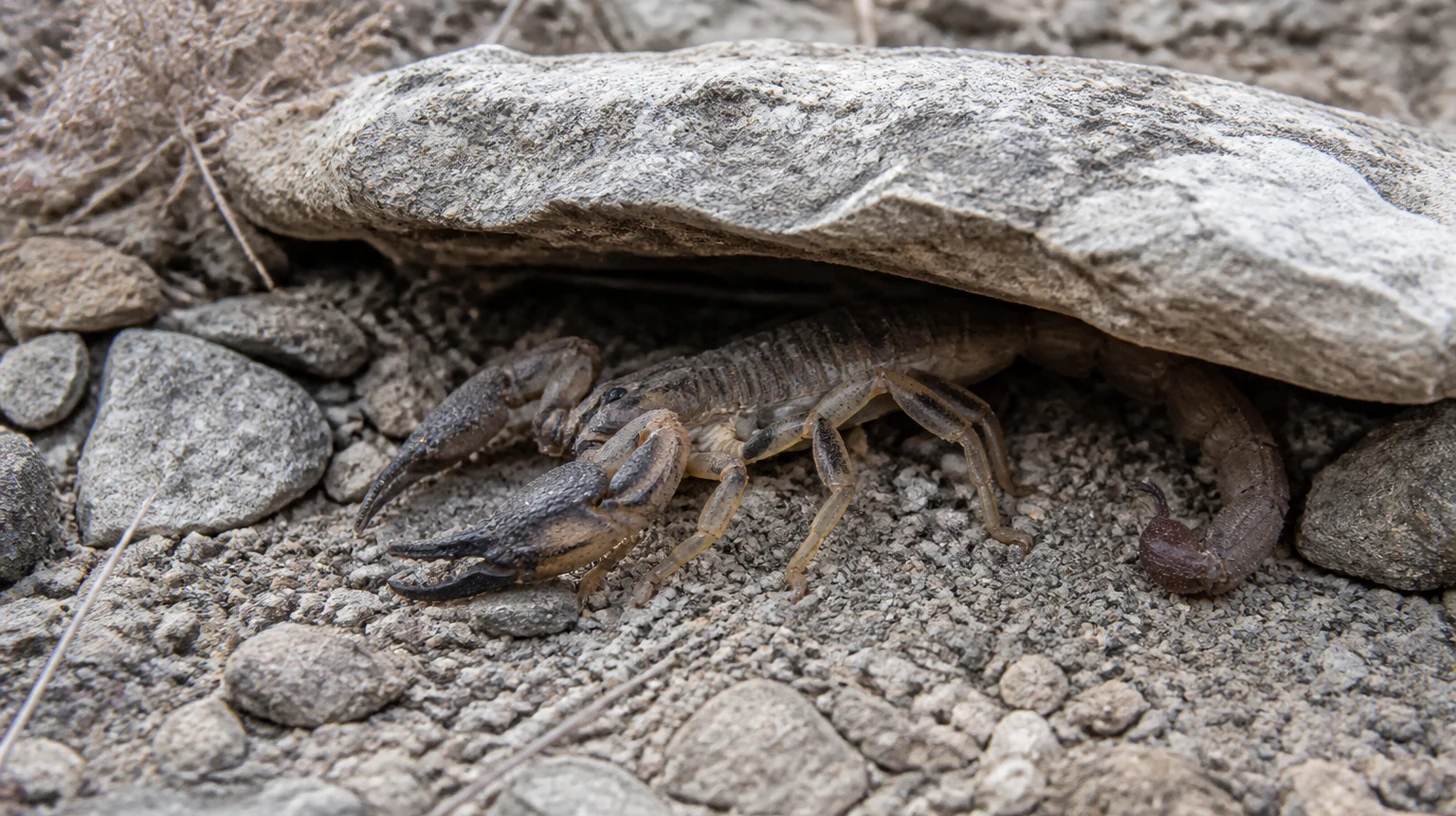
Yes, there can be scorpions in winter; in cold weather most of them move less, but they don’t disappear for the whole winter. The really important distinction is how a scorpion hides in the cold and why in some homes it can be seen in winter too. The term hibernation doesn’t describe the same thing for every species; the temperature of its location and how sheltered it is are decisive. Scorpions are in the same class, Arachnida, as spiders; they are not insects. The guide to entry points and a safe approach when a scorpion is seen at home also explains the basic protection steps.
Do scorpions hibernate?
Short answer: you cannot speak of the same, uninterrupted hibernation period for every scorpion. In the cold, metabolism and mobility may slow down; a scorpion may retreat under stones, into cracks, into hollows in the soil or into other shelters around buildings. The duration and form of this behavior vary from species to species, with the climate and with the conditions of that winter. That is why not seeing scorpions in winter does not mean that all the scorpions in the area have died or are asleep.
Experimental studies on cold tolerance in scorpions examine particular species and particular laboratory conditions. For example, the overwintering study published on Diplocentrus spitzeri addresses seasonal cold tolerance; its results cannot be directly generalized to all scorpions in Türkiye. The study summarizing the species diversity of scorpions in Türkiye also requires not assuming a single type of scorpion behavior across the country.
Where do scorpions hide in winter?
Outdoors, the undersides of stones, wall cracks, loose bark and shelters in the soil can serve as hiding places. These small cavities provide partial protection from the weather; however, not every scorpion overwinters in the same place. Living conditions in dry and warm regions are not the same as in cold, high-altitude places. A field study in Türkiye on Mesobuthus gibbosus reports that the species is common in hot-arid regions and that its most active period falls in the summer months; this is a finding for a single species and study area, not a calendar of winter activity for the whole country.
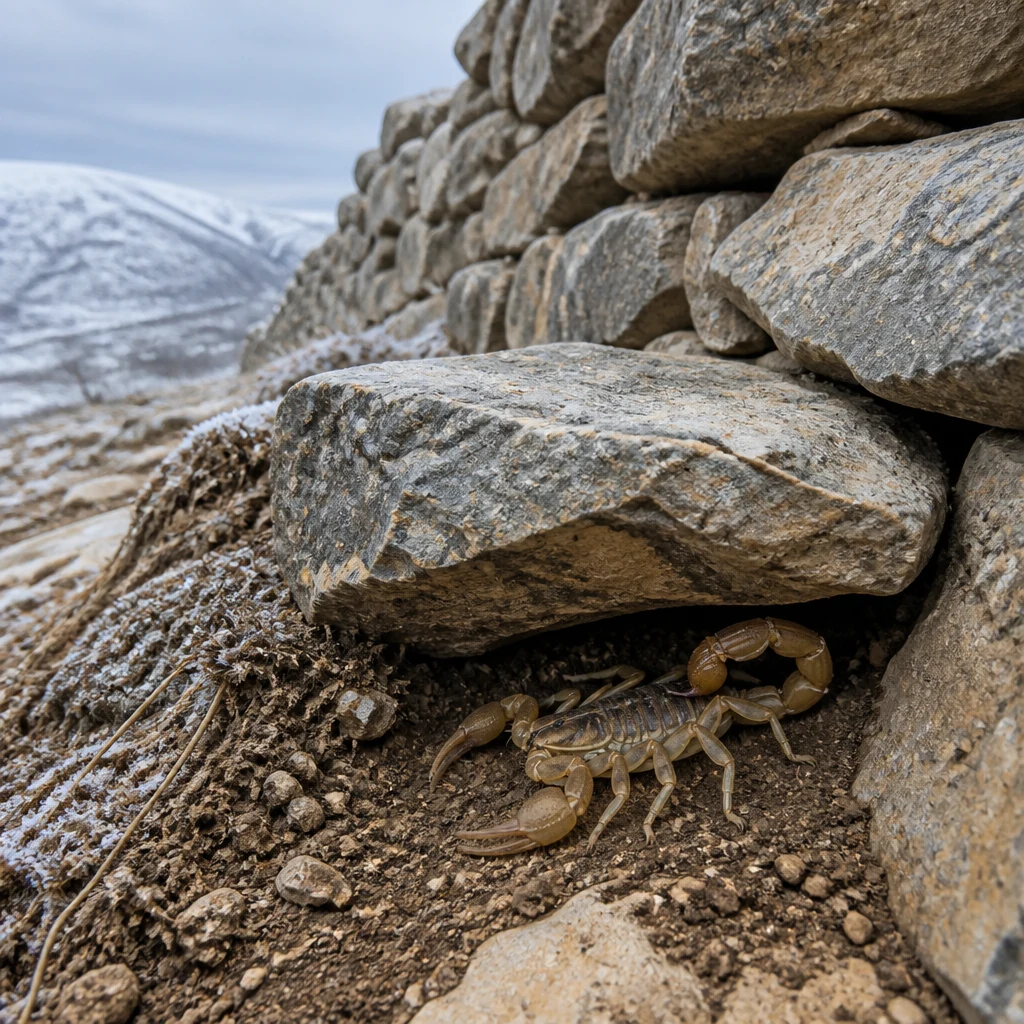
Can you see scorpions at home in winter?
Yes, you can; the cold season alone does not show that no scorpion can be found at home. The inside of a building, a basement, a storeroom or the area around plumbing can be more sheltered than outdoors. Gaps under doors, wall cracks and pipe penetrations are possible entry routes. Firewood, a box being moved or belongings left outside for a long time can also carry the animal inside unnoticed. However, a single sighting does not prove that there is a nest inside the home.
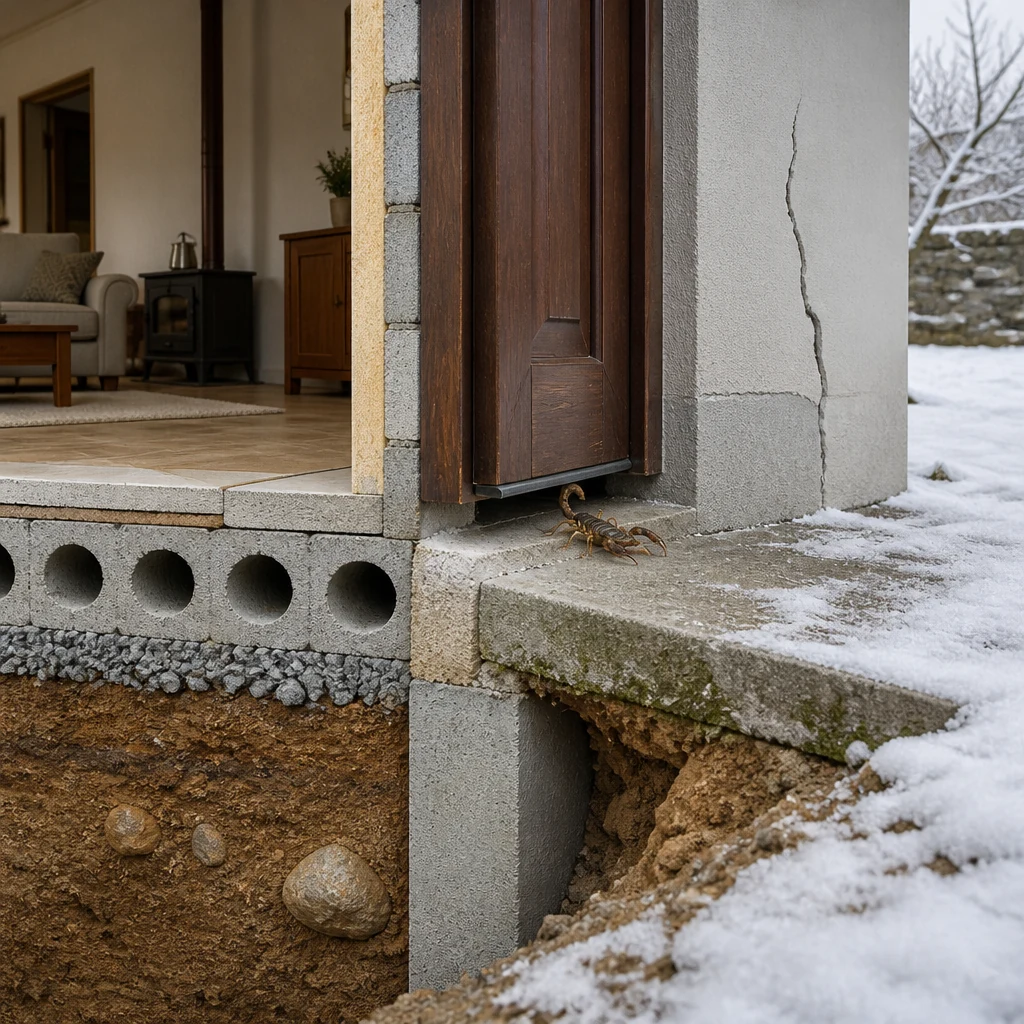
I could not find a verified rate, representative of Türkiye as a whole, proving that scorpions enter homes more often in winter. That is why, rather than building a firm claim of an increase based on the season, you need to assess the region where the home is, the openings in the building and whether the sightings repeat. The chance of movement on cold days or during mild spells also depends on local conditions; giving a fixed temperature threshold for every species would be misleading.
Does the cold kill scorpions?
Prolonged or extreme cold can cause harm; but tolerance depends on factors such as the species, the severity of the cold and the duration of exposure. The temperature in a sheltered hollow may not be the same as the temperature measured in the open air. That is why giving a single number such as “a scorpion definitely dies below this many degrees” is not reliable. The fact that one species withstands cold in a controlled experiment also does not mean that all scorpions are resistant to freezing.
Searching for scorpions outdoors in winter or lifting stones by hand is not a safe method of control. Around the home, keep stone, rubble and woodpiles away from the base of walls; look over cracks and the gaps under doors. If you see a scorpion inside the home, don’t approach it, don’t catch it with your bare hands, and move children and pets away from the area. In case of repeated encounters, follow the safe control and professional help thresholds for scorpions in the house. To get to know scorpion anatomy, you can also look at the visual explanation in the scorpion guide.
What to do if a scorpion is seen in winter?
With a single sighting, first keep your distance and reduce the chance of contact. Check shoes, gloves or items stored in a storeroom carefully before using them; don’t put your hand into dark gaps. If you suspect a scorpion sting, get medical advice; with serious or widespread symptoms, call your country’s emergency number. In case of repeated sightings, entry gaps or vulnerable people in the home, ask a licensed pest control specialist for an on-site assessment. Not every single sighting automatically means that pesticide treatment is needed.
| Situation | What can it mean? | Appropriate approach |
|---|---|---|
| No scorpions seen outdoors in the cold | May indicate that visible activity has decreased; does not prove they are gone | Don’t search under stones by hand; keep the surroundings tidy |
| A single scorpion inside the home in winter | It may have come in or been carried in; it is not proof of a nest at home | Prevent contact, check openings |
| Repeated sightings on different days | There may be an access/hiding problem in the building or surroundings | Ask a specialist for an on-site inspection |
| Sting or symptoms | A health matter regardless of the season | Medical advice; for severe/systemic symptoms, your country’s emergency number |
Frequently asked questions
Do scorpions sleep completely in winter?
We cannot say that all species sleep completely in the same way. Reduced mobility in the cold and staying in a sheltered place is the more accurate, cautious explanation.
How do scorpions get into the house in winter?
Gaps under doors, cracks and plumbing penetrations are possible openings; belongings that have been left outside can also carry a scorpion. In every encounter, the entry route may not be determined with certainty.
Is a scorpion seen in winter more dangerous?
The season alone does not indicate the effect of the venom. Don’t touch a scorpion without knowing the species; if you suspect a sting, get professional medical advice.
Sources
- Özkan Ö, Karaer KZ. “Türkiye Akrepleri” (Scorpions of Türkiye). Türk Hijyen ve Deneysel Biyoloji Dergisi (in Turkish), 2003. https://dergipark.org.tr/tr/pub/thdbd/article/968098
- Koç H, Arıkan H. “Biological and Ecological Observations on Mesobuthus gibbosus (Brullé, 1832) (Scorpiones: Buthidae).” Kommagene Biyoloji Dergisi (in Turkish), 2018. https://dergipark.org.tr/tr/pub/commagene/article/406174
- Crawford CS, Riddle WA. “Overwintering Physiology of the Scorpion Diplocentrus spitzeri.” Physiological Zoology, 1975. https://www.jstor.org/stable/30155640 (search result and publisher record page reviewed; full-text access could not be verified.)