The ant is a group of social insects belonging to the family Formicidae within the order Hymenoptera. The number of described species exceeds 14,000; its evolutionary history goes back roughly 140 million years, to the Cretaceous period. Living as a colony rather than as single individuals, this group sets up a division of labor shared by queens, workers, soldiers and males. An ant you see in the house is usually not alone but the forward outpost of a larger organization. This article is a general guide; for the detail asked about most often in daily life, you can look at our article How Do Ant Trails Form? The Pheromone Language.
The 4 Main Types of Ant Seen in Türkiye
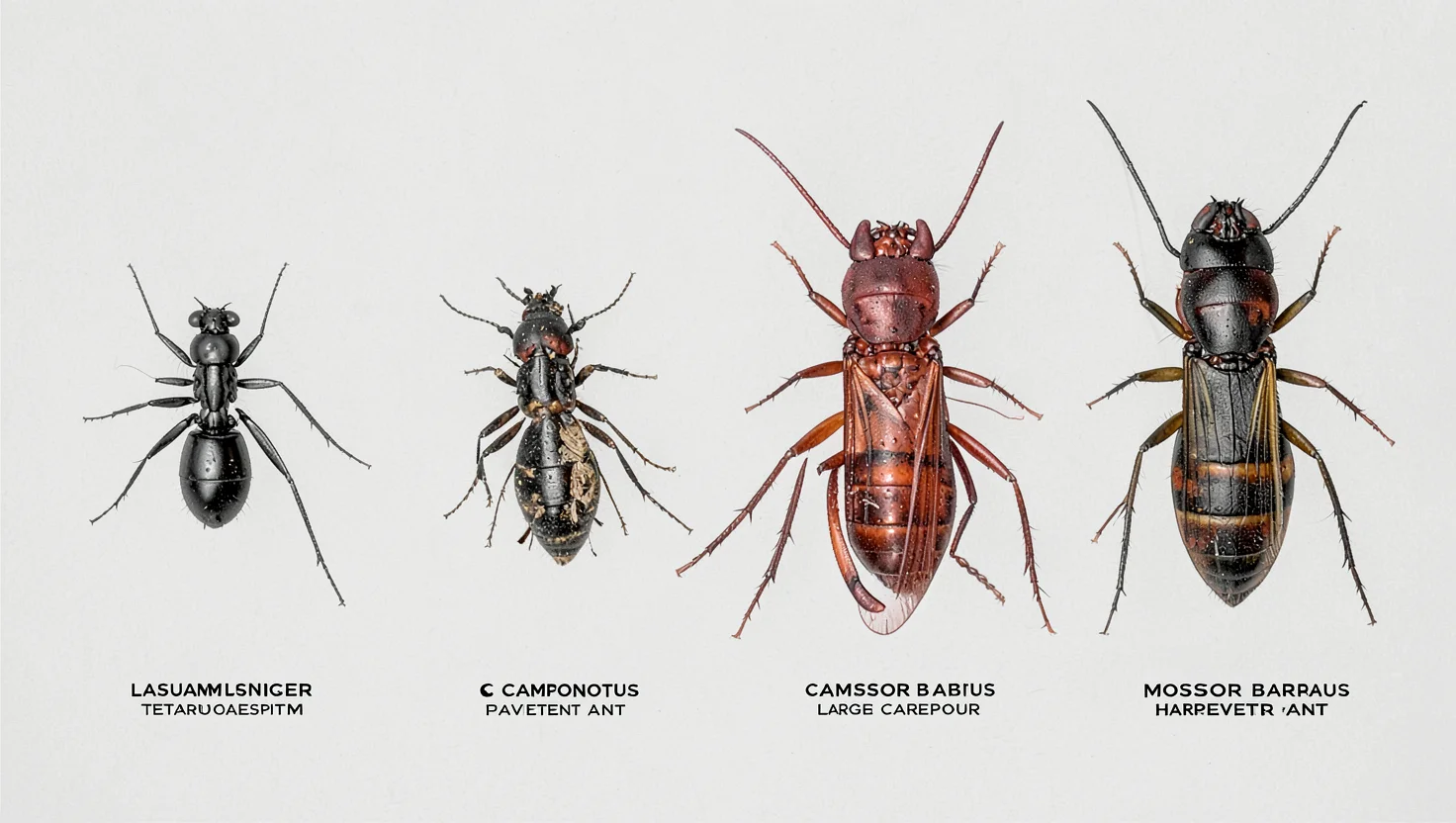
When it comes to ants, the four types most often encountered in the field in Türkiye are a good starting point for understanding their behavior in and around the house. Because size, color, nest preference and diet differ, there is no single profile under the same name. A small black individual you see in the kitchen and a large, dark individual in the basement may be from the same family, but the way they cause problems will be different. This distinction is the first filter for a correct reading.
Lasius niger
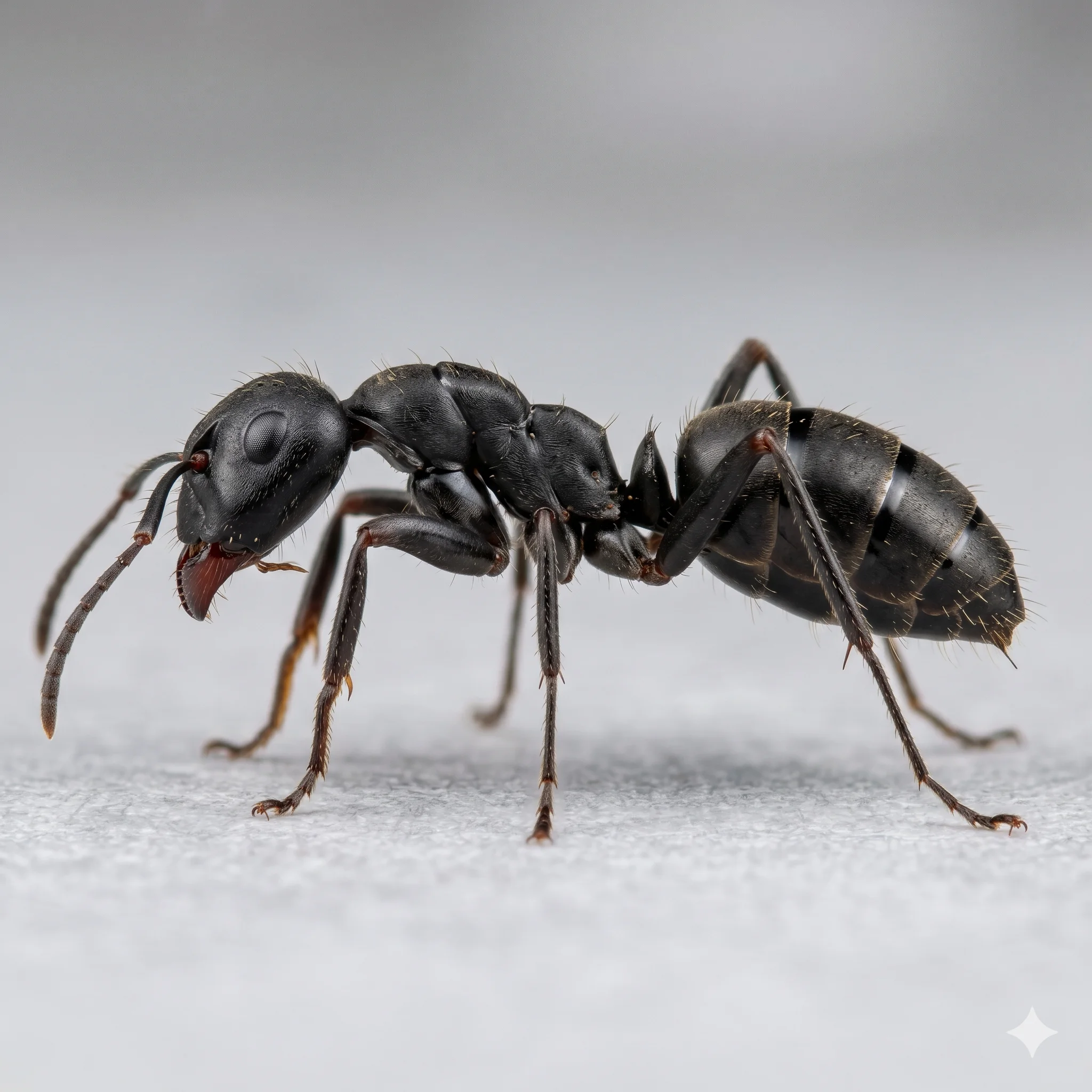
Lasius niger is known as the garden ant or black ant. It is a small, dark-colored and widespread species. Inside the house it enters the kitchen and areas that attract food scraps. Because it easily passes through narrow cracks and has a mass trail behavior, it catches the human eye very early. Gardens, curb edges and the surroundings of buildings are its typical route. When you see a single individual, it is right to think that there may be a search line connected to that direction behind it.
Tetramorium caespitum
Tetramorium caespitum is known as the pavement ant. In the urban fabric it can build nests between paving stones, at the base of walls and around apartment buildings. It is small but has an organized structure. When it finds food it spreads out quickly, then returns again in a group. If it enters the house, it generally makes use of openings at floor level and dry-damp transitions around the building. Its adaptation to the urban environment makes it one of the species often seen in the field.
Camponotus
Camponotus is a large genus known as carpenter ants. It stands out with its large-bodied individuals. It gnaws wood not to eat it but for its nest structure; this distinction is important. Damp wood, cavities and old structures suit it. Seeing it in the house sometimes points to a hidden moisture problem in the structure. Its large appearance can be frightening, but its risk to humans is generally low; the real issue is its settlement in the structure.
Messor barbarus
Messor barbarus is one of the classic representatives of the harvester ant group. It collects grain, carries seeds and stores them. It becomes more significant in rural and semi-arid areas. Its jaw structure is prominent; this shows that it is adapted to cracking and processing seeds. Seeing it inside the house is less typical, but dry areas and plant resources nearby can attract it. Its feeding strategy is a large part of the colony’s economy.
Ant Social Structure and Colony Organization
The backbone of an ant colony is built on the caste system. The queen produces eggs; worker ants find food, build the nest and feed the larvae; soldier individuals, where present, are used for defense and high-pressure tasks; males, meanwhile, take a role outside the colony after the mating season. In this structure the individual alone has no value; the division of labor does. Caste differences are reflected in behavior, size and sometimes even morphology.
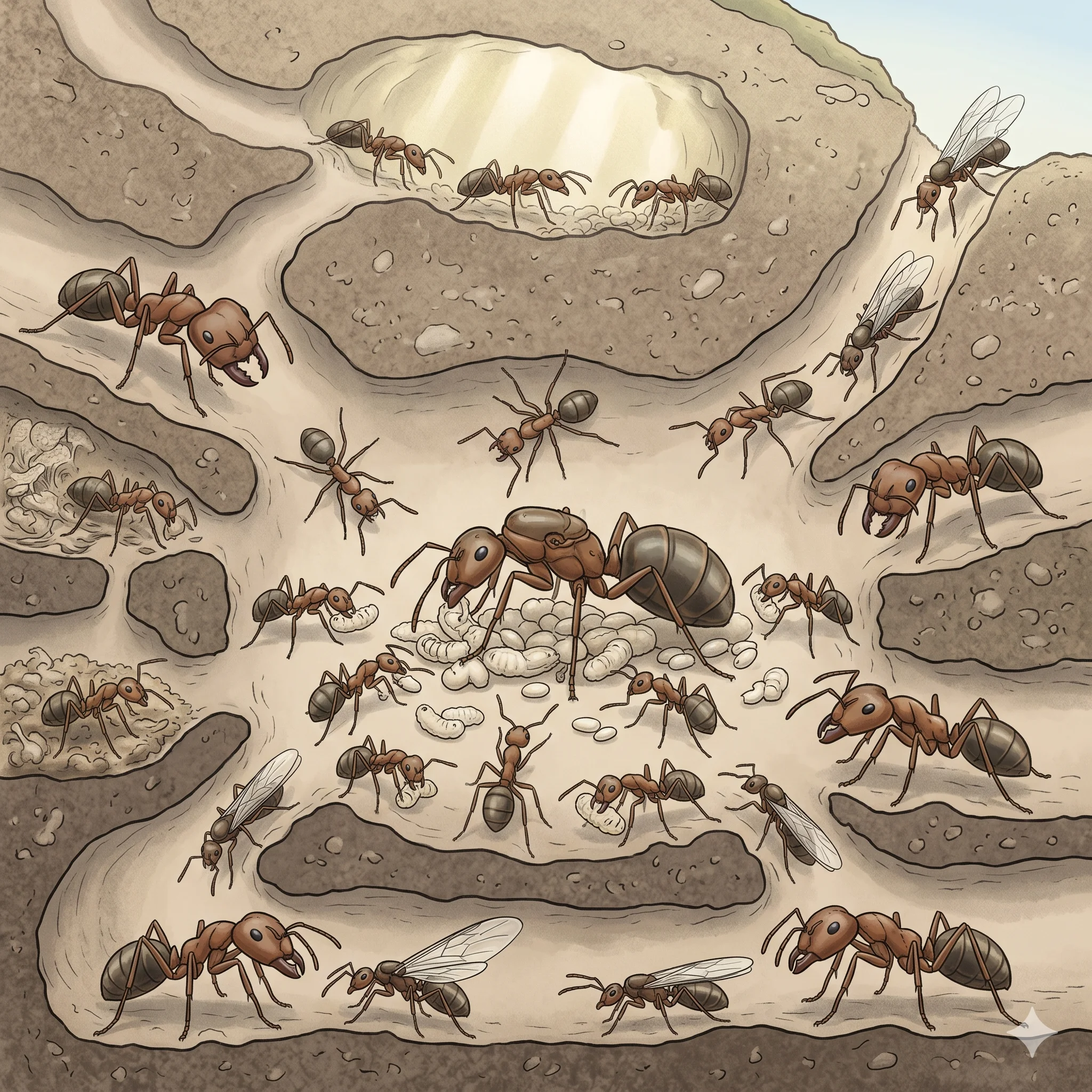
The queen is the reproductive engine; the colony’s flow of eggs runs through her. Workers are the backbone of the colony; they keep the living space going, collect resources and take on brood care. In some species, soldier individuals carry out defense duties with large heads and strong mandibles. Males, on the other hand, generally have a mating role for a single season. This flexibility is one of the main reasons for the ant’s successful spread.
The colony’s organization is not fixed; it shifts with the genus and the environment. If food is plentiful, the number of workers can increase; if there is defensive pressure, soldier differentiation can become more pronounced. In some species more than one queen can be found in the same system. This extends all the way to supercolony behavior. In other words, an ant works not as a single body but like a distributed system.
Ant Communication and the Pheromone Language
The main language of ant communication is pheromones. A pheromone means a chemical trail; it becomes the signal for who in the colony will do what, which direction to go and what to watch out for. Trail pheromone describes the route to food. Alarm pheromone announces danger. Queen pheromone, in turn, maintains the colony’s identity and balance. The beauty of this system is that a single message can grow stronger over time.
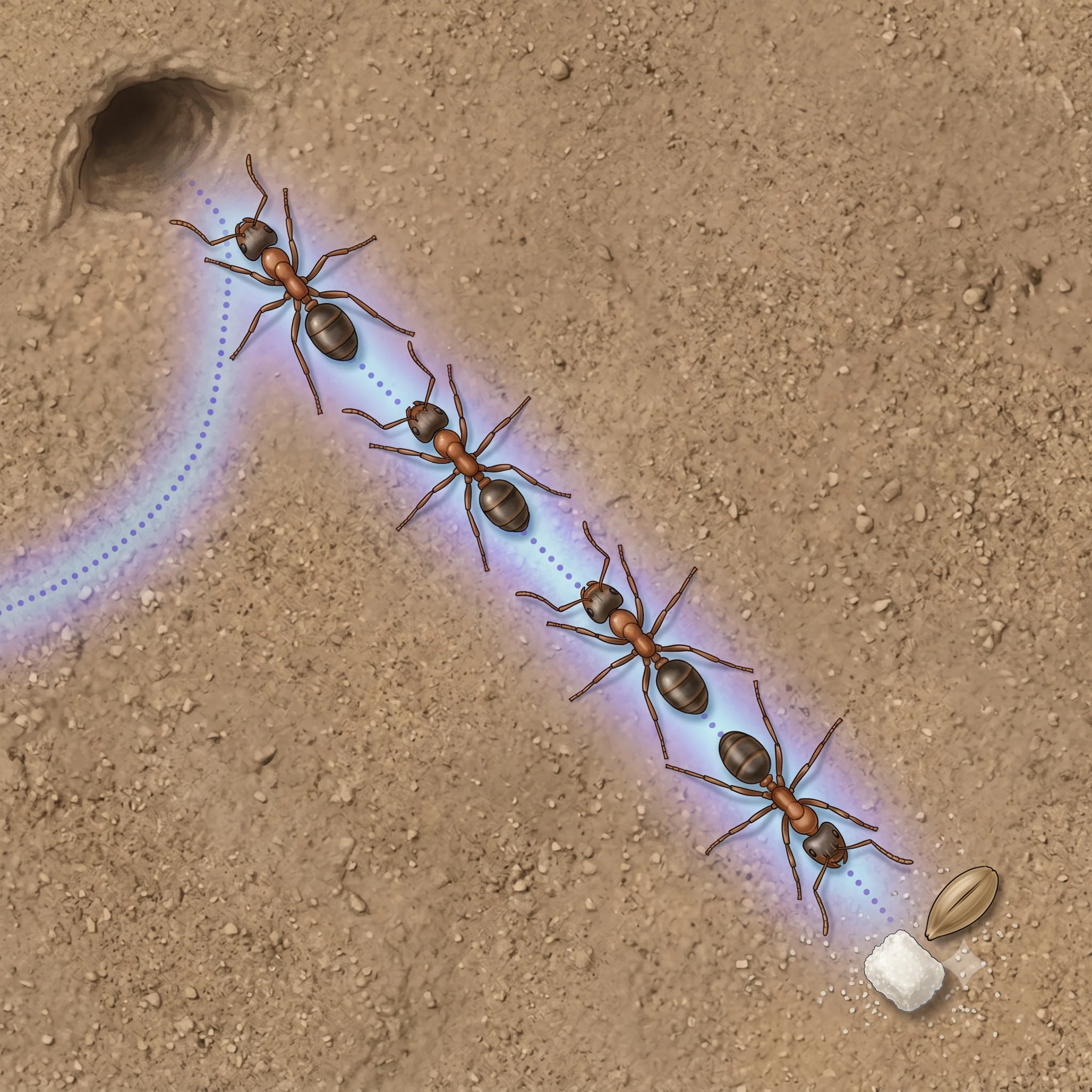
An ant trail starts with a simple rule: the first individual finds the source, leaves a trail on the way back, the others follow that trail, and as the trail grows stronger it turns into a route. That’s why a good source is turned into mass movement in a short time. If the trail is disrupted, the flow weakens. Wiping the trail is not a solution on its own, but it slows the system down. Vinegar, lemon juice and surface cleaning are methods that confuse things at this point; the real goal is to close off the source.
The pheromone language also provides coordination within the colony. Brood care, marking the current area and defensive behavior are carried out through this chemical network. That’s why the ant is not just a creature that moves mechanically; it is a social system working over a chemical map.
Ant Life Cycle
The ant goes through complete metamorphosis: egg, larva, pupa and adult. The egg stage is low-key, but it is a critical step for the colony. In the larval stage feeding is high; this is where the load of growth lies. In the pupal stage the body is reshaped. When the adult individual emerges, a new workforce is added to the colony. This cycle is the biological basis of social life.
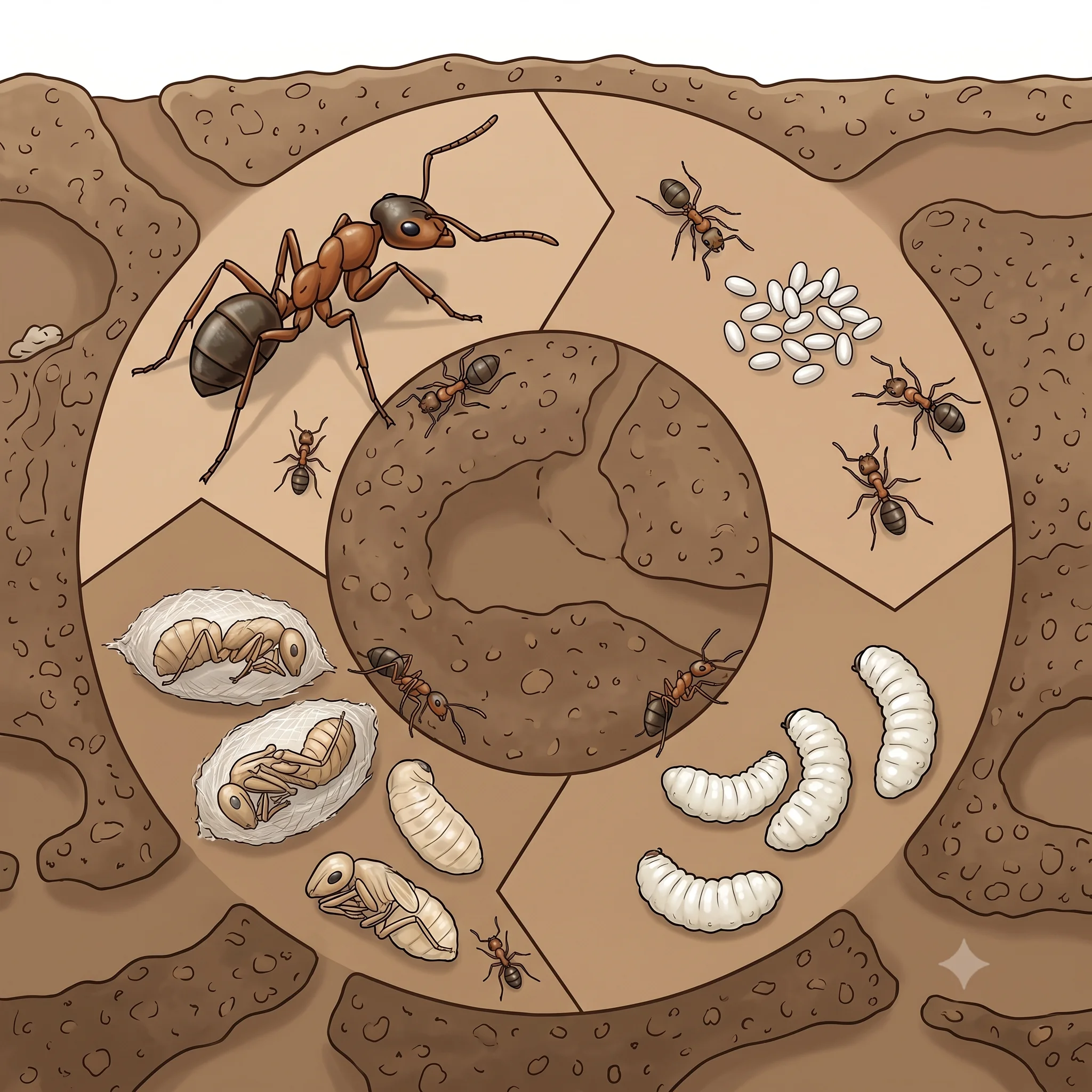
In colony founding, the nuptial flight, i.e. the mating flight, is a critical threshold. Winged males and queen candidates fly under suitable conditions, mate, and the new queen chooses a site and begins laying eggs. In some species the queen lives a long time; a band of 10-30 years can be given. Worker lifespan is shorter, sometimes varying in the 1-3 year range. This difference reflects the colony’s structure, which constantly renews itself but keeps its center.
The life cycle depends heavily on the environment. Temperature, humidity and food abundance affect it quickly. Spring and summer are more suitable times for activity to increase. The winter months, depending on the species, are a period of slowing down, withdrawal or staying more dormant underground. In other words, the ant calendar looks more at the microclimate than at the human calendar.
Ants and Humans
The relationship between ants and humans spans a wide range, from kitchen infestations to ecological benefit. At home, the most common problem appears around food scraps and open water. Although the ant may look like a pest, in the ecosystem it does jobs such as soil aeration, seed dispersal and nutrient cycling. This two-sided picture makes it hard to put it into a black-and-white category.
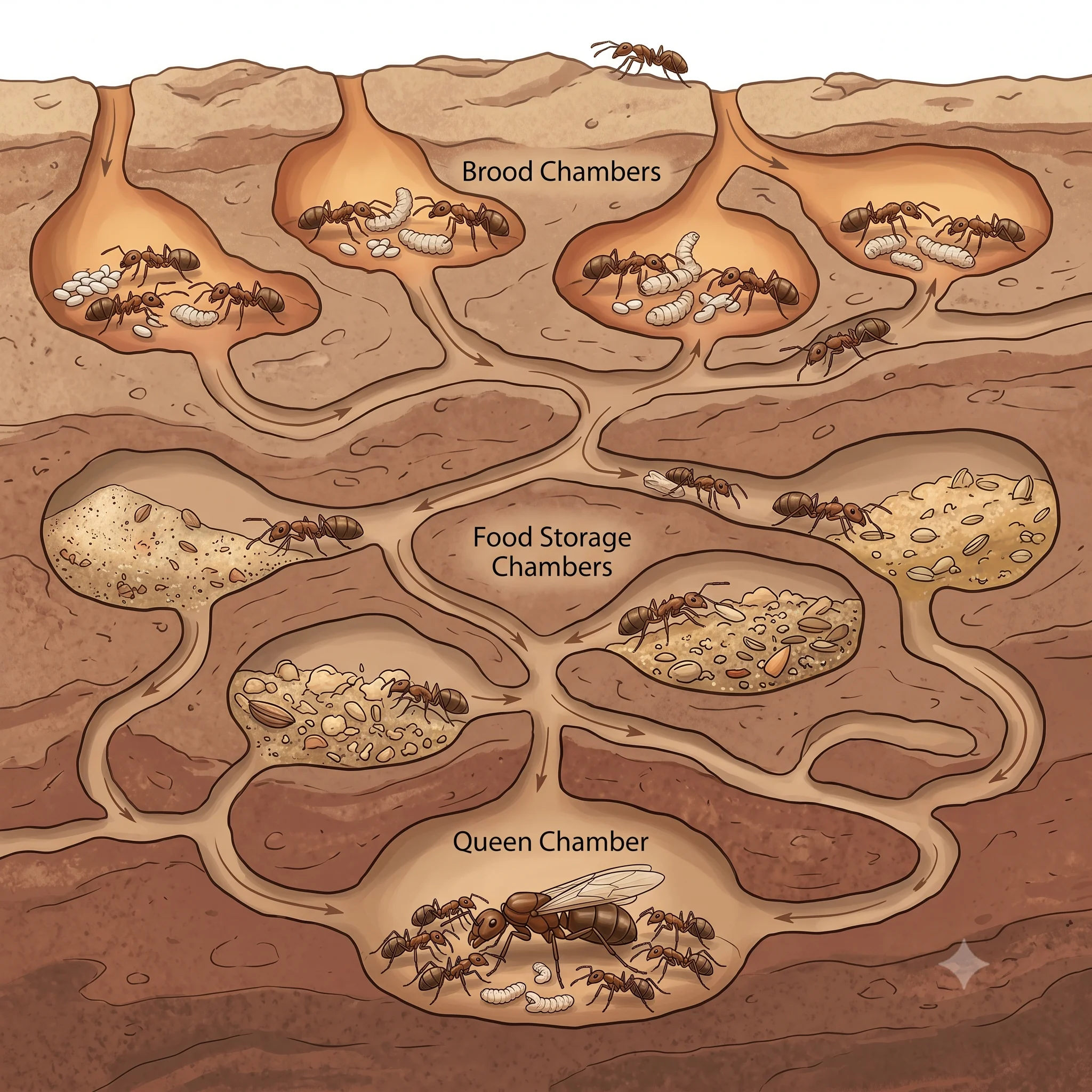
In historical records, observing ants is very old. Since Egyptian and Roman times, this creature has been part of the metaphor of hard work. In many languages the expression “to work like an ant” comes down to the same logic. This comparison isn’t empty; the ant is a model that works constantly and fast, but collectively rather than individually. Nest architecture supports this too: depth, chambers, tunnels and task areas work together.
Some species such as Camponotus can cause problems in wooden structures. The issue is not eating the wood but opening cavities inside it for the nest and creating structural weakness. A kitchen infestation, meanwhile, is usually not the result of a single cause; there is a chain from food, to moisture, to entry points. Chasing only the individual without understanding the chain does not bring a lasting solution.
Ant Health Perspective
The ant is not considered a mechanical carrier on the level of the cockroach. Still, it can carry microbes via surfaces and food. This is especially important in the kitchen area. But there is no need to exaggerate the language of risk; the ant is generally an indirect hygiene issue, not a direct source of crisis. There is also the matter of biting and, rarely, stinging, which varies from species to species.
Some species bite and cause pain. In large-bodied species such as Camponotus and Messor the sensation is more pronounced, but serious danger is generally not expected. Allergen risk is low; still, in cases such as swelling, a widespread reaction or fever, a physician’s assessment is needed. Giving medical advice here is unnecessary; the basic rule is to take an unexpected reaction seriously.
The real importance of the ant from a health perspective is the hygiene of the area where it comes into contact with people. Open food, accumulated dirt and moisture draw the colony in. In other words, the problem is not just the ant but the environment. Cut off the source, close the entry, keep surfaces clean. These three steps also reduce the unnecessary chemical load.
Ant FAQ
How do I break an ant trail?
You can disrupt the pheromone trail by cleaning the surface. Vinegar or lemon juice helps, but the real job is to close off the food source and reduce entry points.
If you’ve seen one ant, how many are there?
It depends on the species. Small colonies can reach thousands of individuals; in supercolonies the number is much higher. A single individual is usually a sign that there is a colony nearby.
Are ants active in winter or in summer?
Most species are more active in the warm period. In the winter months the colony slows down underground; feeding and reproduction decrease markedly.
Do ants have beneficial sides?
Yes. Working the soil, aeration, seed dispersal and suppressing some pests are the best-known benefits. They play a quiet but effective role in the ecosystem.
Do ants bite or sting?
It depends on the species. Garden ants such as Lasius can bite. Some can sting. However, in most species seen in Türkiye no serious risk to humans is expected.
Ant Related Topics and Subtopic Links
This page is the main hub that the subtopic articles will link to. The aim here is to build a readable map that goes from the general to the specific. The links below connect the subpages that will go deeper in the future and spread the topic without scattering it.
- How Do Ant Trails Form (The Pheromone Language) — subtopic #13
Ant Sources
The backbone sources for ant information are clear. These sources form the basic backbone for taxonomy, behavior and the relationship with humans. AntWeb offers a strong reference for taxonomy and species records. Encyclopedia of Life opens a broad biological gateway for Formicidae. Hölldobler and Wilson’s “The Ants” is the classic reference for ant biology. TUBITAK, meanwhile, provides a useful entry point for searching in Turkish and following popular science.
- AntWeb.org
- Hölldobler & Wilson, The Ants (Princeton University Press)
- Encyclopedia of Life — Formicidae
- TUBITAK “Science and Future” search page (in Turkish)
Related Topics
If you want to read this topic in a broader context, look at the cluster articles: Cockroach: Species, Biology and Relationship with Humans, Honey Bee: Society, Communication and Ecological Importance.