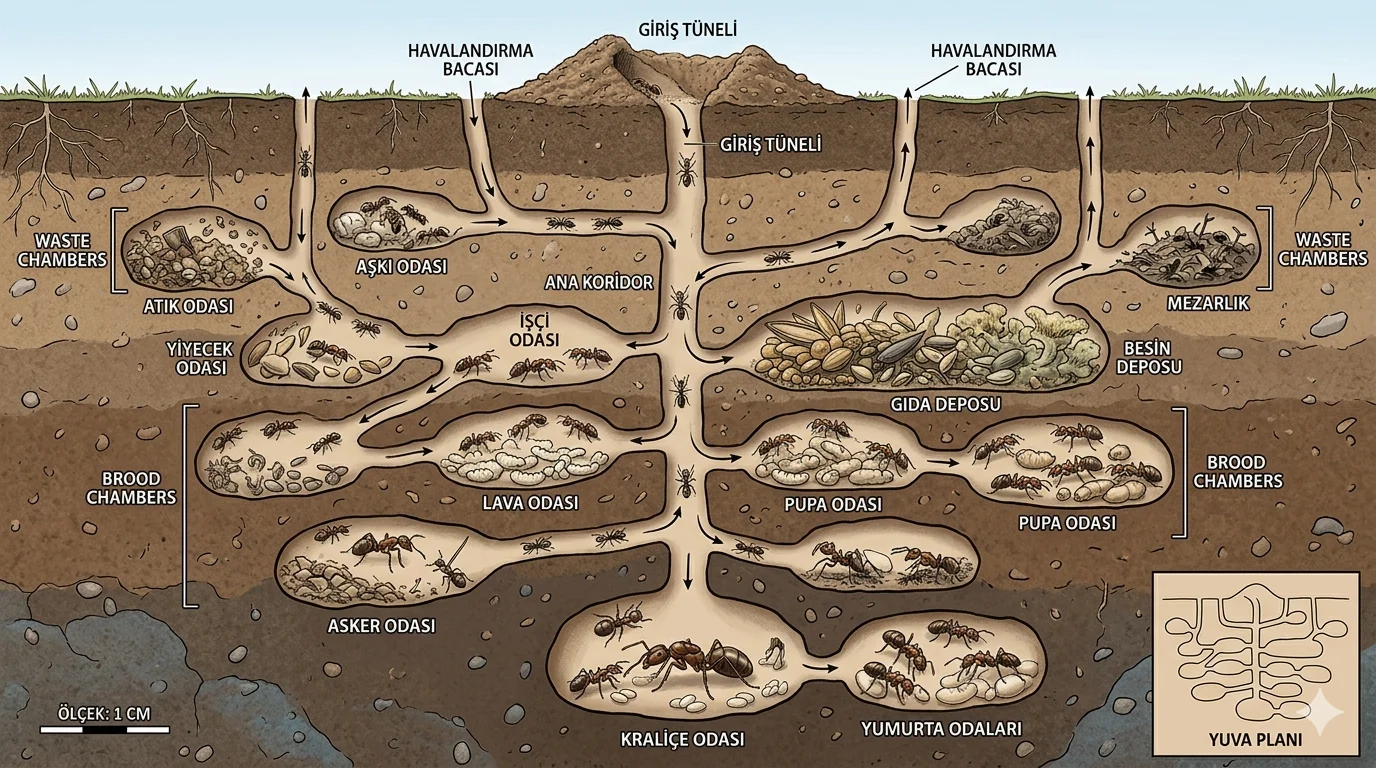
Ant nest structure is the colony order seen in the main Ant article translated into soil; if you want to complete the behavioral side, the article How Do Ant Trails Form? The Pheromone Language is a good companion. What you encounter under the soil is not random hollows but an architecture with a division of labor. The queen, larvae, food, waste and airflow each settle into a separate layer. This order also carries the colony’s heat, humidity and disease load.
The basic plan of the soil nest
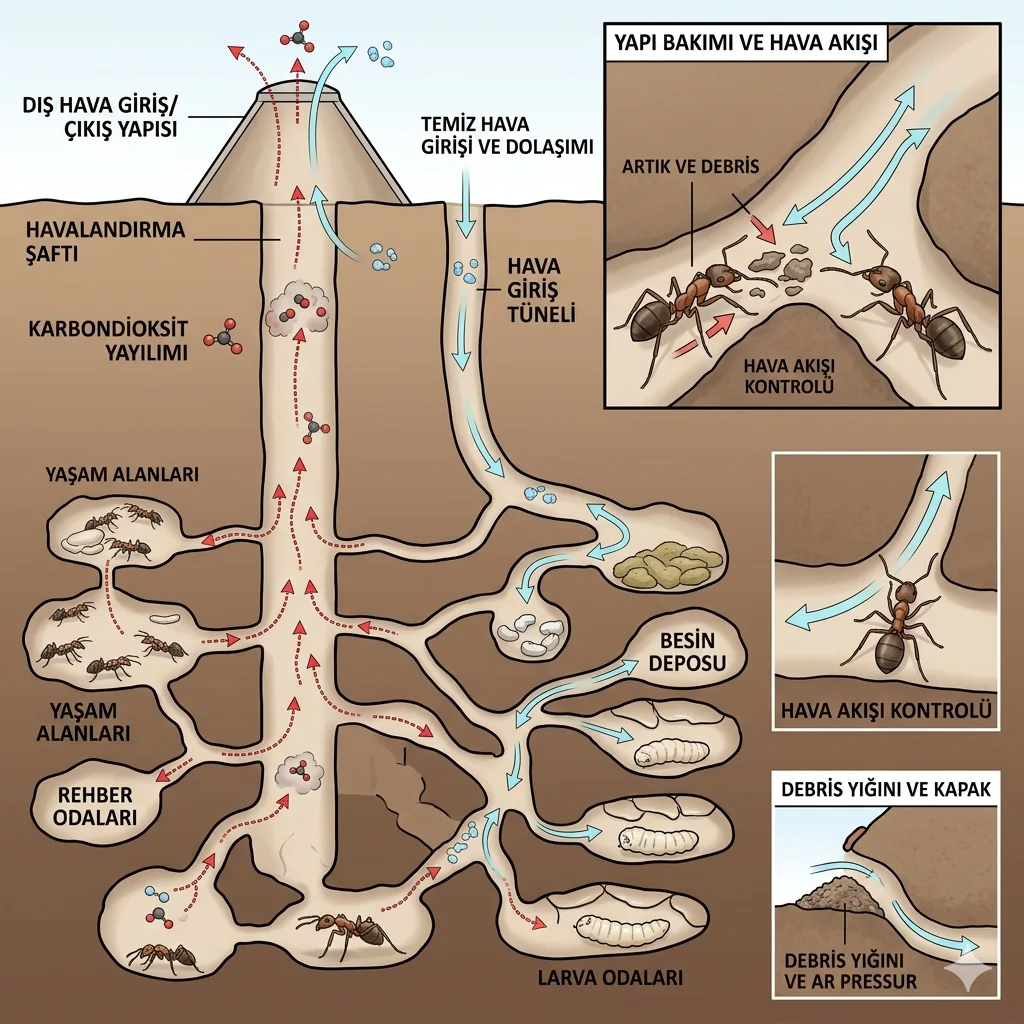
The most basic skeleton in an ant nest consists of a main corridor with branching chambers. After the entrance, the workers don’t pile into a single cavity; they spread out to different chambers via narrow corridors. The diameter of these corridors varies with the species and worker size, but channels of a few millimeters are commonly seen in field readings. A band of 2-3 mm in small species and 4-5 mm in large species is a reasonable reference. The advantage of a narrow channel is not just saving space; it also controls air movement, traffic density and defense.
The arrangement of the chambers is purposeful too. The queen chamber is at the deepest point. Above it or near it is the larva-rearing chamber. Because larvae are more sensitive to temperature changes than adults. A little higher up there is the food store; and at the outermost point, the waste chamber or refuse pockets are seen. This separation keeps the microbial load away from the center. It would not be right to consider the center of the nest sterile; but not piling up garbage in the core is a clear engineering decision for colony health.
Why is heat distributed layer by layer?
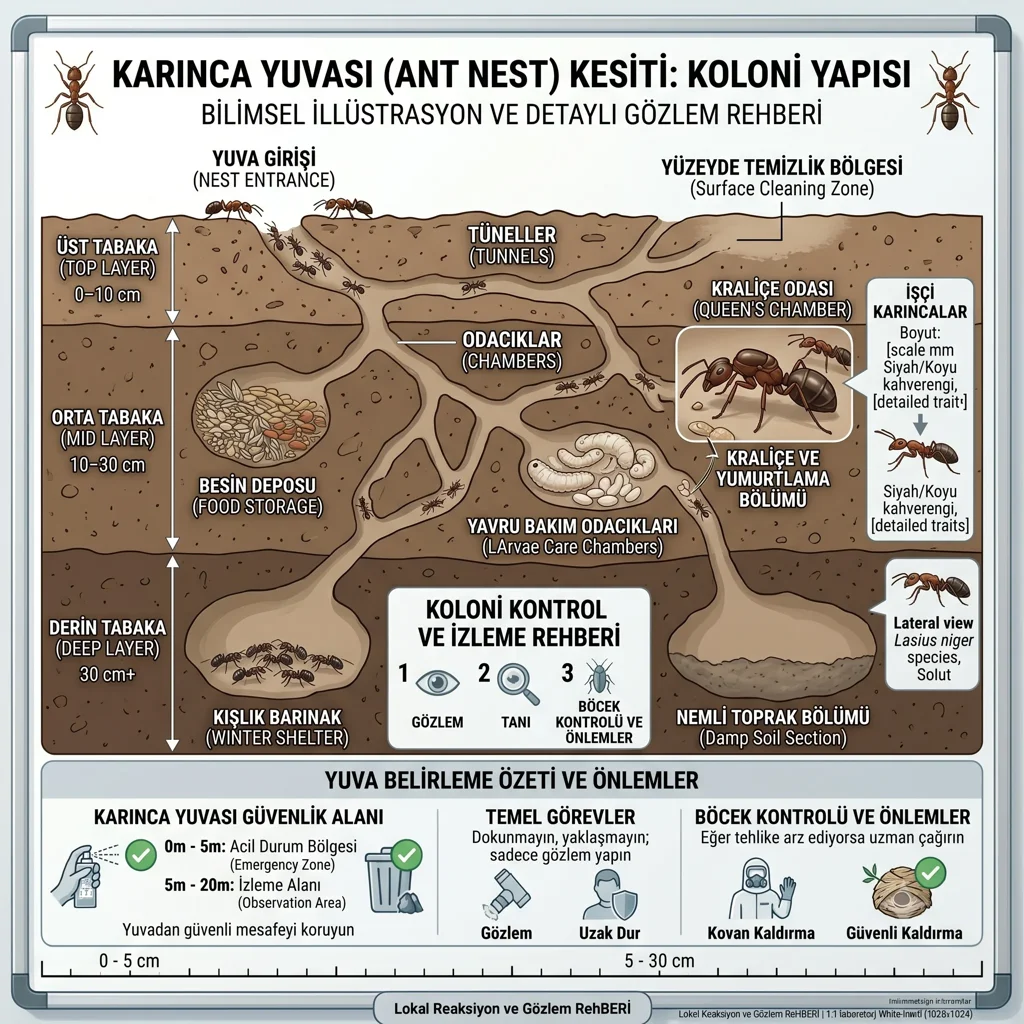
An ant nest is not a box with a single temperature. In soil, heat does not stay the same from top to bottom. The shallow layer is warmer in summer, while the deep layer is cooler and more stable. In winter this direction does not reverse, but depth protects against the harsh fluctuations at the surface. That’s why deep pockets work like a safe core in the cold period. Areas close to the surface, meanwhile, can be more beneficial for larval development on sunny days.
This thermal zoning directly affects the colony’s production rhythm. Instead of leaving the depth of the larva-care chambers fixed, workers can sometimes carry the brood one level up or down. In other words, nest architecture is not a fixed concrete plan; it is a living system that is readjusted when necessary. Looked at through a biologist’s eyes, what is seen here is not passive adaptation to the environment but active climate management.
How is CO2 removed, and how does the air circulate?
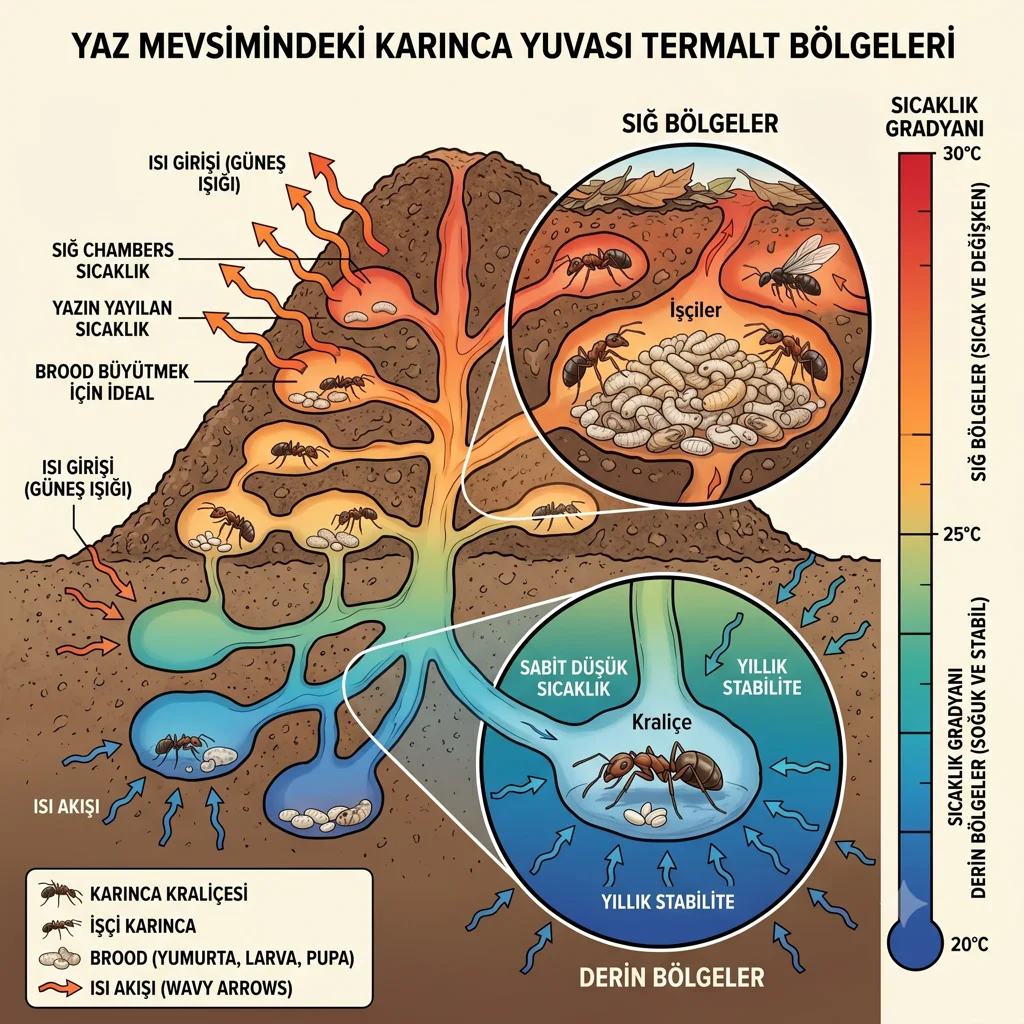
In an underground nest, the quietest but most critical issue is air. Thousands of respiring individuals produce CO2. If there is no air exchange, gas builds up in the interior volume and the living space deteriorates. Two mechanisms work together here: drift-based passive flow and worker-based maintenance. Temperature differences, density differences and wind pressure push the air up and down. On top of this, the workers keep the channel mouths open, clean out the blocked section and carry away collapsed material.
That’s why a ventilation shaft is not a random hole. In many species, vertical or sloping shafts draw fresh air in and carry heavy gas out. CO2 is not “sucked out” directly; the direction of flow is managed. To put it in the language of the field: the worker ant is not just a digger but a flow keeper. The garbage, soil and spoiled material arriving at the entrance are also part of this flow management. If the airway closes, the brood pockets are affected first, and then the whole colony comes under pressure.
Species don’t use the same plan
Atta cephalotes, i.e. the leafcutter ants, is one of the most spectacular examples of this. The colony can reach millions; resources, the fungus garden and the division of labor work together. In the literature it is known that the nest depth goes down to 1 meter and beyond, and that the main fungus chambers are located in these sheltered zones. Here the nest is not just a shelter; it is an agricultural production area. Leaves are carried, the fungus is fed, and the colony produces energy from it.
Formica rufa follows a completely different line. It builds a dome-like nest with pine needles, dead wood debris and plant litter. This dome retains heat, collects sunlight and protects the inner core. It is not hard like stone; but in terms of insulation it is clever. In a cold climate, the natural material on the surface serves as a thermal shield for the brood inside. For in-depth reading in Turkish, the Red Wood Ants article in TÜBİTAK’s Bilim ve Teknik magazine (in Turkish) describes the same form with a local example.
Lasius niger works more simply. In places such as under houses, at garden edges and in pavement cracks, simple corridors and one or two chambers can be enough. The queen-centered core stays small, and the trail network is short as well. That’s why in the field you usually see a few workers first; then it becomes clear that the same line feeds a larger colony.
Camponotus, i.e. the carpenter ants, uses cavities inside wood. The critical point here is not eating the wood but hollowing it out to open up living space. Old window and door frames, moisture-holding beams and cavities under apartment building roofs become risk areas. If the load-bearing wooden part of the structure weakens, the problem becomes bigger than the ant’s size.
The engineering side: slope, depth, drainage
Ant nest structure is read through three engineering principles: suitable depth, correct slope, good drainage. Going below the frost line increases the chance of surviving the cold. A nest built too shallow feels the day-night fluctuation harshly. A nest that is too deep and holds water causes other problems; humidity rises, the air deteriorates and the chamber walls can collapse. That’s why a nest should be neither a dry pit nor a water trap.
Slope matters too. Water runs downhill; that’s why the main corridor and the waste pockets are positioned so that water won’t flow into the brood area. If there is drainage, the colony lives long. If there is no drainage, even the strongest colony takes a hit after rain. From a biologist’s point of view, this is an architectural output shaped jointly by species behavior and the physical environment.
The ecosystem value of the underground nest also emerges here. Ants aerate the soil, mix organic matter, open microchannels and change how water infiltrates. In other words, the nest is an engineering device not only for the ant but also for the soil life around it.
How should it be read through a biologist’s eyes?
When a biologist looks at an ant nest, they don’t just count holes. They look at the direction of the entrance, the texture of the soil mound, the distribution of the exit holes, the location of the waste pockets and the light-shadow relationship. The specimen plate logic works well for this examination: a top view, a side cross-section, a scale bar and short explanations are in the same frame. Such a visual reduces interpretation errors in the field, because what is seen from a single angle usually remains incomplete.
For anyone who wants to look at this topic in depth, the backbone is clear: AntWeb’s species and specimen records, the Smithsonian’s in-depth content on ant ecology and Tschinkel’s work on the nest architecture of the Florida harvester ant should be read together. An ant nest is not a cavity dug at random by nature; it is a living system with a sharing of tasks, which manages temperature and controls air.
Source backbone
- AntWeb — Formicidae family page
- Smithsonian Magazine — Ants in the Spotlight: The Hidden Gaps in Neotropical Ant Behavior Research
- Tschinkel and the Florida harvester ant nest architecture paper
- AntWeb specimen — Atta cephalotes
- AntWeb species — Formica rufa
- AntWeb specimen — Lasius niger
- TÜBİTAK Bilim ve Teknik — Red Wood Ants (in Turkish)
- SAIC Earthly Observatory — Walter Tschinkel / Fire Ants’ Nest Cast
Related pages
For the main backbone, go back to the Ant page. If you want to go deeper into the behavioral side, the article How Do Ant Trails Form? The Pheromone Language is the next link in the chain.